Advertisement Header Ad
Resource Recycling
  • The Latest
  • Analysis
    • All
    • Certification Scorecard
    • Industry Announcements
    • Opinion

    Certification scorecard for Dec. 18, 2025

    Industry announcements for the week of Dec. 15

    Certification scorecard for December 10, 2025

    Industry Announcements for Week of December 8

    Certification Scorecard for December 3, 2025

    Industry Announcements for Week of December 1

    News from Dynamic Lifecycle Innovations, Precision E-Cycle

    News from Northeast Recycling Council, Plastipak and more

    News from Northeast Recycling Council, Sortera Technologies and more

  • Conferences
  • Publications

    Other Topics

    Textiles
    Organics
    Packaging
    Glass
    Brand Owners

    Metals
    Technology
    Research
    Markets
    Grant Watch

    All Topics

Subscribe
No Result
View All Result
Resource Recycling
  • The Latest
  • Analysis
    • All
    • Certification Scorecard
    • Industry Announcements
    • Opinion

    Certification scorecard for Dec. 18, 2025

    Industry announcements for the week of Dec. 15

    Certification scorecard for December 10, 2025

    Industry Announcements for Week of December 8

    Certification Scorecard for December 3, 2025

    Industry Announcements for Week of December 1

    News from Dynamic Lifecycle Innovations, Precision E-Cycle

    News from Northeast Recycling Council, Plastipak and more

    News from Northeast Recycling Council, Sortera Technologies and more

  • Conferences
  • Publications

    Other Topics

    Textiles
    Organics
    Packaging
    Glass
    Brand Owners

    Metals
    Technology
    Research
    Markets
    Grant Watch

    All Topics

Subscribe
No Result
View All Result
Resource Recycling
No Result
View All Result
Home Plastics

How a company is turning PET into durable asphalt

byJared Paben
August 19, 2020
in Plastics
How a company is turning PET into durable asphalt
Share on XLinkedin
TechniSoil Industrial can process post-consumer or post-industrial PET for it’s asphalt binder product. | Courtesy of Technisoil.

A California company is using glycolysis to depolymerize PET scrap for use in an asphalt binder. The pavement it produces is stronger than traditional hot-mix asphalt.

TechniSoil Industrial has recently garnered widespread media attention because the California Department of Transportation (Caltrans) used the company’s asphalt binder to repave a segment of highway last month. Asphalt binder is essentially the cement that holds aggregate together in pavement.

Sean Weaver, CEO and founder of TechniSoil Industrial and inventor of the recycled-content asphalt binder, recently provided more details to Plastics Recycling Update about his company’s technology and its potential widespread use.

“It’s a pretty big deal to introduce a new type of pavement to a large agency like Caltrans, but I think the want is there from a sustainability standpoint and a performance standpoint,” Weaver said.

The road to recycled plastic

Eight years ago, Weaver began looking at polymer chemistry to produce an asphalt binder for golf cart paths (he has a sister company that produces landscaping-related products). Lab and field tests showed that using virgin urethane in an asphalt binder produced strong pavement, he said.

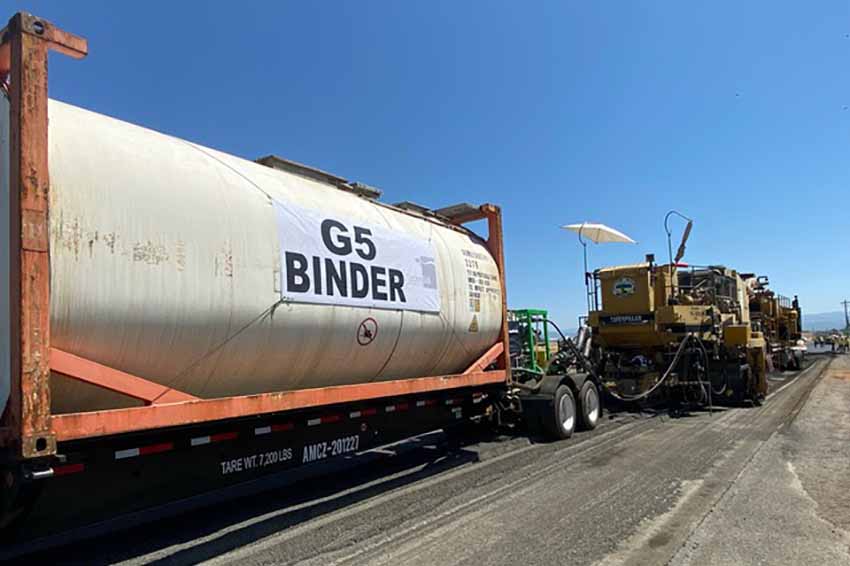
Based in Redding, Calif., TechniSoil Industrial’s asphalt binder with urethane is called G5. In 2017, Weaver began experimenting with using recycled polyester in G5 formulations, he said, calling that binder G5P. The city of Los Angeles has tested asphalt with different G5 and G5P formulations.

TechniSoil Industrial can process post-consumer or post-industrial PET, Weaver said. It uses glycolysis to depolymerize the PET into polyester polyols, which are then mixed with urethane to produce the binder (polyester polyols are also a feedstock for producing polyurethanes).

Weaver said that, with some testing, TechniSoil Industrial can use 20-25% recycled polyester polyol in the asphalt binder, but the company plans to start with 3-5% chemically recycled plastic.

When asked why his company uses recycled PET, for which there are established markets, instead of a lower-value scrap plastic, Weaver said TechniSoil Industrial started looking at PET because it was the feedstock available when it began its research into using recycled plastics. But, he added, the company is looking at using other recycled polymers, including PE.

Still, he argued the benefits of recycling PET into asphalt.

“Utilizing plastic from single-use applications into applications that last multiple decades, in my opinion, is the greatest use of a recycled material,” Weaver said.

The $3.2 million Caltrans repaving project covered three lanes for about 1,000 feet along Highway 162 in Oroville, which is a town north of Sacramento. The asphalt there has a range of recycled polyester polyol loadings, Weaver said. For the entire project, G5 makes up about 4.2% of the weight of material used. Of that G5 weight, specifically, the recycled polyol ranges from 4% to 20%, Weaver said.

If the G5P is made with 20% recycled polyester polyol, then one mile of asphalt uses nearly 4,000 pounds of recycled PET.
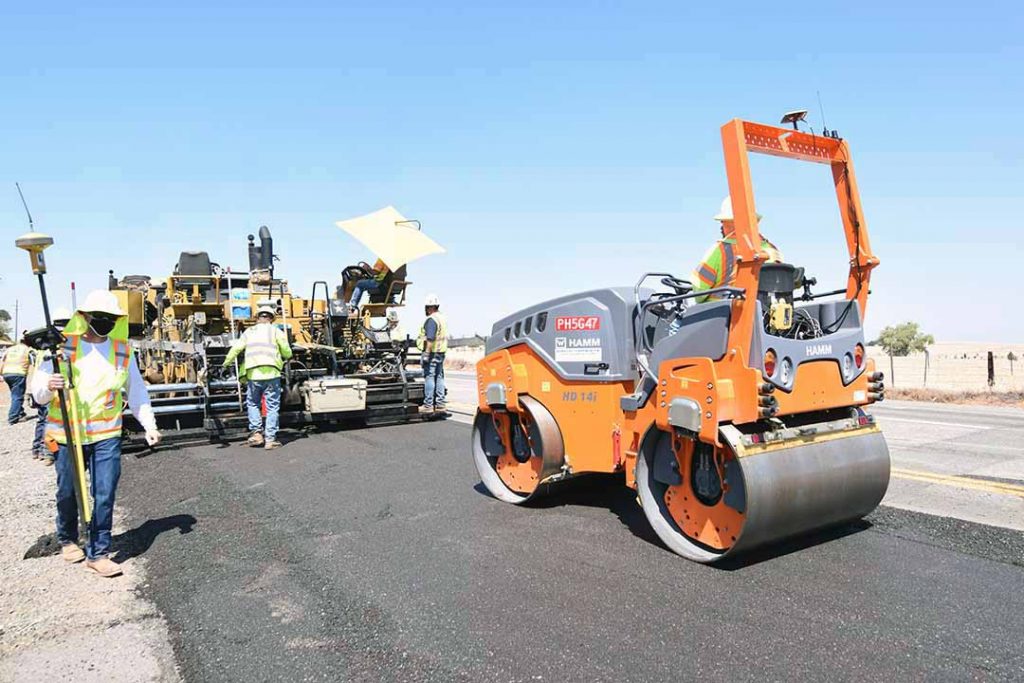
Courtesy of Caltrans.
According to Caltrans, previous tests have found G5-containing asphalt lasts two to three times longer than traditional hot-mixed asphalt pavement. | Courtesy of Caltrans.

Benefits to road repaving

A significant amount of research has recently examined using recycled plastic in asphalt. The Plastics Industry Association is working with partners to test the recycling of recovered LDPE film into asphalt binders. A couple of years ago, global chemical company Dow began testing the use of scrap plastic in a roadway in Indonesia, research that has since moved to Texas. Separately, the Texas Department of Transportation has begun funding research into the topic.

Weaver emphasized his technology is different from Dow’s approach of melting PE chips into virgin hot mix asphalt. G5 completely replaces the use of bitumen as a binder, he said.

G5 can be used to recycle a road in place, which represents “just a huge step change,” Weaver said. Normally, for every lane mile of road, 42 truckloads will be used to remove the waste pavement and another 42 truckloads are needed to bring in new asphalt, he said.

The Caltrans project used what’s called “cold, in-place recycling,” which involves using a train of vehicles to grind and resize the top three inches of pavement, mix the material with the G5 binder, and then place and steamroll the new asphalt. It reuses 100% of the old asphalt.

Caltrans already uses the cold in-place process, mixing ground-up asphalt with a foamed binding agent made of bitumen. But the resulting pavement is only durable enough to be used as a road base, and hot-mix asphalt must still be trucked in to place the top layer, according to a Caltrans press release.

According to Caltrans, previous tests have found G5-containing asphalt lasts two to three times longer than traditional hot-mixed asphalt pavement.

“To be able to recycle 100% of the road into a road that’s stronger than the original road has always been a holy grail of road construction,” Weaver said, “and we have achieved that.”

In terms of upfront costs, asphalt with G5 costs about the same or less than installing traditional asphalt, he said.
 

Tags: PETTechnology
Jared Paben

Jared Paben

Related Posts

Austria’s DRS on track for 80% collection in first year

Austria’s DRS on track for 80% collection in first year

byAntoinette Smith
December 17, 2025

Austria was the 17th country in Europe to implement a deposit-return scheme for single-use beverage containers, and aims for a...

Phoenix Technologies shuts Ohio RPET plant

byAntoinette Smith
December 12, 2025

The reclaimer, owned by Taiwanese polyester giant Far Eastern New Century, shuttered its Poe Road site in Bowling Green but...

plastic bale

NAPCOR finds RPET imports hit record in 2024

byAntoinette Smith
December 11, 2025

Despite gains for thermoforms and other materials, bottle recovery rates and RPET consumption eased from 2023 highs amid abundant imported...

Eastman, Indorama pin hopes on pent-up demand

Eastman, Indorama pin hopes on pent-up demand

byAntoinette Smith
November 18, 2025

Tennessee-based Eastman and Thailand's Indorama Ventures painted bearish pictures of the PET landscape, to different degrees.

APR applies pressure on PET imports, tariffs

APR applies pressure on PET imports, tariffs

byAntoinette Smith
October 23, 2025

As pressure builds and the recycling industry faces an existential crisis, speakers at the fall member meeting for the Association...

Glacier AI at Penn Waste aims to improve PET, fiber output

Glacier AI at Penn Waste aims to improve PET, fiber output

byScott Snowden
October 8, 2025

Glacier, the Amazon-backed AI and robotics company, has installed its sorting technology at Penn Waste’s MRF in York County, Pennsylvania,...

Load More
Next Post

Certification Scorecard: Aug. 20, 2020

More Posts

Analysis: EU softens ESG rules as compliance pressure builds for US

Analysis: EU softens ESG rules as compliance pressure builds for US

November 19, 2025
Sector holds wide gaps in environmental standards

Sector holds wide gaps in environmental standards

November 19, 2025
From crawl to run: a clear roadmap for ITAD ESG

From crawl to run: a clear roadmap for ITAD ESG

November 19, 2025
New entrepreneurs bring renewed energy to e-cycling

New entrepreneurs bring renewed energy to e-cycling

November 19, 2025
The Re:Source Podcast Episode 1: E-Scrap look-back and 2026 outlook

The Re:Source Podcast Episode 1: E-Scrap look-back and 2026 outlook

November 21, 2025
ERI and ReElement partner on rare earth magnet recovery

ERI and ReElement partner on rare earth magnet recovery

November 26, 2025
Cyber risks confront ITAD work, contracts, coverage

Cyber risks confront ITAD work, contracts, coverage

November 26, 2025
Weak bale pricing compounds hauler headwinds

Weak bale pricing compounds hauler headwinds

November 18, 2025
Paper grades, plastic film bales soften 

Paper grades, plastic film bales soften 

November 18, 2025
Ohio start-up turns plastics into high-end furniture

Ohio start-up turns plastics into high-end furniture

November 24, 2025
Load More

About & Publications

About Us

Staff

Archive

Magazine

Work With Us

Advertise
Jobs
Contact
Terms and Privacy

Newsletter

Get the latest recycling news and analysis delivered to your inbox every week. Stay ahead on industry trends, policy updates, and insights from programs, processors, and innovators.

Subscribe

Welcome Back!

Login to your account below

Forgotten Password?

Retrieve your password

Please enter your username or email address to reset your password.

Log In

Add New Playlist

No Result
View All Result
  • The Latest
  • Analysis
  • Recycling
  • E-Scrap
  • Plastics
  • Conferences
    • E-Scrap Conference
    • Plastics Recycling Conference
    • Resource Recycling Conference
    • Textiles Recovery Summit
  • Magazine
  • About Us
  • Advertise
  • Archive
  • Jobs
  • Staff
Subscribe
This website uses cookies. By continuing to use this website you are giving consent to cookies being used. Visit our Privacy and Cookie Policy.