














This story originally appeared in the May 2017 issue of Plastics Recycling Update. Subscribe today for access to all print content.
With the volume of recovered plastics rising and with more large materials recovery facilities (MRFs) coming on-line, the use of optical systems to sort plastics by resin and color is becoming more common.
Such demand and investment from processors has helped to push forward optical innovation. To help readers understand the state of sortation technology, this article offers a general status update. The assessment focuses only on optical methods and does not include hand-held resin identification devices or other technologies, such as electrostatic or machinery relying on density separation.
From agriculture to infrared innovation
Though it’s often framed as a method at the cutting edge of recycling technology, optical sorting itself is a 90-year-old sector. The original technology was developed to sort tomatoes, rice, coffee beans and other agricultural products.
In terms of plastics sorting, the first color sorters were used in the late 1980s to separate clear from green PET, and initial resin-identification units were brought to the market to sort PET and HDPE containers. These new units replaced the crude burn and sniff resin-distinction method.
Optical separation can handle various forms of plastics, including bottles and other whole products or shredded material such as flake. Also, some units sort plastic pellets. Sorting machines are used in various recycling applications, including MRFs and plastics reclamation plants.
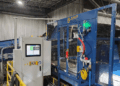
A typical system includes an in-feed conveyor; resin identification, using a sensor and a computer; and pneumatic separation. Such systems often use a metering device, such as a vibratory feeder or disc screen, to produce an even flow with little or no clumping.
In terms of general resin sortation technology, two methods are used: X-ray and spectroscopy. In systems relying on X-ray, the unit analyzes the plastics on an elemental level. This includes XRF technology (X-ray fluorescence).
In terms of spectroscopy, several technologies read various lightwave lengths, including Fourier transform infrared (FTIR), near infrared (NIR), midrange infrared (MIR) and Raman laser. These spectroscopy technologies beam a light or a laser onto the plastic and then measure absorption and/or refraction, given that different organic molecules absorb light at different wavelengths. They look for compounds, such as carbon-hydrogen, carbon-oxygen or carbon-carbon. That elemental information allows the machine to determine the plastic type and to sort accordingly.
Each optical approach has its merits and constraints. For example, XRF can detect bromine and chlorine, thus distinguishing between halogenated and nonhalogenated plastics. X-ray systems are also good at sorting very dirty plastic. However, as a whole, X-ray units are less prevalent in plastics sorting and tend to be better suited to metals identification.
A downside to the spectroscopy methods, meanwhile, is that they cannot identify bromine additives, such as those used as a fire retardant. Also, while FTIR and Raman laser methods offer more detail than NIR, and are better at identifying black and highly colored plastics, NIR is faster and cheaper, and it dominates the marketplace.
Plastics can also be sorted by color using vision technology, which employs cameras (often CCD linear cameras), and innovation such as visual-range spectrometry.
Aiming to lift efficiency
Material specifics help determine productivity. For instance, when operators aim to use a device for multiple sorting categories, the overall efficiency and processing capacity may be reduced.
Processors also note that size variability affects efficiency, with problems arising if the targeted materials are too small or thin. Thus, one unit might sort 7 to 8 tons per hour as it handles uniform material and moves it into several categories. But when the same device is used to handle multiple resins and lightweight plastics, throughput might drop to 2 to 3 tons per hour.
How is optical effectiveness being improved? In interviews with nearly two dozen experts, the following sortation findings and trends were listed:
- Units are now more scalable. For example, belt widths are becoming wider to increase capacity.
- The number of moving parts has been reduced. Solid-state sensors, for instance, have replaced rotating or scanning devices.
- For sorting flake, uniform flake size aids efficiency.
- Flake sorters are more expensive on a capital cost per pound of capacity than whole-unit sorters. To sort flake, you need to have higher resolution versus handling containers and more tighter-spaced air valves.
- Sorters can be upgraded with new software enhancements so that existing units can handle new resins or products.
- Optical sorters tend to outlast other processing units in MRFs.
- The sortation equipment industry is continually changing. A database maintained by Plastics Recycling Update lists 16 equipment producers serving North America. New firms continually enter the market while others occasionally exit. We’ve also seen some mergers and acquisitions in the space.
- Several of these sorting equipment producers are formally linked up with full system providers as a way of supplying turnkey solutions.
- Chinese equipment makers have entered the flake-sortation market.
- By one estimate, the number of different types of sorting units available from producers has grown four-fold in the past decade.
The future of sortation
Optical sortation equipment makers and users point to a handful of operational factors that could change the industry over time.
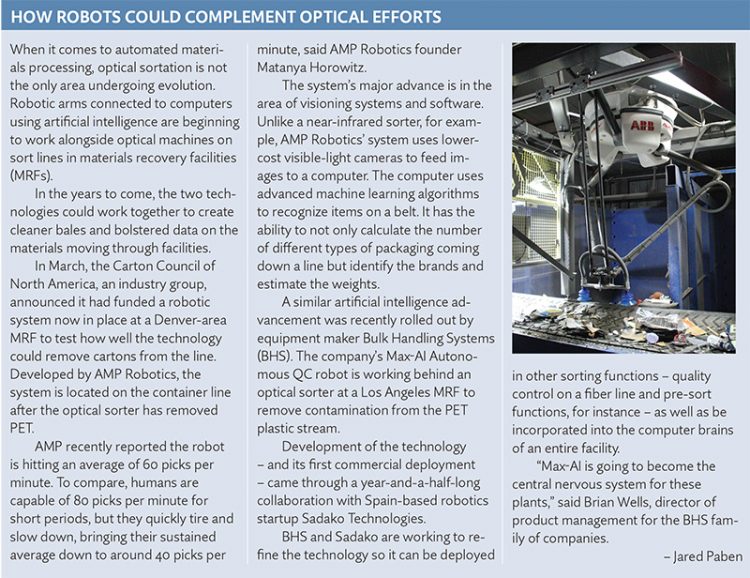
Equipment suppliers are focusing on new sorting challenges that have hindered the efforts of many stakeholders throughout the plastics recycling value chain.
For instance, as materials recovery programs grow and single-stream collection of recyclables becomes more common, processors have encountered poor quality in incoming material. Changes in packaging design, meanwhile, mean more challenging items are found in the stream. These products include full-sleeve bottle labels, flexible and multi-layer packaging, smaller packaging (coffee pods, pill bottles, etc.), PET thermoforms and more black plastics.
The next stage of sortation will likely involve machines that can work faster and feature higher spatial and spectrometry resolution. Higher resolution is needed to handle the new packaging forms mentioned above. The challenge will be to capture these materials from the residential recycling stream and then further separate components.
The shifting nature of the plastics stream is something that will continue to be a key issue for processors. The optical solutions that will succeed in the marketplace will be those that can evolve alongside the material mix.
Jerry Powell is the founder and executive editor of Plastics Recycling Update, and he can be contacted at [email protected]. In the development of this article, technical experts at several firms provided comments, including those from B+B, EagleVizion, Green Machine, MSS, NRT, Pellenc, Sesotec and Tomra.