






Resource Recycling
  • The Latest
  • Analysis
    • All
    • Certification Scorecard
    • Industry Announcements
    • Opinion
    Colorado regulators suggest mid-range EPR scenario

    Why collaboration on plastic waste still matters

    Battery processors lay out latest moves

    Battery recycler Ascend Elements files for bankruptcy

    EPR fees are a market signal. Here’s what they’re telling you.

    EPR fees are a market signal. Here’s what they’re telling you.

    Wolframite ore, the primary ore of tungsten from Altai, Russia

    Tungsten scrap export controls draw industry attention

    Certification Scorecard — Week of April 6, 2026

    Closed Loop Partners acquires Sutter Metals, connecting electronics disposition to metals recovery

    Certification Scorecard — Week of March 30, 2026

    Industry announcements for January 2026

    Industry announcements for April 2026

    Certification scorecard – Week of March 23, 2026

  • Conferences
  • Publications

    Other Topics

    Textiles
    Organics
    Packaging
    Glass
    Brand Owners

    Metals
    Technology
    Research
    Markets
    Grant Watch

    All Topics

Subscribe
No Result
View All Result
Resource Recycling
  • The Latest
  • Analysis
    • All
    • Certification Scorecard
    • Industry Announcements
    • Opinion
    Colorado regulators suggest mid-range EPR scenario

    Why collaboration on plastic waste still matters

    Battery processors lay out latest moves

    Battery recycler Ascend Elements files for bankruptcy

    EPR fees are a market signal. Here’s what they’re telling you.

    EPR fees are a market signal. Here’s what they’re telling you.

    Wolframite ore, the primary ore of tungsten from Altai, Russia

    Tungsten scrap export controls draw industry attention

    Certification Scorecard — Week of April 6, 2026

    Closed Loop Partners acquires Sutter Metals, connecting electronics disposition to metals recovery

    Certification Scorecard — Week of March 30, 2026

    Industry announcements for January 2026

    Industry announcements for April 2026

    Certification scorecard – Week of March 23, 2026

  • Conferences
  • Publications

    Other Topics

    Textiles
    Organics
    Packaging
    Glass
    Brand Owners

    Metals
    Technology
    Research
    Markets
    Grant Watch

    All Topics

Subscribe
No Result
View All Result
Resource Recycling
No Result
View All Result
Home E-Scrap

AI servers reshape ITAD sector, recyclers brace for new wave

byScott Snowden
March 9, 2026
in E-Scrap

Quality Stock Arts / Shutterstock

The rapid expansion of artificial intelligence infrastructure is expected to reshape how recyclers and IT asset disposition providers manage retired data center hardware, as a new generation of complex servers begins approaching end-of-life cycles later this decade.

Operators across the IT asset disposition (ITAD) sector say the next wave of decommissioned systems will differ significantly from earlier generations of enterprise hardware because of the concentration of high-value components packed into AI-focused server racks, including graphic processing units (GPUs).

“Most hyperscale operators refresh their core server infrastructure every three to five years,” said Linda Li, chief strategy officer at Li-Tong Group, the Hong Kong-based parent company of IT lifecycle management firm Re-Teck. “Given how dramatically GPU deployments scaled between 2022 and 2024, the first real wave of GPU-dense AI servers is likely to enter decommissioning cycles between 2026 and 2029.”

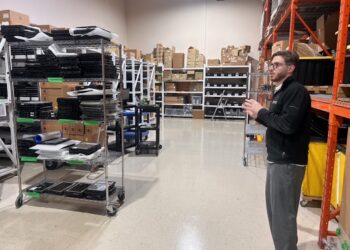
Re-Teck, which began operations in 2000 under Hong Kong-based Li-Tong Group, provides reverse supply chain management services including logistics, secure data handling, refurbishment and materials recovery for retired technology equipment. The company operates facilities across North America, Europe and Asia and says those sites process more than 100 million devices each year, including enterprise servers, telecom hardware and networking equipment.

AI hardware brings new recovery challenges

Data centers built to support large-scale AI workloads rely heavily on GPUs, high-capacity memory systems and specialized cooling assemblies. Those systems are significantly denser than conventional enterprise servers, which introduces both economic opportunities and technical hurdles for processors handling the equipment after retirement.

“What makes this wave different is what’s inside the hardware,” Li said. “GPU-dense systems are packed with highly valuable components.”

That concentration of valuable components can make refurbishment, harvesting and resale more economically attractive than direct shredding or bulk materials recovery, particularly when GPUs and other specialized hardware retain secondary market demand.

Li said the company prioritizes extracting value from equipment before it enters the recycling stream. “What sets Re-Teck apart is the conviction that shredding electronics is a last resort,” Li said. “Our focus is on data-secure disassembly, testing, grading, parts harvesting and repurposing.”

Automation and AI reshape processing

The growing complexity of AI-focused hardware is also accelerating adoption of automation and analytics within recycling and asset recovery facilities. Companies across the sector are experimenting with machine vision systems and data tools to identify devices, classify components and improve processing throughput in recycling and refurbishment operations.

“At the front end of the process, AI-enabled visual recognition systems identify device models, configurations and cosmetic grades in seconds,” Li said.

Automated inspection and component recognition systems can reduce the time technicians spend identifying equipment and grading components while helping standardize reporting across facilities that process equipment from multinational customers.

At the same time, Li said the evolving design of AI infrastructure introduces new operational challenges for recyclers and ITAD providers attempting to scale those technologies.

“AI models for our business need regular retraining as hardware form factors evolve, and in the world of high-density AI servers those form factors evolve quickly,” she said.

Processors must also contend with variation in incoming equipment streams and the difficulty of integrating automation with older facility infrastructure.

“Normalizing data across global facilities is complex, and integrating legacy equipment isn’t always clean or straightforward,” Li said.

The AI boom is also increasing demand for more detailed lifecycle documentation as large cloud operators track the environmental and operational impacts of their equipment fleets. Asset owners increasingly request serialized tracking, compliance documentation and carbon-related reporting associated with retired hardware.

Server refresh cycle expected later this decade

Li said that shift is contributing to a broader change in how the industry views end-of-life technology management.

“AI’s rise is pushing our entire industry toward higher technical standards, tighter compliance and a much stronger emphasis on giving components a second life before they ever reach the recycling stream,” she said.

The retirement of early AI server deployments is unlikely to occur as a single surge of equipment entering recycling channels. Instead, industry observers expect a gradual turnover as data center operators replace systems in stages.

“What’s more likely is a rolling, staggered series of retirements as operators continuously upgrade to more power-efficient, higher-density accelerators,” Li said.

As those systems begin reaching recovery facilities and secondary markets, recyclers may encounter hardware that carries greater technical complexity and higher component value than previous generations.

“The defining characteristic of this next chapter in ITAD will be that the hardware is more technically demanding and more valuable per rack than anything the industry has dealt with before,” Li said.

Tags: ITADTechnology
TweetShare
Scott Snowden

Scott Snowden

Scott has been a reporter for over 25 years, covering a diverse range of subjects from sub-atomic cold fusion physics to scuba diving off the Great Barrier Reef. He's now deeply invested in the world of recycling, green tech and environmental preservation.

Related Posts

Amazon, DOE partner on critical materials recovery

byScott Snowden
April 13, 2026

DOE and Amazon will study recovery of graphite from textiles and gallium from IT hardware, aiming to strengthen US supply...

Packaging sector sees shift from AI pilots to wider use

byScott Snowden
April 1, 2026

AI adoption is expanding across packaging operations as costs fall and use cases widen, though concerns around accountability, ROI and...

ReElement, Mitsubishi partner on rare earth supply chains

byScott Snowden
March 31, 2026

ReElement and Mitsubishi Materials form a US-Japan partnership to expand rare earth refining, targeting supply chain gaps with recycling, feedstock...

Circularity push meets internal behavior hurdles

byScott Snowden
March 30, 2026

At PRC, former Jabil executive Cassie Gruber argued circular economy efforts often stall on internal habits and culture, as she...

Report pegs fire losses at $2.5b in US and Canada recycling industry

byScott Snowden
March 27, 2026

A new fire report estimates $2.5b in damage across US and Canadian recycling facilities in 2025, with lithium-ion batteries still...

#ESC2025 Speaker Spotlight: Matthew Young

From bootstrap to boom: EVR poised for growth after capital injection

byStefanie Valentic
March 26, 2026

Baltimore e-recycling company Electronics Value Recovery (EVR) is accelerating nationwide expansion into the ITAD and enterprise markets after securing a...

Load More
Next Post
Machinex debuts organics co-collection system

Coastal partners with Machinex on four Florida MRF projects

More Posts

EPR fees are a market signal. Here’s what they’re telling you.

EPR fees are a market signal. Here’s what they’re telling you.

April 10, 2026
End markets, policy key to RPET viability

End markets, policy key to RPET viability

April 8, 2026

Trafigura signs $1.1b deal for recycled battery metals

April 8, 2026
Wineries help create model for film recycling

Wineries help create model for film recycling

April 7, 2026
With RPET in crisis, focus turns to solutions

With RPET in crisis, focus turns to solutions

April 2, 2026
Wolframite ore, the primary ore of tungsten from Altai, Russia

Tungsten scrap export controls draw industry attention

April 9, 2026
Plastics Recyclers Have the Capacity to Recycle More. Now Let’s Use It.

Study finds most recycling occurs within 30 miles of access

April 8, 2026

WM opens new $60m MRF in Indy

April 10, 2026
Solarcycle starts up Georgia recycling plant

S3399 signals a shift in how states are tackling solar panel waste

April 6, 2026
Bill to update New Jersey e-scrap program heads to governor

New Jersey recyclers talk EPR

April 9, 2026
Load More

About & Publications

About Us

Staff

Archive

Magazine

Work With Us

Advertise
Jobs
Contact
Terms and Privacy

Newsletter

Get the latest recycling news and analysis delivered to your inbox every week. Stay ahead on industry trends, policy updates, and insights from programs, processors, and innovators.

Subscribe

Welcome Back!

Login to your account below

Forgotten Password?

Retrieve your password

Please enter your username or email address to reset your password.

Log In

Add New Playlist

No Result
View All Result
  • The Latest
  • Analysis
  • Recycling
  • E-Scrap
  • Plastics
  • Policy Now
  • Conferences
    • E-Scrap Conference
    • Plastics Recycling Conference
    • Resource Recycling Conference
    • Textiles Recovery Summit
  • Magazine
  • About Us
  • Advertise
  • Archive
  • Jobs
  • Staff
Subscribe
This website uses cookies. By continuing to use this website you are giving consent to cookies being used. Visit our Privacy and Cookie Policy.