





Editor’s note: Stewardship for batteries and electronics are among sessions at the 2026 E-Scrap Conference, Oct. 26-28 in New Orleans. Register today!
With nearly 13 million residents, Illinois is the sixth-most populous state and contains the third-largest city – creating a fertile landscape for environmental policy.
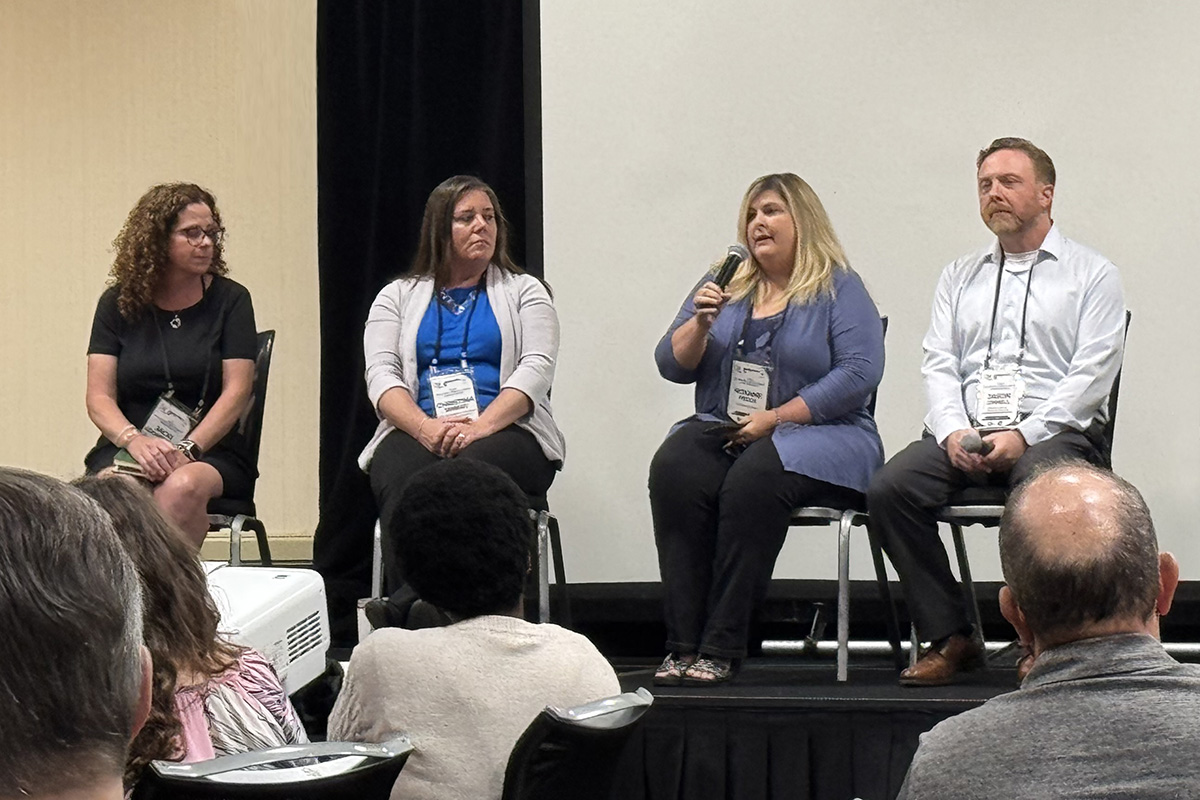
The state’s electronics and battery programs are paving the way toward managing embedded batteries and more complex electronics, product stewardship stakeholders said during the Illinois Circularity Conference, Aug. 19-20 in Tinley Park.
In January Illinois began its EPR program for household batteries, led by The Battery Network. Not even a year in, the program has provided valuable lessons, said Roxane Peggs, director of state stewardship for the group, during a producer responsibility session at the conference.
Illinois enacted EPR for batteries in 2024 requiring battery producers to fund and manage the collection and recycling of portable primary and rechargeable batteries from small consumer electronics, in addition to medium-format batteries such as those in e-bikes and scooters.
Siting permanent collection in each of the state’s 102 counties is among the initial challenges, Peggs said. Of course, more populous counties will have multiple collection points, but so far all but 17 counties have a site. “And we’re not going to give up on those counties, but boy, is that tough!”
She also noted that the timing of the group’s shift from Call2Recycle nomenclature delayed marketing efforts the organization needed to make. “We would have rather not rebranded in the middle of Illinois implementation.”
The rebrand in mid-January delayed marketing efforts by about two weeks, she said. “Looking back, that was too late.”
With experience in Vermont and Washington, DC, The Battery Network also looked to its previous efforts to guide planning for Illinois, but “it’s so different.” Residents of those two jurisdictions had been hoarding batteries, she said, in the absence of a formal collection program. This resulted in very high initial collected volumes – a phenomenon Illinois so far has not experienced.
Illinois has a goal of collecting 950,000 pounds of batteries in its first year. As of the second half of 2026, just over 320,000 pounds have been collected, and about 28% of the total are primary (single-use) batteries, Peggs said.
Historically, Illinois regulations for batteries have focused on rechargeables, with a program beginning more than 30 years ago. Peggs credited these efforts with providing an outlet prior to the current program, so residents did not amass large quantities.
“The transition from only recycling rechargeable batteries through our program has been really, really slow in the market, unfortunately,” she said. “And if we could go back, we would look at that much differently.”
And while consumer transition to the new program has been sluggish, implementation was intentionally fast, out of necessity, said Christina Seibert, executive director of the Solid Waste Agency of Northern Cook County (SWACC).
As one of the lead authors for the 2024 bill, Seibert helped push for rapid implementation to address safety concerns in the waste and recycling streams.
Despite the compressed implementation timeline, Seibert commended The Battery Network for listening and responding to state concerns during the process.
That said, handing the responsibility to a third party is a challenge in itself for a local agency, after operating its own programs and doing things a certain way, Seibert said. “The producer responsibility aspect means that we have to take a step back,” she said. But “having that good partnership for electronics and for batteries has made those programs much more beneficial.”
The ‘elephant in the room’
Looking ahead, the state will have to confront “the elephant in the room”: embedded batteries in everything from clothing to tools and appliances.
Among the first steps in addressing the issue is to determine whether responsibility for the ubiquitous items will fall under batteries or electronics, said panel moderator Walter Willis, executive director of the Solid Waste Agency of Lake County (SWALCO).
A few embedded-battery devices are already covered in the state’s electronics recycling program, said Jason Linnell, executive director of the National Center for Electronics Recycling (NCER). Linnell also sits on the advisory board for the E-Scrap Conference, presented by Resource Recycling, Inc.
“Where it gets difficult are the things that have batteries that are not electronics for the electronics program,” he said.
Linnell pointed out that embedded batteries appear in “a whole universe of so many industries and products,” including clothing, home appliances, tools and even singing or light-up greeting cards.
“There’s no way a single electronics recycler is going to want to take all of those types of devices,” he said. “So I do think that we need to start segregating them a little bit,” grouping the true electronic devices into electronics EPR programs.
In a first for the US, in January California implemented a disposal fee charged at the point of sale of battery-embedded devices, to fund their addition to the existing electronics program.
Also in California, The Battery Network is conducting a Bay Area study on these devices to help bridge the gap between current programs and a more nuanced approach. The study should wrap up in January 2027 and the results are expected to be published shortly afterward, Peggs said.
The study aims to categorize the wide array of battery-embedded devices, which has proved challenging. “As soon as anyone tries to get a comprehensive list, it’s going to change the next day,” she said, noting the rapidly changing electronics landscape.
Policy-forward in the heartland
Among Midwestern states, Illinois is tied with Minnesota for the most EPR laws (6), putting the two in a league with stewardship-forward coastal states such as California (12), Maine (11), Vermont (10), Washington (8) and Connecticut (7).
According to the Product Stewardship Institute, other central-region states have only a handful of EPR laws, mostly addressing end-of-life electronics or batteries: Iowa (3), Wisconsin and Indiana (2 each), and Michigan, Missouri, Nebraska and Oklahoma (1 apiece).
Local and regional stakeholders play a crucial role in developing EPR policy, to address handling of problem materials – those that are not easily or safely managed at the curbside, and may not be generated as frequently as product packaging, Seibert said.
Stakeholders connect through different channels, including SWANA and the Illinois Recycling Foundation, to determine policy priorities based on what materials are causing the most issues, she said.
With any proposed stewardship legislation, the Illinois EPA must evaluate its scope and whether it sits within the agency’s remit, said Jacki Cooperider, deputy bureau chief for land pollution control at the agency. In addition, the IEPA considers information and logistical demands on the agency, and weighs the proposal against the governor’s and state leadership priorities, she said.
Cooperider added that IEPA’s role includes supporting related bills, both during the legislative process and afterward, by facilitating program education and communication to reach consumers.