



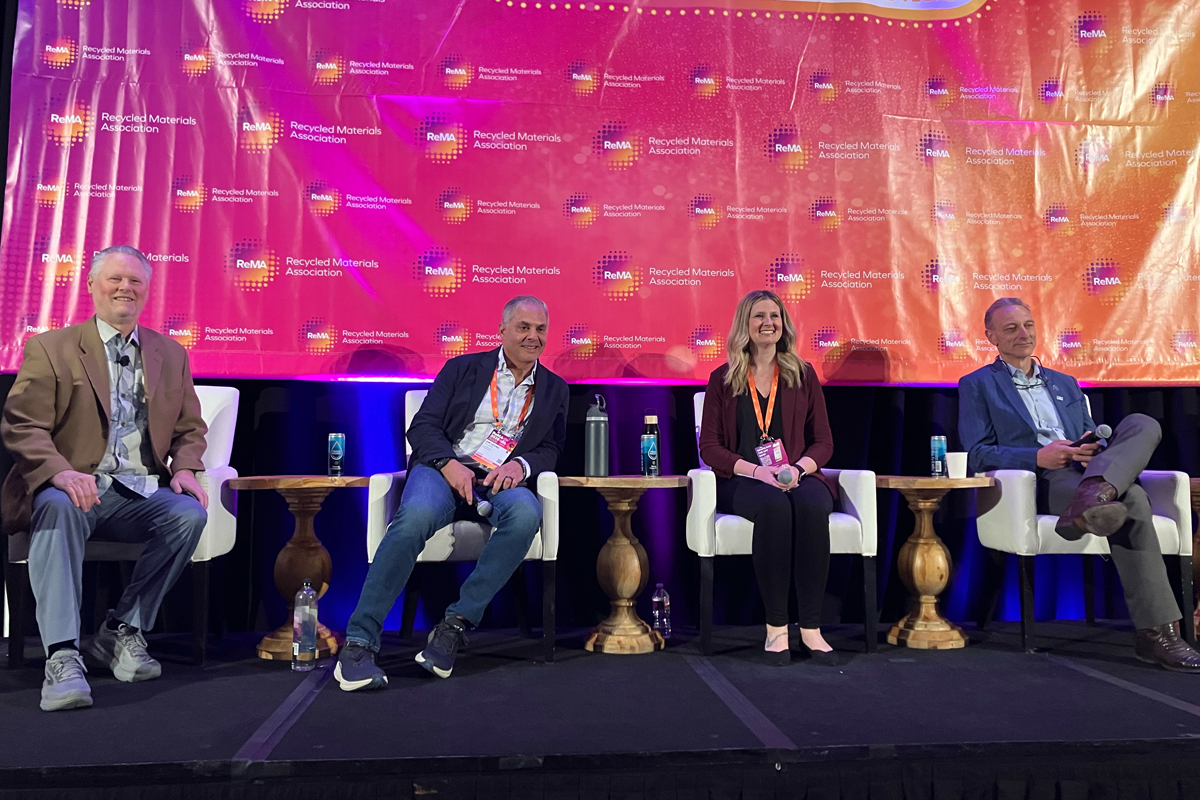
Representatives of the IT asset disposition industry said artificial intelligence adoption, consolidation activity and evolving certification requirements are reshaping operations, during the ReMA conference in Las Vegas Wednesday.
Speakers described how AI tools are being deployed across facilities to improve efficiency in testing, grading and asset tracking. Jim Levine of Iron Mountain said automated systems are beginning to reduce manual inspection work in repair and processing environments.
“One thing I’m particularly interested in is AI vision and how we’re auditing and testing equipment,” he said, pointing to tools that can perform repetitive checks that were previously handled by workers.
Amanda Tischer Buros, Vice President of Dynamic Lifecycle Innovations, said her company is using optical character recognition to capture serialized data and reduce manual entry. She said the company is also testing systems that evaluate devices and determine resale or scrap pathways.
“That is really helping us make quick decisions about, should this be a product that’s moving in the scrap channel or a product that has a maximized ITAD resale value,” she said.
Panelists said these tools are improving accuracy and productivity rather than eliminating jobs. Levine said AI can assist employees in identifying equipment and making decisions in what he described as a complex intake environment. “We call it triage in our operation, where you get a pile of stuff, and you have to figure out what that stuff is,” he said.
Beyond operations, speakers pointed to market impacts tied to data center expansion and demand for computing hardware. Buros said both resale and scrap markets have benefited from supply constraints and increased infrastructure buildout, adding that companies are seeing higher volumes of enterprise equipment entering the ITAD stream.
She said the shift is introducing new challenges, including unfamiliar equipment types and expanded service expectations from clients. “We’re seeing a lot better, high value equipment, but also equipment we’ve never managed before,” she said.
Levine said changes in hardware design and cooling systems could complicate processing and resale markets, while global data center expansion could present logistical challenges. Panelists also discussed ongoing merger and acquisition activity in the sector, which they said is being driven by the need for scale and service diversification.
Levine said transactions in the industry can be difficult to structure due to differences in operations, customer relationships and regulatory environments. “Every one of our companies, while we might handle a lot of the same materials, we all do it a little bit differently,” he said.
Craig Boswell, President of HOBI International, said organic growth has become more difficult as competition has increased. “You’re the third call today and the fifth call this week,” he said, describing the level of competition for new business.
He said investment banks are increasingly focused on the sector and are highlighting factors such as service revenue, intellectual property and long term contracts when evaluating companies. Certification and regulatory requirements were also identified as key factors shaping operations.
Buros said customers are placing greater emphasis on data security certifications and internal controls. She said companies are expanding certification coverage to include standards such as ISO 27001 and SOC 2 to address both device level and system level security. Panelists said global trade conditions are creating additional challenges, particularly as countries interpret and implement rules under the Basel Convention.
Boswell said changing policies can complicate planning and cross border material movement. “It is hard to run a business in an uncertain environment,” he said.
Speakers said industry groups can help companies track regulatory changes and share information about compliance requirements. Looking ahead, panelists identified battery handling and rare earth recovery as areas of focus. Levine said improving economics could support recovery of materials such as neodymium, while Buros pointed to increased regulatory attention on battery safety and transportation.
Panelists said ongoing technological change and infrastructure investment are expected to continue influencing the volume and type of material entering ITAD operations.