
Resource Recycling
  • The Latest
  • Analysis
    • All
    • Certification Scorecard
    • Industry Announcements
    • Opinion
    Feds to develop repairable computer donation program

    The whitebox blind spot in PC recycling

    Analysis: circular design still elusive in laptops

    PC shipments grew in Q1, but questions remain

    The independent ITAD at a crossroads

    The independent ITAD at a crossroads

    Certification Scorecard — Week of April 20, 2026

    Apple Watch on product box.

    Wearables are coming and ITAD isn’t ready

    Certification Scorecard — Week of April 13, 2026

    EV Battery Pack - Sergii Chernov-Shutterstock

    Redwood, Rivian deal fuels US infrastructure plans

    Bloom ESG and e-Stewards roll out critical metals metric

    Colorado regulators suggest mid-range EPR scenario

    Why collaboration on plastic waste still matters

  • Conferences
  • Publications

    Other Topics

    Textiles
    Organics
    Packaging
    Glass
    Brand Owners

    Metals
    Technology
    Research
    Markets
    Grant Watch

    All Topics

Subscribe
No Result
View All Result
Resource Recycling
  • The Latest
  • Analysis
    • All
    • Certification Scorecard
    • Industry Announcements
    • Opinion
    Feds to develop repairable computer donation program

    The whitebox blind spot in PC recycling

    Analysis: circular design still elusive in laptops

    PC shipments grew in Q1, but questions remain

    The independent ITAD at a crossroads

    The independent ITAD at a crossroads

    Certification Scorecard — Week of April 20, 2026

    Apple Watch on product box.

    Wearables are coming and ITAD isn’t ready

    Certification Scorecard — Week of April 13, 2026

    EV Battery Pack - Sergii Chernov-Shutterstock

    Redwood, Rivian deal fuels US infrastructure plans

    Bloom ESG and e-Stewards roll out critical metals metric

    Colorado regulators suggest mid-range EPR scenario

    Why collaboration on plastic waste still matters

  • Conferences
  • Publications

    Other Topics

    Textiles
    Organics
    Packaging
    Glass
    Brand Owners

    Metals
    Technology
    Research
    Markets
    Grant Watch

    All Topics

Subscribe
No Result
View All Result
Resource Recycling
No Result
View All Result
Home Analysis

Europe pulls ahead on ITAD now while US growth remains slower

byDavid Daoud
January 28, 2026
in Analysis, E-Scrap
New entrepreneurs bring renewed energy to e-cycling

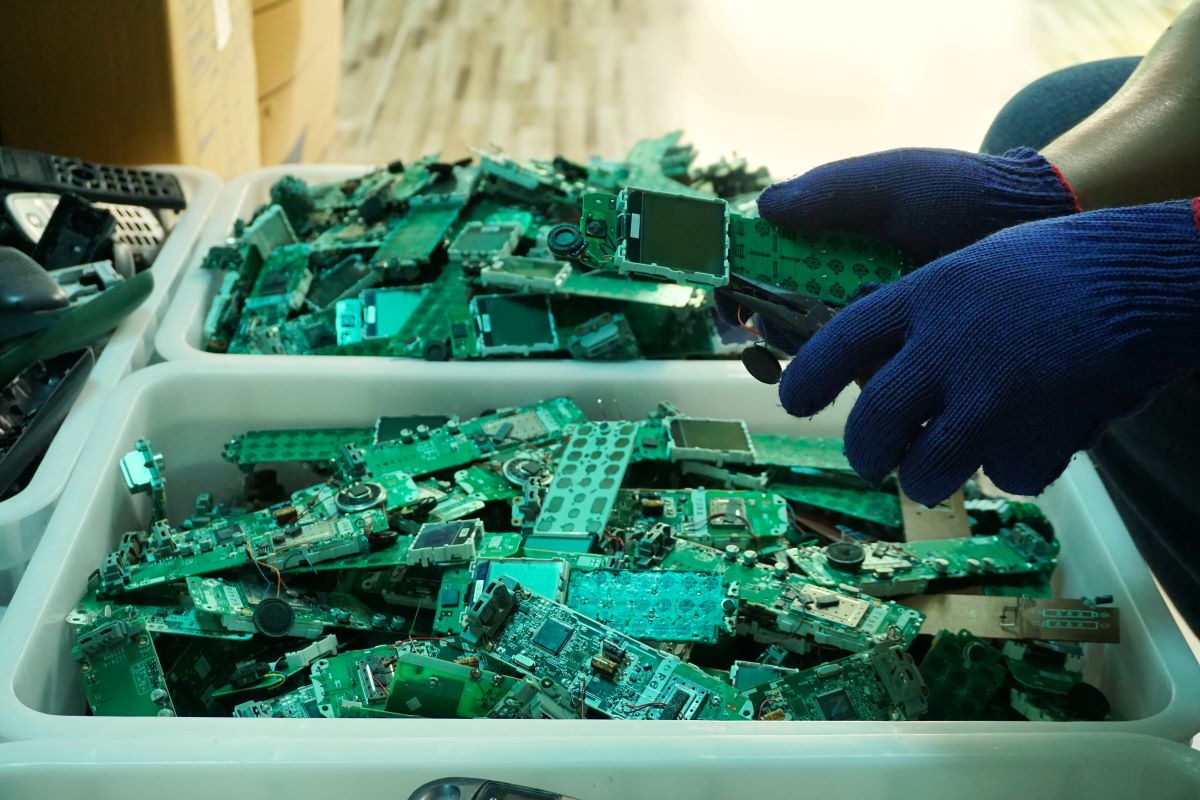
Early 2026 shows Europe accelerating IT asset disposition investment through facilities, acquisitions and regulation, while US ITAD growth continues in a more incremental model. | RATTANAPONG/shutterstock

Early 2026 shows evidence of a widening gap between Europe and the United States in the pace and structure of IT asset disposition development. 

While US operators continue to invest and adapt, recent announcements point to Europe experiencing denser activity across facilities, acquisitions, regulatory infrastructure and downstream integration. And so while the US remains the largest single ITAD market, the momentum is clustering in Europe driven by a combination of policy, capital and customer demand.

Where Europe’s momentum is concentrating

Several strands of activity point to Europe’s accelerating position and the first is physical infrastructure. SK Tes’ new facility in Shannon, Ireland, adds ITAD, refurbishment and data center decommissioning capacity directly inside one of Europe’s most active hyperscale corridors. 

European-facing investments also appear downstream, with Fornnax planning to commission what it describes as Europe’s highest-capacity shredding line and Paladin EnviroTech entering the EU through the acquisition of Dutch operator R&L Recycling. These developments suggest that Europe is adding sites, while building capacity aligned with hyperscale, enterprise and cross-border requirements.

Second is consolidation and network-building. Reconomy’s acquisition of Munich-based LiBCycle strengthens a pan-European battery logistics and pre-treatment network spanning more than 30 facilities. This type of platform investment is tied to Europe’s fragmented national markets, where scale is achieved through coordinated networks rather than single mega-sites. It also aligns with tightening battery and hazardous material controls, which require specialized handling well before devices reach traditional ITAD or e-scrap plants.

Third is regulatory infrastructure. The EU’s Digital Waste Shipment System (DIWASS), expected to become operational for shipments from May 2026, is a structural change. By digitizing notifications and Annex VII documents and interconnecting national authorities, DIWASS reduces administrative friction for compliant cross-border e-waste movements. For ITAD companies operating across multiple EU states, this matters as much as any individual facility investment. The UK’s transition to a new government sanitization assurance framework adds another layer, reinforcing formalized data destruction expectations for providers serving public-sector and regulated clients.

Finally, it is worth mentioning Europe’s momentum is also extending into materials circularity. Initiatives such as URT’s NEXLOOP polymers alliance explicitly target Basel-compliant recycled plastics flowing back into electronics manufacturing. While URT is US-based, the alliance’s structure and partners reflect demand signals strongest in Europe and Asia, where OEMs face binding recycled-content and reporting obligations.

Why Europe is moving faster

The drivers behind Europe’s pace are structural rather than cyclical. EU-wide policy frameworks, including extended producer responsibility, right-to-repair rules, and cross-border shipment controls, create predictable demand for compliant ITAD and recycling services. This predictability supports investment decisions and favors operators capable of meeting harmonized standards across jurisdictions.

Europe’s data center geography also plays a role. Ireland, the Nordics, Germany and the Netherlands concentrate hyperscale assets within relatively short distances but across national borders. This inherently rewards operators with multi-country footprints and sophisticated logistics. In contrast, US hyperscale growth is geographically vast but often served within single-state or single-operator frameworks.

The US picture: active but fragmented

There are also noticeable developments in the United States. Universal Recycling Technologies’ expansion in Oregon shows confidence in secure disposition demand and Tech Defenders’ expansion into broader IT asset management reflects a shift toward lifecycle services. State-level policy is also advancing, with new battery EPR programs, right-to-repair laws and expanded data privacy obligations.

However, US momentum is fragmented. As has always been the case, regulatory changes emerge state-by-state rather than through a unified federal system, increasing compliance complexity without necessarily delivering the same cross-border efficiencies seen in Europe. Community-focused partnerships, such as Goodwill Houston’s collaboration with CompuCycle, expand collection but do not reshape the national ITAD landscape in the way pan-European acquisitions and systems do.

Is Europe the better opportunity for global ITADs?

For global ITAD providers, Europe increasingly looks like the market where scale, compliance capability and network design can translate into defensible positions. Entry barriers are higher, but so is the value of being established. The Paladin acquisition in the Netherlands illustrates this logic: acquiring compliant capacity is often faster and more credible than building from scratch in a tightly regulated environment.

That said, Europe is not universally “easier.” Labor costs, permitting and regulatory scrutiny are higher and margins can be compressed. The opportunity favors operators with strong governance, data security, and downstream transparency rather than volume-driven models.

The near-term outlook suggests Europe will continue to outpace the US in structural ITAD development through 2026, particularly in battery handling, cross-border logistics, and hyperscale-aligned facilities. The US market will remain large and resilient, but more incremental, shaped by state-level policy and organic operator expansion.

For multinational ITADs, Europe is certainly becoming the proving ground for compliance-heavy, networked ITAD models that are likely to define global best practice. What succeeds there is increasingly what regulators, OEMs, and enterprise clients elsewhere will expect next.


Tags: ITADMarkets
TweetShare
David Daoud

David Daoud

David Daoud is a contributor to Resource Recycling and E-Scrap News, covering IT asset disposition, electronics recycling, and circular IT governance. He is the founder of and current Principal Analyst at Compliance Standards LLC, where he conducts independent research and advisory work on ITAD markets, sustainability and ESG compliance, data security, and lifecycle risk management. Daoud has analyzed enterprise IT trends since the late 1990s and was among the first analysts to examine ITAD as a distinct market segment during his time at IDC. He advises operators, OEMs, and investment teams on regulatory, technology, and market developments affecting the electronics lifecycle.

Related Posts

Volatility reshapes outlook for US metals businesses

byScott Snowden
April 15, 2026

Panelists at the ReMA conference in Las Vegas said tariffs, reshoring and geopolitical tension are remaking trade flows, lifting US...

NERC launches hub to promote PCR demand 

byAntoinette Smith
April 15, 2026

The Northeast Recycling Council's PCR Material Demand Hub offers resources for government procurement, material- and product-specific resources, and certification and...

Industry group: Help us find the plastic bale volumes we need

PET bales sink further as other grades firm 

byRecyclingMarkets.net Staff
April 15, 2026

Pricing for HDPE and PP bales rose again, while PET bales remained low, film grades have steadied, and paper and...

Lead battery recycling market set for steady growth

byScott Snowden
April 14, 2026

The global lead battery recycling market is projected to grow steadily through 2034, supported by regulation, automotive replacement cycles and...

GFL acquires SECURE Waste for $6.4bn

byStefanie Valentic
April 13, 2026

GFL Environmental has agreed to acquire SECURE Waste Infrastructure Corp. in a $6.4 billion deal that expands the waste hauler's...

Trafigura signs $1.1b deal for recycled battery metals

byScott Snowden
April 8, 2026

Trafigura entered the agreement to expand access to recycled critical materials, supporting efforts to build more resilient battery supply chains...

Load More
Next Post

Wisconsin food waste amounts to 1,033 pounds per resident each year

More Posts

Birch Plastics gets FDA green-light for post-industrial PP

LyondellBasell upgrade to PreZero assets on hold

April 23, 2026
The independent ITAD at a crossroads

The independent ITAD at a crossroads

April 22, 2026
Towfiqu ahamed barbhuiya

Before the Bin: Breaking down food date labeling

April 20, 2026
Industry group: Help us find the plastic bale volumes we need

PET bales sink further as other grades firm 

April 15, 2026
EPR fees are a market signal. Here’s what they’re telling you.

Oregon DEQ flags 250 producers for RMA noncompliance

April 21, 2026

Google pilots reuse kits to extend device life

April 21, 2026
EPR fees are a market signal. Here’s what they’re telling you.

EPR fees are a market signal. Here’s what they’re telling you.

April 10, 2026
Battery recycler Ascend Elements files for bankruptcy

Battery recycler Ascend Elements files for bankruptcy

April 13, 2026

NERC launches hub to promote PCR demand 

April 15, 2026
Hawaii trials asphalt made with plastic debris and nets

Hawaii trials asphalt made with plastic debris and nets

April 20, 2026
Load More

About & Publications

About Us

Staff

Archive

Magazine

Work With Us

Advertise
Jobs
Contact
Terms and Privacy

Newsletter

Get the latest recycling news and analysis delivered to your inbox every week. Stay ahead on industry trends, policy updates, and insights from programs, processors, and innovators.

Subscribe

Welcome Back!

Login to your account below

Forgotten Password?

Retrieve your password

Please enter your username or email address to reset your password.

Log In

Add New Playlist

No Result
View All Result
  • The Latest
  • Analysis
  • Recycling
  • E-Scrap
  • Plastics
  • Policy Now
  • Conferences
    • E-Scrap Conference
    • Plastics Recycling Conference
    • Resource Recycling Conference
    • Textiles Recovery Summit
  • Magazine
  • About Us
  • Advertise
  • Archive
  • Jobs
  • Staff
Subscribe
This website uses cookies. By continuing to use this website you are giving consent to cookies being used. Visit our Privacy and Cookie Policy.