
Resource Recycling
  • The Latest
  • Analysis
    • All
    • Certification Scorecard
    • Industry Announcements
    • Opinion

    AI and the changing economics of retired hardware

    Certification Scorecard — Week of June 8, 2026

    ITAD is moving past its adolescent phase: beyond end-of-life

    Rainforest

    Inside the Circle: What the rainforest can teach us about EPR

    Closeup of a printed circuitboard

    Hardware demand puts new focus on parts harvesting

    Rare look inside the world’s largest plastics recycler

    Mass balance matters: Why different rules can lead to different outcomes 

  • Conferences
    • Resource Recycling Conference
    • Plastics Recycling Conference
    • E-Scrap: The Longevity Conference
    • Textiles Recovery Summit
  • Publications
    • E-Scrap News
    • Plastics Recycling Update
    • Policy Now
    • Resource Recycling
    • Other Topics
      • All Topics
      • Brand Owners
      • Critical Minerals
      • Glass
      • Grant Watch / RFPs
      • Markets
      • Organics
      • Packaging
      • Research
      • Technology
      • Textiles
Subscribe
No Result
View All Result
Resource Recycling
  • The Latest
  • Analysis
    • All
    • Certification Scorecard
    • Industry Announcements
    • Opinion

    AI and the changing economics of retired hardware

    Certification Scorecard — Week of June 8, 2026

    ITAD is moving past its adolescent phase: beyond end-of-life

    Rainforest

    Inside the Circle: What the rainforest can teach us about EPR

    Closeup of a printed circuitboard

    Hardware demand puts new focus on parts harvesting

    Rare look inside the world’s largest plastics recycler

    Mass balance matters: Why different rules can lead to different outcomes 

  • Conferences
    • Resource Recycling Conference
    • Plastics Recycling Conference
    • E-Scrap: The Longevity Conference
    • Textiles Recovery Summit
  • Publications
    • E-Scrap News
    • Plastics Recycling Update
    • Policy Now
    • Resource Recycling
    • Other Topics
      • All Topics
      • Brand Owners
      • Critical Minerals
      • Glass
      • Grant Watch / RFPs
      • Markets
      • Organics
      • Packaging
      • Research
      • Technology
      • Textiles
Subscribe
No Result
View All Result
Resource Recycling
No Result
View All Result
Home E-Scrap

Repair movement reshapes reuse as laws reshape ITAD

byScott Snowden
December 17, 2025
in E-Scrap
mobile phone fix

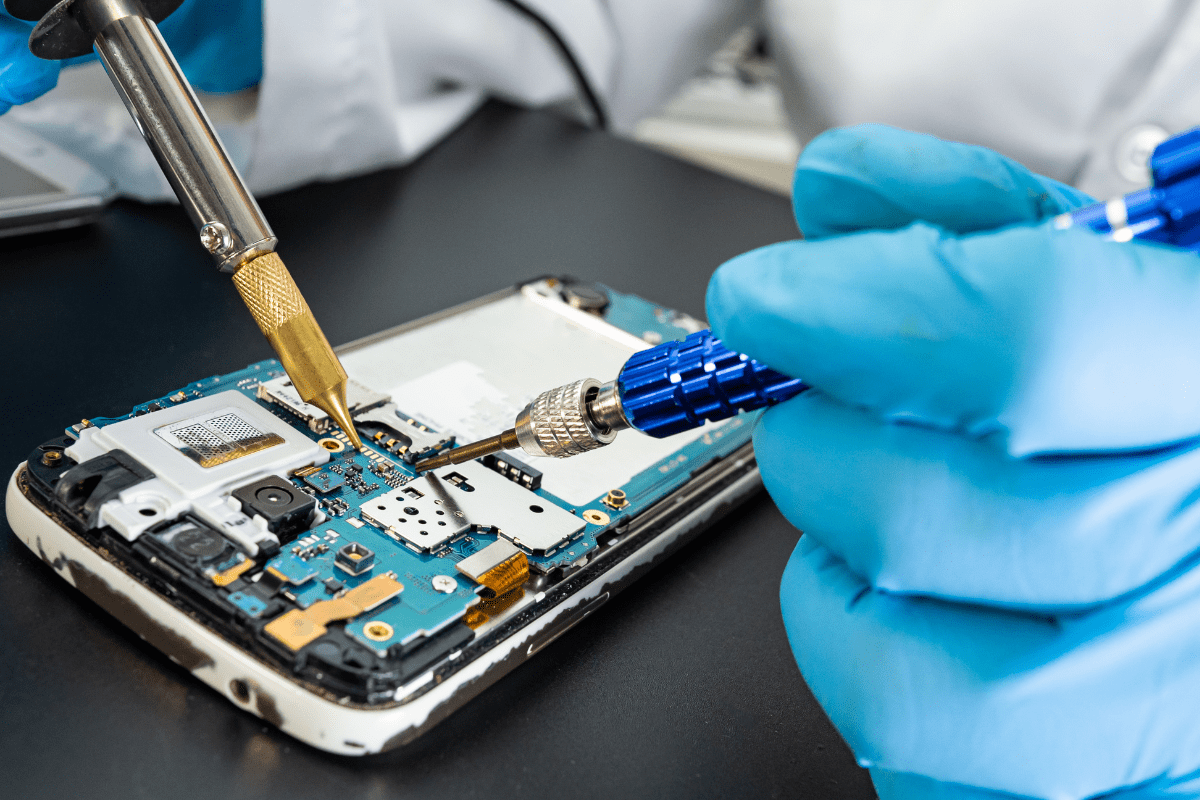
The same laws enabling kitchen-table fixes are also starting to change conditions for refurbishers, ITAD firms and e-scrap operators. | Sasirin Pamai/Shutterstock

Right-to-repair rules are moving from fringe cause to market force, and electronics recyclers will feel the effects along the entire lifecycle, speakers told attendees at E-Scrap Conference 2025.

Consultant Chris Bross of Tierrabyte and iFixit sustainability director Liz Chamberlain outlined how fast-changing laws are reshaping design, service and end-of-life decisions.

“Basically, if you bought it, you own it and you should be able to repair it. Those are the tenets of right to repair,” Bross said. He added that the same laws enabling kitchen-table fixes are also starting to change conditions for refurbishers, ITAD firms and e-scrap operators.

Chamberlain traced the movement’s roots to a 2012 Massachusetts auto repair law that required carmakers to give independent garages access to the same parts, tools and documentation as dealers. That model inspired campaigners to push for similar access in electronics, farm machinery and other equipment with embedded software.

Since the first electronics bills appeared in 2014, state lawmakers have passed measures in California, Colorado, Connecticut, Maryland, Minnesota, Nevada, New York, Oregon, Texas and Washington. Chamberlain said that by population, “over a third of the country” now lives in a state with some kind of right-to-repair law, and that bills in Ohio and Pennsylvania could still move in current two-year sessions.

Despite differences among states, Bross said the statutes share three core requirements. Manufacturers must release repair documentation, sell spare parts to the public and make hardware and software tools available beyond their own authorized networks. That last piece reaches into factory-grade equipment that was never intended for a home garage.

Chamberlain said those rules have already pushed most major phone and laptop brands to launch parts programs and publish at least some manuals. Yet she noted that entire categories remain untouched, including many wearables, smart rings and smart glasses. Farm equipment is covered only in one Colorado law that John Deere is contesting in court, while video game consoles are excluded in most states and sit in a gray area under New York’s statute.

A major flashpoint is “parts pairing,” where tiny chips link components such as batteries and screens, to a specific logic board. Chamberlain showed how Apple’s iPhone evolved from pairing a single security component to pairing nearly every major part. Independent shops told iFixit that even with legal access to parts, they were still losing customers because warning messages and degraded features followed non-authorized repairs.

To explain the issue to policymakers, advocates briefed the New York Times, which produced a detailed feature on pairing and its effect on independent shops. That coverage helped them convince lawmakers in Oregon and Colorado to restrict the practice and require manufacturers that use cryptographic pairing to give consumers access to the same re-pairing software tools that authorized shops use.

Bross described how Apple’s Repair Assistant now lets owners complete a repair on some newer phones, even with harvested original parts, but he said the experience can still scare buyers. He recalled helping an 83-year-old neighbor set up a refurbished iPhone that threw multiple warnings about replaced components on first boot, prompting her to return the device and keep her older Samsung instead.

Not every large brand is resisting, the panelists said. Bross pointed to Google, which has worked with iFixit to make parts available globally for phones and the Pixel Watch and Chamberlain highlighted modular products such as the Fairphone and Framework laptop as design-for-repair examples.

Fairphone commissioned research from the Fraunhofer Institute that found the climate cost of making a replacement part can be paid back within days or weeks of extended use.

“If we as Americans kept our phones for one year longer, it would be the carbon equivalent of taking 636,000 cars off the road,” Chamberlain said.

Bross contrasted that potential with current recovery performance.

Depending on which numbers are used, “Approximately 18% of electronic waste is actually recycled, recycled with intent and some compliance,” he said. He added that Europe’s combination of collection mandates and design rules has pushed recycling rates over 50% for many products, creating “a lot of growth opportunity” for US systems.

The policy fight is not confined to statehouses, and Chamberlain pointed to renewed federal attention on the 1975 Magnuson-Moss Warranty Act, which already bars companies from voiding warranties simply because a product has been opened or serviced. The Federal Trade Commission has recently fined brands including Harley-Davidson and Weber for manuals that wrongly told customers opening a product would void warranty coverage.

Another federal barrier is Section 1201 of the Digital Millennium Copyright Act, which restricts bypassing technological protection measures. Chamberlain noted that advocates have won temporary exemptions that allow owners to bypass protections on some devices, such as farm tractors and even McDonald’s ice cream machines, but the law still blocks sharing tools or publishing details of successful hacks.

Advocates are also tracking proposals tied to the annual defense spending bill that would require repairable equipment for the US military, along with national efforts focused on automotive and agricultural gear.

Looking ahead, Chamberlain said iFixit wants US buyers to see a repairability score at the point of sale, similar to new European Union energy labels that include A-to-E repair grades. The group is also turning more attention to medical devices, where hospital technicians report long waits for vendor service on life-critical machines, and to software support timelines that can instantly obsolete hardware, as seen in the end of Windows 10 support.

Bross told recyclers and ITAD professionals that the laws now on the books are only a starting point but already change the terrain for everyone in the room. “These laws are really here to support people who are at this show and this industry,” he said, urging companies to track both new obligations and new repair opportunities as the movement matures.
Tags: Repair & Reuse
TweetShare
Scott Snowden

Scott Snowden

Scott has been a reporter for over 25 years, covering a diverse range of subjects from sub-atomic cold fusion physics to scuba diving off the Great Barrier Reef. He's now deeply invested in the world of recycling, green tech and environmental preservation.

Related Posts

Google pilots reuse kits to extend device life

byScott Snowden
April 21, 2026

Google, Back Market and Closing the Loop pilot a reuse model pairing ChromeOS Flex with e-scrap recovery, extending device life...

REUSE Act heads to US House for consideration

byAntoinette Smith
February 9, 2026

The bill would require the US EPA to collect data on reuse and refill systems across industries including consumer packaging,...

Electronics on a desk.

New Blancco workflow targets ITAD bottleneck

byDavid Daoud
February 4, 2026

As resale dynamics evolve, Blancco has released a new reimaging tool that aims to improve laptop rebuild quality for ITAD...

VW investing millions in auto recycling in Germany

byAntoinette Smith
January 28, 2026

The German vehicle manufacturer plans to invest up to €90 million in its Zwickau plant, in efforts to supply its...

Server resale values surge in AI-driven markets

Server resale values surge in AI-driven markets

byDavid Daoud
January 22, 2026

Server resale values jumped sharply in 2025 as AI infrastructure demand tightened supply, reshaping secondary IT markets and boosting returns...

Colorado expands repair rights as electronics rules take effect

Colorado expands repair rights as electronics rules take effect

byScott Snowden
January 19, 2026

A new Colorado law expanding consumers’ right to repair electronic devices took effect this month, requiring manufacturers to provide access...

Load More
Next Post
Austria’s DRS on track for 80% collection in first year

Austria's DRS on track for 80% collection in first year

More Posts

House resolution aims to make recyclability central to product design

NY EPR bill fails to advance after third try

June 8, 2026
Various PET thermoform containers.

Thermoform recovery soars, PCR content falls

June 10, 2026
CalRecycle withdraws proposed regs for SB 54

Oceana, NRDC, CAW sue CalRecycle over SB 54 regs

June 5, 2026

Three-bill package aims to revamp Michigan’s bottle return system

June 9, 2026
Circular Materials to supply PlasCred chem recycling plant

Circular Materials to supply PlasCred chem recycling plant

June 4, 2026
Rare look inside the world’s largest plastics recycler

Mass balance matters: Why different rules can lead to different outcomes 

June 5, 2026

Battery fires still a major risk to recyclers: report

June 9, 2026
Recycling industry addresses Beyond Plastics report

Recycling industry addresses Beyond Plastics report

May 26, 2026
Rainforest

Inside the Circle: What the rainforest can teach us about EPR

June 8, 2026
How electronics legislation fared this legislative season

NY sends repairability labeling bill to governor

June 8, 2026
Load More

About & Publications

About Us

Staff

Archive

Magazine

Work With Us

Advertise
Jobs
Contact
Terms and Privacy

Newsletter

Get the latest recycling news and analysis delivered to your inbox every week. Stay ahead on industry trends, policy updates, and insights from programs, processors, and innovators.

Subscribe

Welcome Back!

Login to your account below

Forgotten Password?

Retrieve your password

Please enter your username or email address to reset your password.

Log In

Add New Playlist

No Result
View All Result
  • The Latest
  • Analysis
  • Recycling
  • E-Scrap
  • Plastics
  • Policy Now
  • Conferences
    • E-Scrap Conference
    • Plastics Recycling Conference
    • Resource Recycling Conference
    • Textiles Recovery Summit
  • Magazine
  • About Us
  • Advertise
  • Archive
  • Jobs
  • Staff
Subscribe
This website uses cookies. By continuing to use this website you are giving consent to cookies being used. Visit our Privacy and Cookie Policy.