






It may not receive a lot of media attention, but corporate concentration in America’s waste industry negatively impacts the lives of nearly all Americans and contributes to a range of economic and environmental burdens.
For millions of consumers, “Big Waste” is driving up prices, potentially adding billions of dollars to our solid waste bills while inflicting severe damage on our environment by relying on landfills and incinerators rather than recycling.
A new report from the Institute for Local Self-Reliance (ILSR) explores the problem of concentrated corporate power in the waste sector. Called “How Waste Monopolies Are Choking Environmental Solutions, And What We Can Do About It,” the analysis explains how a small number of giant waste companies came to dominate the industry, and how policymakers and consumers can address the problem.
The early years: A galvanized population and decentralized structure
To start, it can be helpful to lay out some of the historical context around the development of waste and recycling in America over the second half of the 20th century.

The country’s evolution on recycling in many ways began at the first Earth Day in 1970, which helped galvanize millions of people to examine the environmental impact of their consumption habits.
Hundreds of communities began to re-create solid waste from the bottom up. First, they established “drop-off centers” where people could take their recyclables; later, hundreds of small businesses developed across the country to collect the recyclables at the curb.
In response to growing societal pressure, city governments began integrating recycling into their solid waste collection systems, a step they believed would be a modest add-on to the existing city services. Industry and the U.S. EPA persuaded them that people would at best achieve a 10% recycling level.
The federal government, meanwhile, failed to incentivize recycling by giving billions of dollars in subsidies to cities and private companies to build incinerators that allowed cities to maintain their existing collection system, with a detour from giant landfills to giant burn sites.
Despite these obstacles, by the 1980s the recycling movement had demonstrated its collective strength by successfully defeating over 100 proposed incinerators (and by 1996, over 300 proposed incinerators were rejected). By the early 2000s the U.S. recycling rate was 35% and in some cities it exceeded 50%.
A diverse, decentralized recycling system had been created, made up of over 50,000 companies and 1 million workers earning $350 billion in wages, according to a 2001 recycling economic information study from the U.S. EPA. Recycling and composting were increasing so fast that waste going to landfills declined from 93% of all solid waste in 1970 to 58% by 2000.
Privatizing to try to get rid of problem
Parallel to the growth of this decentralized recycling system, however, was the consolidation of the existing waste hauling industry.
Starting in the 1950s, two heavily capitalized companies, Waste Management and BFI (now Republic Services), initiated the formation of nationally integrated conglomerates by acquiring hundreds of smaller companies and establishing monopoly control of landfills and hauling contracts.
By the start of the 21st century, a handful of nationally integrated companies dominated local and regional markets. And within their integrated business structure, disposal in their own landfills earned them the highest profit.
This corporate action around waste started to affect materials recovery in a big way when residents’ demand for curbside recycling developed at the end of the last century.
Many city governments were indifferent and even hostile to managing the process. They soon privatized services to get rid of their problem, paving the way for the big waste hauling conglomerates to take over urban recycling by low-balling contracts to gain market share and then adjusting the contracts to their interests.
The large haulers raised rates, added surcharges, cut out glass and plastic bag recycling, and forced cities to halt local processing and ship materials up to 50 miles out of town for handling at other sites. For the industry’s convenience, big haulers introduced single-stream systems to cities. This tactic called for collection of mixed recyclables as opposed to localized dual-stream systems, which kept paper separate from other materials.
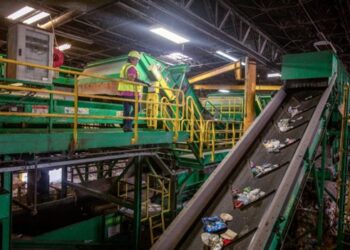
Single-stream recycling did reduce costs for cities and could increase overall volumes of recycling, but it came at the expense of dramatically higher contamination rates. At the same time, corporate haulers worked to establish large, centralized materials recovery facilities (MRFs). This year, Waste Management and Republic will operate roughly 40% of all MRFs in the United States.
Impacts of reliance on Asia
For more than a decade, the system seemed to work, but only because China, desperate for raw materials to feed its surging industrialization, was willing to assume the costs of cleaning up the mixed waste.
However, while material was moving to Asia, contamination from single-stream recycling slowed and then halted the growth of recycling in cities across America.
Glass, which accounts for 20 to 25% of the recycling stream, is often no longer recovered for industrial use. In essence, contamination resulted in the near abandonment of glass recycling, despite high demand for used cullet among glass bottle manufacturers.
By 2018, the rise in the cost of labor and the popular pressure for environmental controls (even under totalitarian rule) forced China to halt imports of contaminated recovered materials from the U.S. The North American recycling industry was – and is – in turmoil, having to re-create an ecosystem that had been undermined since 2000.
Adding insult to injury, Chinese demand for materials had led it to bid up the price of recycled paper, making it too expensive for U.S. paper mills. That meant domestic capacity dwindled.
Since China’s ban, we have certainly seen domestic end users rush to try to find a home for the material coming in through municipal recycling programs. Some plastic recyclers in the U.S. have begun to make their own pellets rather than send raw plastic to China. Investment in U.S. recycled paper mills has soared recently, with over 20 announced plans for building or renovating plants in every part of the country.
The recycling movement also continues to exercise political influence at the local level, leading to new rules to expand recycling and reduce disposal. These include bans on single-use plastics, investments in distributed composting, unit pricing for garbage collection, surcharges and packaging taxes, the reversion to dual-stream collection, and new municipally owned processing facilities.
Next phase of the recycling movement
Over two generations, the recycling movement created a recycling ecosystem dependent on the active participation of consumers and a processing economy largely populated by small and medium-sized businesses that are able to serve their local and regional markets.
The pushback from Big Waste in the last 20 years has certainly bloodied the recycling movement. But it remains unbowed and dynamic.
And a number of key factors are primed to continue the momentum back toward a more decentralized model for materials recovery. There’s new urgency about climate change and ocean plastics as well as heightened awareness of the relationship between our material consumption and the health of the environment.
Individuals wanting to create resilient recycling systems have a treasure trove of information available about what works and what doesn’t, all gathered from generations of activists, policymakers and entrepreneurs. We can add to that discussion new awareness of the impact of corporate consolidation and monopolies on our privacy, our democracy and our well-being.
Together, these powerful realities augur in an even more vigorous and sophisticated environmental movement.
Neil Seldman, Ph.D., co-founded the Institute for Local Self-Reliance and is director of the group’s Waste to Wealth Initiative. Prior to founding ILSR, Seldman was a manufacturer of consumer products and professor of political science. He can be contacted at nseldman@ilsr.org.
The views and opinions expressed are those of the author and do not imply endorsement by Resource Recycling, Inc. If you have a subject you wish to cover in an op-ed, please send a short proposal to news@resource-recycling.com for consideration.