

Alphabet’s moonshot factory has spent years building a molecular map of what Americans throw away. Its strategy lead says the data, not more equipment, is what recycling has been missing.
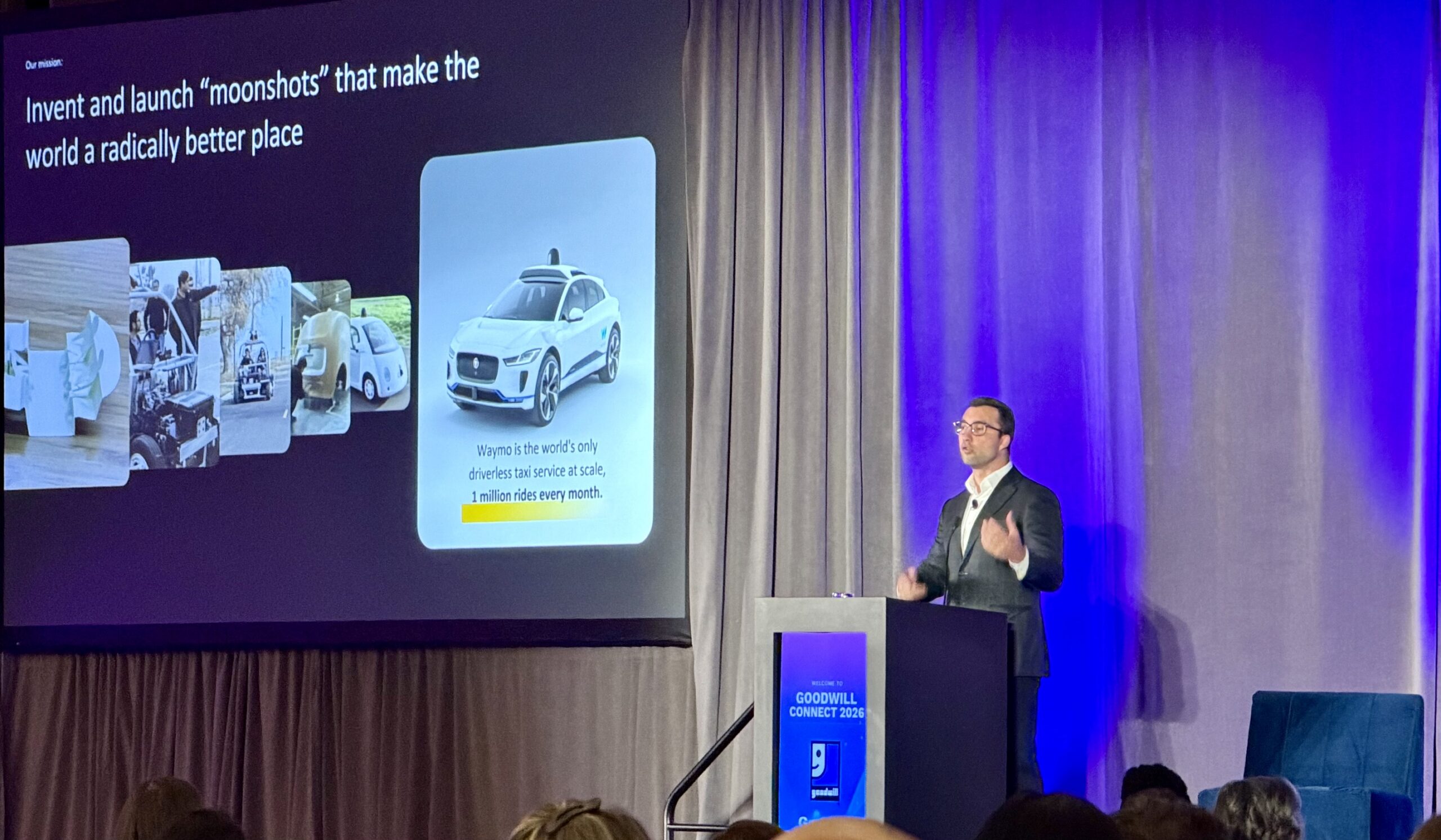
Peter Chauvel is strategy and operations lead for Materra, the circularity project inside X, Alphabet’s innovation lab. He spoke about the project’s approach Nov. 10 at the Goodwill Sustainability Summit in Houston.
“We’re looking at how we might radically reimagine waste so nothing is ever thrown away again,” Chauvel said.
X, formerly Google X, has launched more than 30 technologies and companies in 16 years, including Waymo. Every project starts from the same blueprint, Chauvel said. The team finds a problem affecting millions or billions of people, proposes a solution that sounds like science fiction, then builds the technology to make it work.
Chauvel pointed to Waymo as the clearest example. Traffic crashes kill 1.16 million people a year, according to the World Health Organization. Ninety-three percent of those deaths trace to human error, he said. Other companies were working on better seatbelts and airbags, he said. In 2007, X decided to take the driver out.
Materra applied that same blueprint to materials. Chauvel said humanity spends trillions of dollars a year extracting raw materials and throws away roughly 75% of them. He said the mineral value alone will reach $8.6 trillion a year by 2040.
“Right now, we’re throwing that all back into the ground,” he said.
Seeing is believing
Recycling has existed for decades but “the process is operating blind,” Chauvel said. Processors have little visibility into where their feedstock comes from or what is in it.
They often pay for the very materials that contaminate their output. Without traceability, they have no way to know which supplier is responsible for contaminated loads.
Recyclers also compete against oil, gas and mining — industries that have had a century to refine their operations, he said.
Chauvel compared recycling to baking.
“If you put the wrong thing in at the beginning, if you, for example, switch up your sugar for salt, … you end up with a bad product at the end,” he said.
The system’s incentives make the problem worse, Chauvel said. Collectors are paid to gather as much material as possible and keep it out of landfills.
The bales they sell carry contamination, so reclaimers have to buy what amounts to mini sorting facilities at the front of their lines. Even after that capital spending, the resin often doesn’t meet the quality or price brands require.
From objects to molecules
Materra’s answer is to replace what Chauvel called an object-based view with a molecular one. Instead of seeing a bottle, a T-shirt or a laptop, the system identifies the molecules each item is made of.
Analytical chemistry labs could already do that, he said, but never quickly, cheaply or at scale.
The technology stack has four parts:
- A molecular knowledge base. When Chauvel joined Materra, his job was to pick material off MRF lines. The team did that for years, reverse-engineering discarded items to learn what they contained and using the results to train its AI.
- Inline sensors. These run on conveyor belts and identify the molecular makeup, shape and color of thousands of items per minute.
- Molecular sortation. Sorting decisions go to robotics, air jets or human sorters through what Materra called a “human assist.”
- A recycling optimizer. This feedback loop learns from recyclers’ results.
“We are not a recycler,” Chauvel said. “There’s people in the world who are very good at this, and we are not one of them.”
Film and flex
Film and flexible packaging is Materra’s most public test case. Chauvel said the US produces 7 million tons of it a year and recycles less than 5%. Most of what is recycled is post-industrial scrap.
Working with Dow, Materra showed it could detect the individual layers in multilayer film and each layer’s share of the item’s weight. That tells a recycler whether it can accept the material and which process it fits, Chauvel said.
“Today, film and flexible has basically zero value to the world. It’s actually a cost,” he said. Turning it into feedstock means taking something “you might even get paid to take” and producing a valuable product.
A systems challenge
Chauvel said technology alone won’t close the loop. “Circularity is a systems challenge,” he said.
Materra’s long-term vision is the circularity hub. A single facility would take in textiles, packaging and electronics and sell reuse, resale and recycling outputs. Combining streams would cut transport costs and help recovered materials compete with virgin ones, he said.
“It might sound a lot like a Goodwill,” Chauvel said. “When I was thinking about it, it really looks like a Goodwill.”
He added that Materra is “not there today.”
Chauvel said the technology won’t replace human sorters. He cited a summit exercise in which Goodwill staff sorted shoes he couldn’t classify. He also said bad product labels often send material to the wrong recycler, and Materra hopes to fix that upstream.
Chauvel urged attendees to try things quickly and inexpensively. X builds a deliberately bad first prototype of every project, Waymo included.
“There’s no such thing as failure. There’s only learning,” he said. “Don’t measure twice, cut once when you’re trying something innovative.”
He predicted that within 10 years, material data will be “a currency” for organizations that handle physical goods at scale.
“We don’t need to go back to the ground to get the materials for the products of tomorrow,” Chauvel said. “We have them in the products of today and yesterday.”