




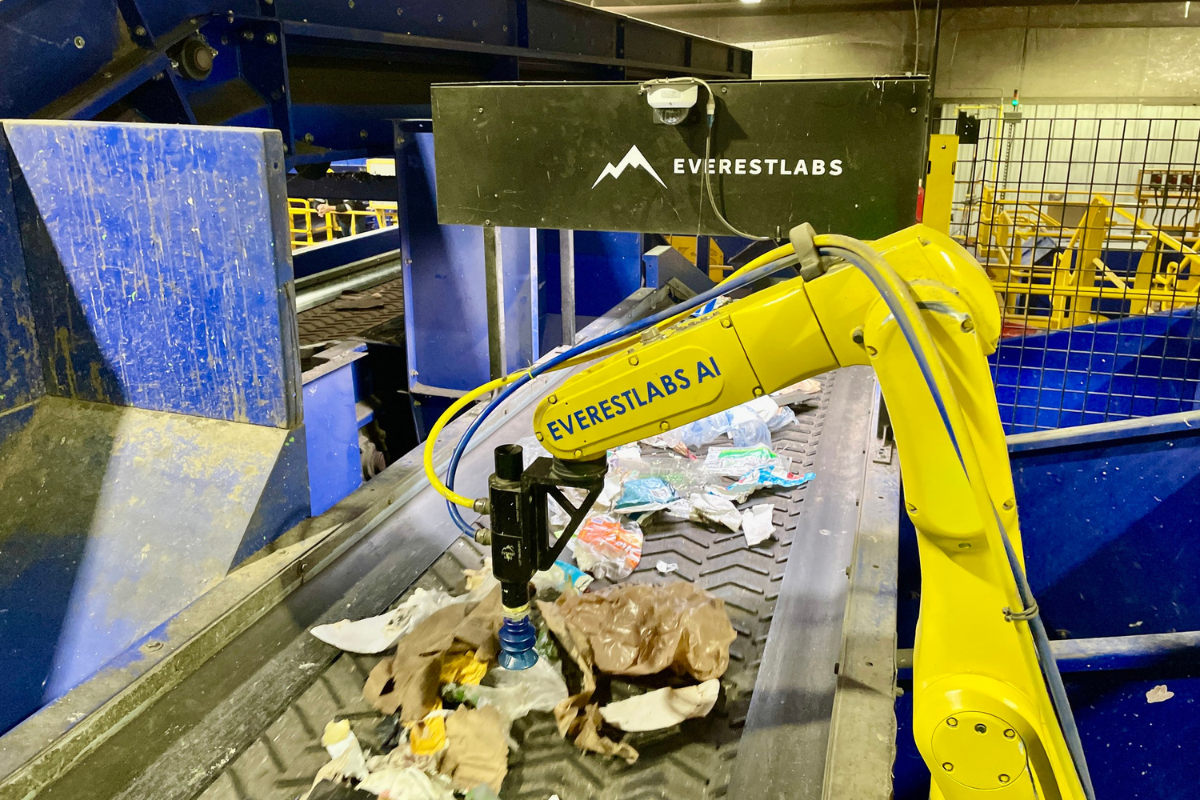
Producer responsibility organizations (PROs) are buying AI vision systems and running them in their own test labs as state packaging extended producer responsibility (EPR) programs build out audit and reporting requirements.
Once PROs trust the technology, recycling facilities will likely be asked to install it, according to Apurba Pradhan, head of product at EverestLabs.
EPR laws shift the cost of recycling packaging away from residents and local governments and onto the companies that make and sell packaged products. Producers pay into programs run by PROs, which work with state regulators to set accepted materials lists, recovery targets and reporting rules. The fees producers pay are generally higher for packaging that is harder to recycle.
“Once they get comfortable that this technology works and I can deploy it in the wild, then they’re going to ask the recovery facilities to purchase this, and they’ll probably give them money to do that,” Pradhan said at RCon in St. Louis, Missouri.
Who ultimately foots the bill is still being worked out, he said.
“I’m not sure who ultimately pays for it, but there’s enough value in this that whoever pays for it will get a payback,” Pradhan said.
EverestLabs, a Silicon Valley company that has built AI robotic systems for recycling facilities since 2021, is working with PROs to train its models on the materials listed in state program rules.
Documentation
Pradhan described EPR’s effect on MRFs in two parts. First, everything gets documented: what comes into a facility, how it is recovered and what is sold to end markets.
Second, facilities will need capital investment as recovery targets rise and materials such as film and cartons, which most MRFs do not currently recover, are added to accepted materials lists.
The current audit method is manual. Facilities pull a 50- to 100-pound sample and sort it by hand into bins, a process that takes about half an hour and captures roughly 0.01% of a day’s material, Pradhan said.
Vision systems, by contrast, record every object that passes under the camera. Pradhan showed an audit report from one fiber line that tracked bale purity at 91.27% over seven days and broke out the remaining contaminants by resin type, including PET, polypropylene and HDPE, as well as aluminum.
The same data can be used for state reporting and in disputes with mills over bale quality, he said.
A separate infeed report showed a facility running 21 tons per hour against a capacity of 41 tons per hour, about half of what the plant can process. Pairing infeed cameras with cameras at the end of the line gives operators a daily view of tons received, tons recovered and tons landfilled.
In the loop
EverestLabs’ platform layers what Pradhan called agentic AI on top of its vision data. Operators can type questions into a chat interface, such as how a disc screen is separating 2D and 3D material, and receive step-by-step instructions on adjusting disc speed, feed rate and screen angle.
The system does not make those changes itself.
“We don’t plug this directly into control systems today because we always want people in the loop to be actually doing these changes,” Pradhan said.
Pradhan said the data can also support investment decisions as PROs ask MRFs to recover materials that lack established markets. In one study, EverestLabs tracked aseptic cartons through a facility and found many ending up in aluminum and PET lines. That kind of tracking can help operators decide whether volumes justify a robot, an optical sorter or an additional sorter, he said.
One facility now uses a robot on a container transfer line to pull cartons. Another MRF uses robots to separate green PET from clear PET.
State accepted materials lists generally include about 13 major material classes and roughly 70 subclasses, Pradhan said. HDPE, for example, may be split by color and packaging format. EverestLabs has to find examples of each subclass to train its models, and that work varies state by state.
The company can now train its AI on a new material in two to three weeks, in part by using synthetic images generated by another AI model. Pradhan estimated the system will be able to recognize everything on state lists within six to 12 months.
Retrofitting for the future
The biggest technical obstacle is retrofitting older lines where material is piled on top of itself, Pradhan said.
“It’s really a physics problem,” he said. “If you can’t see it, then you can’t tell what it is.”
New facilities can be designed with belt speeds and feed rates that make identification easier, while existing plants cannot.
Cameras also have limits. A clear PET cup and a clear polypropylene cup look the same to a camera, so facilities need near-infrared sensors to tell the difference. Shredded packaging is harder still.
When asked whether improving AI could reduce the number of vision systems a MRF needs, some of which run more than 20, Pradhan said the opposite is more likely.
Cameras are the only source of object-level data, and a single camera on a residue line can show what is being landfilled but not where the problem started, he explained.
The company’s goal is to make cameras cheap enough that facilities can install 10 to 15 without weighing each one, he said. That includes testing off-the-shelf IP cameras that cost about $100, supplemented by belt weight sensors and encoders.
Upstream detection is another frontier EverestLabs is exploring. Pradhan said some facilities see roughly one battery per minute on their lines, too many to stop for each one. EverestLabs has R&D underway on identifying problem materials earlier and IP cameras pointed at tip floors can already flag contamination. Tying that contamination back to a route or neighborhood is a logistics problem for haulers and MRFs, not a technology one, he said.
US facilities are approaching the technology with curiosity rather than urgency, Pradhan said.
“It’s not a necessity today,” he said. “It’s more of a, ‘Hey, it’s coming in the future.'”
To the North, Canadian facilities facing near-term deadlines were in what he described as panic mode. In at least one case, the PRO relaxed some auditing rules so facilities would not have to install systems before they were ready, Pradhan said.