



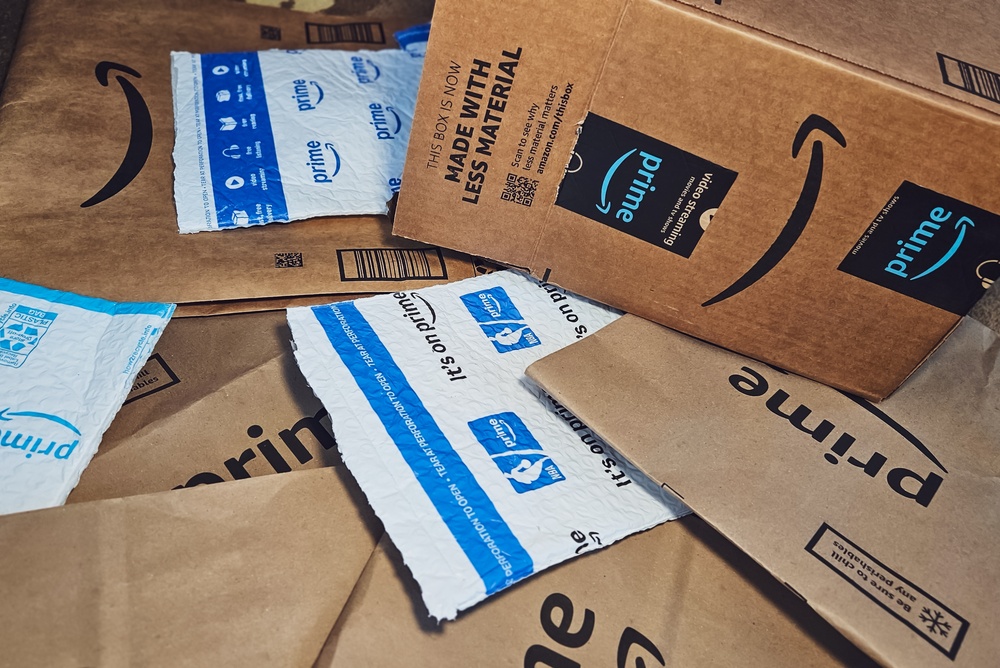
Although global e-tailer Amazon highlighted its source-reduction efforts and push to use recyclable packaging materials for shipments, its latest sustainability report showed that the company’s use of plastic delivery packaging remained flat in 2025.
For the year, the company’s volumes of single-use plastic packaging in North America decreased only marginally, to 68,196 metric tons (mt), representing 92% of the company’s global single-use plastic. Other regions actually increased usage, albeit from much lower starting points.
Single-use plastic packaging used (in metric tons)
| Region | 2023 | 2024 | 2025 | 2025 vs 2024 |
| North America | 83,513 | 68,679 | 68,169 | -0.7% |
| Europe | 877 | 894 | 1,199 | +34% |
| Rest of World | 4,308 | 4,564 | 4,678 | +2% |
| Global total | 88,698 | 74,137 | 74,073 | 0% |
Even so, by converting automated packaging machines in North America to use paper-based materials, the company avoided 288 million single-use plastic bags in 2025, more than double the 134 million reported in 2024.
“It’s a bit disappointing to see only minor improvement this year in reducing overall delivery plastic packaging after the major improvement we saw last year,” Conrad MacKerron, senior vice president at shareholder advocacy organization As You Sow, told Plastics Recycling Update. “However, it is good to see that they continue to convert operations away from the flexible plastic mailers.”
Dr. Dana Miller, senior director of strategic initiatives at NGO Oceana, said in a statement: “When Oceana started campaigning in 2020 for Amazon to reduce its dependence on single-use plastic packaging, the company did not report on its plastic footprint. Now, Amazon has removed plastic air pillows from its global fulfillment centers, decreased its plastic packaging by nearly a quarter, and reports annually on its plastic footprint.”
She added, “This demonstrates that it is possible for large, multinational corporations to move away from plastic packaging while still maintaining profitability. It is important that Amazon continue this progress, switch to reuse systems wherever possible, and maintain transparency within reporting. Our oceans are drowning in plastic and corporate polluters must take responsibility for their waste and environmental impacts. Other companies like The Coca-Cola Company – the world’s top branded plastic polluter – should take note and follow suit.”
As an example, earlier this year global brand owner Unilever said it was shifting its plastics goals to focus on substituting paper-based alternatives in its flexible packaging, after achieving its goal of 25% PCR use by 2025.
Plastic film and multi-material flexible packaging have assumed a prominent role in efforts to reduce plastic waste, amid challenges in recycling and uncertainty about the future – both regulatory and scalability – of non-mechanical processes to recycle the complex materials.
Plastic transparency
For several years, investors and activists have implored Amazon to be more transparent about the amount of flexible plastic packaging used in shipping as well as in the products the company sells.
For 2025, despite the flat volumes of plastic used, Amazon reported a lower share of North American shipments containing single-use plastic delivery packaging at 27%, down from 37% in 2024 and 65% in 2023. However, the company did not disclose how many shipments this represented, nor the weight of the plastics used in the shipments.
And the share of North American shipments using packaging that is recyclable in household waste streams was at 73% for 2025, compared to 63% in the prior year. At press time, Amazon had not responded to a request for clarity on what drove the increase – materials substitution or increasing acceptance from haulers due to technology improvements, emerging extended producer responsibility (EPR) programs or some other factor.
Despite the apparent progress in material substitution, calls continue for the company to provide better transparency. Over the past five years, NGOs including Oceana, congressional Democrats and SEC procedural rulings have all attempted to make Amazon divulge more about its sustainability and plastics footprint, with limited results.
Since 2020, As You Sow has filed resolutions addressing Amazon’s plastics usage. But for 2025 and 2026 the focus of the shareholder proposal shifted from plastic delivery packaging, where the company was making progress, to the plastic pouches and sachets used to package food, beverages and products at Amazon’s Whole Foods stores, as well as Amazon’s Happy Belly brand, MacKerron said.
“While Amazon is moving away from flexible plastic delivery packaging, we have no solid evidence yet that they are doing so for their food and product packaging,” MacKerron told Plastics Recycling Update via email.
He noted that competitors Walmart and Target disclose how much plastic product packaging they use and have committed to reducing it, while Amazon has not.
Looking ahead, MacKerron said As You Sow would like to see Amazon:
- include a separate section in the sustainability report that discloses how much product packaging the company uses, along with details about efforts Amazon is making to move away from non-recyclable flexible packaging
- match peers by setting a goal for reducing plastic packaging, and commit to making all packaging recyclable, reusable or compostable
- join the Ellen MacArthur Foundation Global Commitment process
Operational waste footprint
In addition to the stagnant plastic volumes, Amazon’s internal recycling rate has been flat since 2023. The 2025 rate was at 82%, versus 83% in 2024 and 82% in 2023, after jumping from 79% in 2022.
Fulfillment represents the largest materials footprint, with a main waste stream consisting of transportation and handling materials including cardboard, plastic, pallets, racks and totes.
Cardboard and wood constitute 64% of the waste stream, according to the report.
Late last year, Amazon laid out six approaches it is using to address hard-to-recycle materials. Among them are expanding recycling for self-adhesive label backing to its US operations, while also testing processes in the UK to recycle additional label backing types.
And the company created a hub-and-spoke system to improve collection of shrink wrap and label backing paper at smaller sites that don’t generate enough material on their own. In addition, Amazon invested in on-site balers to condense plastic wrap for more efficient transport.
In 2025, Amazon implemented the Oscar Sort AI recycling assistant from Intuitive AI across North America fulfillment centers. The system analyzes materials in waste streams to spot contamination, and provides instant feedback to improve sorting processes.
And in the UK, Amazon is exploring use of end-of-life PP cargo straps in home goods such as soap dishes.
In its Whole Foods stores, to reduce food waste, Amazon expanded use of “Enjoy Today” 50% off stickers, and expanded a collaboration with the Too Good To Go app, to help sell perishable items nearing their expiration date.
“We view waste as a defect, aiming to prevent it whenever possible. We draw on an industry standard waste management hierarchy that prioritizes prevention, then reduction, reuse, and recycling,” the company said in the report.