



Resource Recycling
  • The Latest
  • Analysis
    • All
    • Certification Scorecard
    • Industry Announcements
    • Opinion

    Certification scorecard for the week of March 9, 2026

    Diversion Dynamics: Secondhand exports slow down fast fashion

    Certification scorecard for the week of March 2, 2026

    Industry announcements for January 2026

    Industry Announcements for March 2026

    HP receives ocean plastics certification

    HP Inc. earnings point to memory inflation challenge

    Certification scorecard for the week of Feb. 23, 2026

    Umicore highlights strength in recycling, catalysis

    Apto, Tusaar partner on rare earths recovery

    Apto, Tusaar partner on rare earths recovery

    Certification scorecard for the week of Feb. 16, 2026

  • Conferences
  • Publications

    Other Topics

    Textiles
    Organics
    Packaging
    Glass
    Brand Owners

    Metals
    Technology
    Research
    Markets
    Grant Watch

    All Topics

Subscribe
No Result
View All Result
Resource Recycling
  • The Latest
  • Analysis
    • All
    • Certification Scorecard
    • Industry Announcements
    • Opinion

    Certification scorecard for the week of March 9, 2026

    Diversion Dynamics: Secondhand exports slow down fast fashion

    Certification scorecard for the week of March 2, 2026

    Industry announcements for January 2026

    Industry Announcements for March 2026

    HP receives ocean plastics certification

    HP Inc. earnings point to memory inflation challenge

    Certification scorecard for the week of Feb. 23, 2026

    Umicore highlights strength in recycling, catalysis

    Apto, Tusaar partner on rare earths recovery

    Apto, Tusaar partner on rare earths recovery

    Certification scorecard for the week of Feb. 16, 2026

  • Conferences
  • Publications

    Other Topics

    Textiles
    Organics
    Packaging
    Glass
    Brand Owners

    Metals
    Technology
    Research
    Markets
    Grant Watch

    All Topics

Subscribe
No Result
View All Result
Resource Recycling
No Result
View All Result
Home E-Scrap

How group bolsters standing of India’s informal workers

byVerena Radulovic
September 20, 2018
in E-Scrap
Meera, e-scrap picker in India

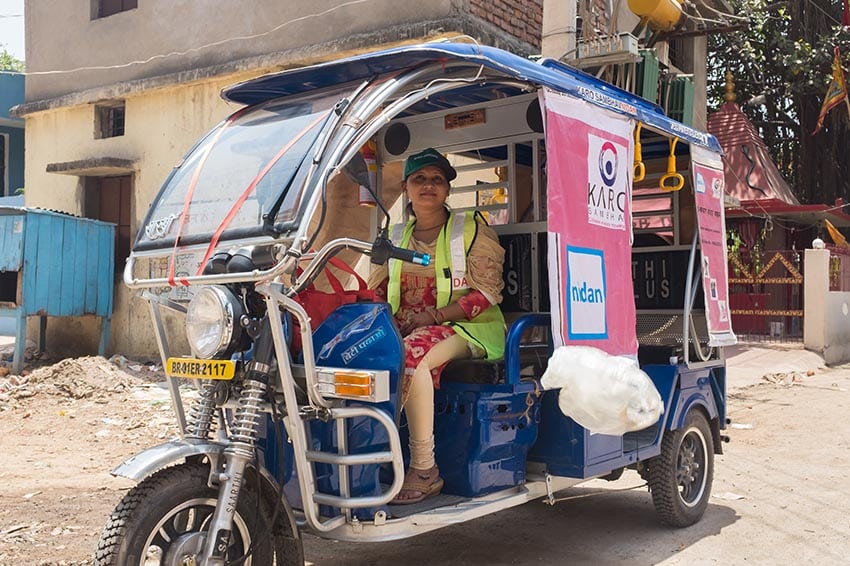
An Indian wastepicker named Reema in her electric rickshaw, which she uses to collect e-scrap from local repair shops.

An Indian wastepicker named Reema in her electric rickshaw, which she uses to collect e-scrap from local repair shops.

Policymakers across the globe recognize the need to engage informal workers in collecting, aggregating and dismantling electronics, given their significant role in managing most of the e-scrap in emerging economies.

But finding ways to effectively bring the informal sector into a government- or producer-backed collection and recycling system is an enormously complex challenge.

In India, for example, the past decade has seen several multilaterally funded pilot initiatives that tried to connect informal collectors to formal dismantlers and recyclers to divert material away from unsafe informal processing.

But few were successful. In general, the projects found that informal processors could offer informal collectors and dismantlers higher prices than formal recyclers could. In addition, material that does go to the formal sector is often first cherry-picked for high-value components, and subsidies to formal recyclers, as part of pilot initiatives, proved unsustainable.

However, there are recent examples that point to possibilities when it comes to effectively engaging India’s informal actors. And one of the most encouraging comes from a group called Karo Sambhav.

Building trust with low-level aggregators

Karo Sambhav is an Indian producer responsibility organization (PRO), a third-party entity that manages collection and recycling contracting on behalf of product manufacturers that must comply with rules set out in India’s burgeoning extended producer responsibility e-scrap system.

Driven to bolster system efficiency and reduce negative social and environmental impacts from scrap processing, Karo Sambhav began experimenting with ways to engage informal workers by targeting lower level aggregators. The group provided these individuals with new skills, trustworthy financial transactions and access to a digital economy by assisting them with setting up bank accounts and tax identification.

Most transactions in the informal “gray” market are cash-based. Karo Sambhav’s representatives first engaged with informal workers to build trust and create inroads with aggregator networks. Since several of Karo’s field staff have a background in social work, community organizing, or international development, they leveraged their expertise to build relationships.

Vikash Rajput, who leads outreach to aggregators on behalf of Karo Sambhav in the Delhi markets, holds a meeting in May of this year with informal aggregators in Mustafabad.

Once Karo Sambhav staff were able to convince them to make smaller trades, they could eventually convince them to transition to digital payments after helping workers establish bank accounts and register their tax information. Some workers began to prefer digital payments once they saw money deposited immediately into their bank accounts, thus alleviating stress over the security risks when carrying large sums of cash. Karo Sambhav provided legitimate business opportunities to waste aggregators by connecting them to formal e-waste take-back channels. In this way, Karo Sambhav helped formalize these aggregators and dismantlers (depending on how one defines “formal”).

Once smaller aggregators began to work more exclusively with Karo Sambhav, staff helped them with business development and public presentation skills. In some cases, these realities increased personal confidence that aggregators applied to other areas of their lives.

Intricacies of e-scrap markets

The Karo Sambhav case study illuminated other important points that should be considered by stakeholders looking to engage informal e-scrap processors elsewhere. One of the most important points is that groups will want to fully understand local material markets and trading patterns before attempting to effect change.

In India, several non-governmental organizations (NGOs) have extensive experience working with waste pickers, providing them, for instance, with organizing platforms to advocate for formal pay and a more structured work environment. Such NGOs have mostly worked in municipal solid waste (focusing on organics, paper and plastics) or worked in other capacity-building efforts for informal workers in other sectors and services.

But Karo Sambhav, in partnering with these groups, discovered many lack awareness of the intricacies of the e-scrap market. It took time for groups to grasp the nuances in pricing, such as which electronic scrap material commands higher prices.

NGOs also had to learn how to develop new relationships with aggregators that already operate successfully with an established clientele.

However, for some, their businesses grew once they learned to navigate the market. For instance a woman named Reema, an informal collector in Patna, who first joined a local waste picker collective in 2007, grew her skills quickly in learning how to negotiate e-waste prices from local repair shops. She is the first women in her community to operate an electric rickshaw and spends her day driving throughout Patna collecting e-waste in her vehicle. With more skills, she is also able to earn more, and, she says with a smile, “is more confident.”

In the end, Karo Sambhav’s efforts made clear that the key to bringing informal players into the fold of a formal framework is meeting those individuals on their terms and working slowly to show them the practical benefits of any procedural shift.

Verena Radulovic is an independent writer and photographer who has been working on an exploration of electronics reuse and recycling in different countries. Look for a feature article from her in the Fall 2018 edition of E-Scrap News in which she outlines the key steps to implementing formal e-scrap frameworks in emerging economies. Radulovic can be contacted at [email protected].


Tags: Asia
TweetShare
Verena Radulovic

Verena Radulovic

Related Posts

Borealis, Borouge aim to bolster PE, PP recycling in Indonesia

byPaul Lane
February 27, 2026

Plastics recycling in the Southeast Asian nation focuses on PET and on industrial and commercial waste, while post‑consumer polyolefin packaging...

Sony heads renewable plastic supply chain

Sony heads renewable plastic supply chain

byScott Snowden
February 19, 2026

Sony and 13 partners formed a unique global supply chain to make circular plastics for Sony high-performance audiovisual products using...

Member states select new chair for global plastics treaty

Member states select new chair for global plastics treaty

byAntoinette Smith
February 10, 2026

During a short session, the Intergovernmental Negotiating Committee elected Chilean diplomat Julio Cordano to continue efforts toward an internationally binding...

Malaysia clamps down on illegal e-waste imports amid probes

Malaysia clamps down on illegal e-waste imports amid probes

byDavid Daoud
February 6, 2026

Malaysia’s growing role as a hub for global e‑scrap is colliding with corruption probes, large container seizures and regional backlash. ...

Equity firm invests in Indian chemical recycling platform

Equity firm invests in Indian chemical recycling platform

byAntoinette Smith
January 21, 2026

Indian recycling technology firm PolyCycl secured Series A investment from Zerodha’s Rainmatter to scale solvent-based polyolefin recycling technology and expand...

APR alliance aligns global packaging design guidance

APR alliance aligns global packaging design guidance

byAntoinette Smith
October 23, 2025

The Association of Plastic Recyclers (APR) has published its design guide in both Mandarin and Spanish, to help reinforce ongoing...

Load More
Next Post
gavel on computer

Former Intercon CEO admits to federal crimes

More Posts

Chinese processing group details goals for US visit

AMP lays out vision of next-generation, AI-driven MRFs

July 24, 2024

Rising containerboard demand comes as OCC prices taper

November 5, 2024
Northeast recycled commodity values hit 5-year lows

Northeast recycled commodity values hit 5-year lows

March 6, 2026

Mint, HP close loop on recycled copper

March 3, 2026
Emerging US EPR programs spark harmonization talks

Washington designates CAA to lead EPR implementation

March 4, 2026

Diversion Dynamics: Secondhand exports slow down fast fashion

March 5, 2026

Paper giants foresee continuing rise in OCC prices

August 28, 2023
EPR rules take shape in Oregon, as first test

Oregon passes battery EPR Law, banning lithium-ion disposal

March 6, 2026
RecycleDat! collects nearly 197,000 cans at Mardi Gras

RecycleDat! collects nearly 197,000 cans at Mardi Gras

March 9, 2026
Fireside Chat at PRC features CAA chief

Fireside Chat at PRC features CAA chief

March 4, 2026
Load More

About & Publications

About Us

Staff

Archive

Magazine

Work With Us

Advertise
Jobs
Contact
Terms and Privacy

Newsletter

Get the latest recycling news and analysis delivered to your inbox every week. Stay ahead on industry trends, policy updates, and insights from programs, processors, and innovators.

Subscribe

Welcome Back!

Login to your account below

Forgotten Password?

Retrieve your password

Please enter your username or email address to reset your password.

Log In

Add New Playlist

No Result
View All Result
  • The Latest
  • Analysis
  • Recycling
  • E-Scrap
  • Plastics
  • Policy Now
  • Conferences
    • E-Scrap Conference
    • Plastics Recycling Conference
    • Resource Recycling Conference
    • Textiles Recovery Summit
  • Magazine
  • About Us
  • Advertise
  • Archive
  • Jobs
  • Staff
Subscribe
This website uses cookies. By continuing to use this website you are giving consent to cookies being used. Visit our Privacy and Cookie Policy.