



This story originally appeared in the November 2016 issue of Resource Recycling.
Subscribe today for access to all print content.
The 2016 Resource Recycling Conference in New Orleans this summer started with a jolt of industry energy.
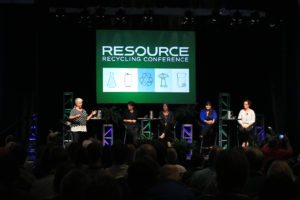
Five well-spoken representatives from groups and companies pushing forward recycling today took the stage for a session called “Curbside Enthusiasm.” The aim was to counteract the recent doom and gloom surrounding recycling as commodity prices have fallen and contamination issues have grown. The speakers focused on a range of possibilities for industry growth, and the theme that emerged was clear: All segments of the industry hold some responsibility for evolution, but all segments are also dependant on others.
Moderated by Nina Goodrich of sustainability nonprofit group GreenBlue, the session featured Stephanie Baker of plastics reclaimer KW Plastics, Elisabeth Comere from carton manufacturer Tetra Pak, The Recycling Partnership’s Keefe Harrison, and Julie Zaniewski from consumer goods giant Unilever.
The conversation laid out below is a condensed and edited version of the Q&A held at the end of the “Curbside Enthusiasm” session. In it, these industry decision-makers opened up about the ways their individual companies and groups are committed to pushing forward recycling in meaningful ways over the long term.
Nina Goodrich: My group recently put out a report on recycling access, and it found that recycling isn’t necessarily as easy and convenient for Americans as we might like. How do we build access but also sync up that growth with what we’re collecting and with what industry is processing?
Keefe Harrison: Why do we talk so much about access? Well, the Federal Trade Commission looks at access to determine whether something is recyclable or not. So if a company wants to label its product as recyclable, it needs to show 60 percent of the U.S. population can put that package into a recycling bin. So we’re looking at the whole system. It’s not just “Is there a bin to put it into?” but also “Is there a system to accept it?” How do grow either one? It’s chicken and egg.
Julie Zaniewski: Access is critical to a brand owner. If we don’t hit that 60 percent mark and I can’t put it on my packaging, then that material is probably not going in the bin. There’s also the issue of communication with the communities. I think the GreenBlue access report pointed out a lot of differences in terms of what’s communicated to the residents. Linking all of that is very critical to building sheer volume.
Elisabeth Comere: For Tetra Pak, access relates to what we do with end markets and how we find what to do with cartons locally. The access piece I see first as an end market piece and a recycling technology piece. What’s our role as a company? Do we want to provide financial support to potentially grow end markets? Because you need that to be able to create an incentive for communities and companies to collect material.
Stephanie Baker: For far too long I think we have thought about recycling as a goodwill effort or a social subject. It’s treated like a charity in a lot of communities. But recycling is a business. At KW, we are referred to as a recycler, but we are really a resin supplier. We depend on our MRFs and other vendors to supply us, and they in turn depend on their communities to supply them. So if we all see the value we have in the supply chain and take on one another’s challenges and opportunities, that’s where we see the supply chain really improving.
Nina Goodrich: What about the issue of contamination? Dirty material hurts everyone in that supply chain. Who should be responsible for addressing it?
Stephanie Baker: I don’t think we can expect consumers to solve contamination for us. We should communicate with them, and it should be convenient communication and be targeted. But we can’t change the message. In an industry when we’re trying to add more things to the bin, I can’t imagine the frustrations of some of you that are coordinators and, for example, for 15 years you’ve been telling residents to take the caps off plastic bottles. And then all of a sudden, you sit in on a webinar and we’re screaming at you, “Leave caps on!” And you have to go and tell that to community members
Keefe Harrison: Recycling will continue to change. That caps on message – there will be more of those to come. That’s because the packaging landscape changes and as recyclers see opportunities to make something from piles of materials, they’ll change too. From our point of view, that’s nimble and active and alive. For a local program point of view, that’s annoying. That’s why groups like ours exist. To help bridge the gap. We can do a better job of that when recycling program coordinators tell us what’s bothering you and confusing or if you need a “prove it.” Maybe you’re saying, “Caps on? I don’t believe it. Prove it.” OK, we’ll help you and we’ll get to the bottom of whether it’s right or wrong.
Julie Zaniewski: Across the evolution of communication, it’s generational as well. I can tell you my kids can tell you a lot more about what can go in bin than I can. That’s something we need to keep ahold of – aiming for that younger generation because it wasn’t in the curriculum when I was in school but it’s definitely in the curriculum now.
Nina Goodrich: Let’s talk about measurement. Communities are saying, “How can we continue to increase access and offer services under budget constraints?” And now we’re seeing more work looking at carbon mitigation potential and questioning whether we’re keeping overall environmental impact top of mind. Have we been limiting ourselves by just using the weight measure?
Elisabeth Comere: Clearly, it’s time to start bringing that life-cycle approach into the picture and to look at other indicators and parameters. But to me, recycling should remain a measurement. We should not lose that. We should continue to aim at designing and putting on the market materials that are recyclable – and to make sure that they feed that next manufacturing process.
Keefe Harrison: I attend a lot of corporate meetings with companies trying to engage with recycling. I inevitably get asked about the fact the national recycling rate has plateaued – that must mean consumer apathy has taken over, right? I say that actually it means the packaging mix has changed. We don’t have as much paper. More products are coming in things like cartons that are lighter in weight. What the plateaued rate tells us is that if you measure in tons, you don’t get an answer. It doesn’t get to a bigger picture of environmental impact.
Stephanie Baker: For years, we’ve seen waste studies being completed to help with measurement. But something interesting about waste studies is when you start assigning values within them. If you want to get your elected officials’ eyes to bulge out, you say, “We threw away this many hundreds of tons this year” and then you have dollar signs associated with that. That method in our experience has driven a lot of additional interest and investment.
Nina Goodrich: Will our current voluntary recycling system ever achieve the volume of scale necessary for a circular economy?
Elisabeth Comere: For me, what is core here is the discussion about funding. I think the Recycling Partnership is one of the great examples of how you leverage private dollars to unlock public investments. But we need so much more than that. We are in a country where there is no level playing field, no national legislation to drive a lot of these things we’re talking about – collection and recycling. The pressure in on industry to solve that.
Julie Zaniewski: The thing that comes to mind is really trying to look at new business models – that’s something we try to focus on within Unilever. It needs to evolve along with industry to move to that circular economy. Included in that is the development of new technologies, whether it be recycling technologies, sortation technologies or something else. Those innovations are a pure enabler to the next level and can really make a transformative change in the long term.
 Stephanie Baker: There’s a lot of room for entrepreneurship in this industry, and I do support voluntary recycling efforts. I never want to be told what to do. Those of you under stringent requirements understand that. But I think you have to have incentives in place. I think if we have the right incentives, which at end of day boils down value and economics, that is what is going to continue to grow this industry, and it’s going to drive continued change.
Keefe Harrison: So there’s a lot of work to define what the future is, but it’s not the future now – it’s today. There’s a lot of work that could be done right now to make our system better so we get the environmental and economic returns we expect from it. So while good work is happening to define the future, we have to do more right now. That’s what we do, and we want to do it with you because it takes a team to deliver tons.