




Live from E-Scrap: The Longevity Conference in New Orleans, Uriah Kiser talks with GiGi Gebhardt of Harris American, the recycling-equipment manufacturer whose roots go back to 1889. GiGi explains how International Baler, American and Harris came together as Harris American, and how the post-World War II generation started building balers to handle manufacturing waste.
She talks about what customers want now — smarter, safer machines and better operational reporting — why transportation is recycling’s biggest cost, and why a regional hub-and-spoke approach matters.
Like, comment, subscribe, and turn on notifications so you don’t miss the next conversation on the Resource Recycling Podcast.
Transcript of episode 10: The Resource Recycling Podcast
Host: Uriah Kiser, Resource Recycling | Guest: GiGi Gebhardt, Harris American
Uriah: Hey everyone, welcome back to the Resource Recycling Podcast. I’m Uriah Kiser. There’s been a lot of talk today about recycling: skipping the bin and turning your batteries in, making sure you reduce and reuse, all the things we’ve been talking about since I was a kid, and I’m an older guy. But your company, Harris American, goes way back, to before anyone was thinking about recycling, before it became a thing. Gigi Gebhardt is on our podcast, with Harris American. Thank you for coming on the Resource Recycling Podcast.
Gigi: Thank you, Uriah. I really appreciate that. Harris has a great, deeply rooted foundation in American recycling as a manufacturer. Harris was started in 1889 producing farm equipment, and after the Second World War it transitioned to other types of machines and baling. Our line combines three companies, International Baler, American and Harris, to make Harris American.
In ‘45 and ‘46, IBC and American started producing balers to handle the waste streams coming out of manufacturing facilities. We had a very conscientious generation that came back from the war. These guys grew up in the Depression. They didn’t waste things, so they looked for solutions when they came back. All the manufacturing had been turned to producing and winning that war for us. And here we are today, in the shadow of the World War II museum. You definitely have to see that if you’re in New Orleans.
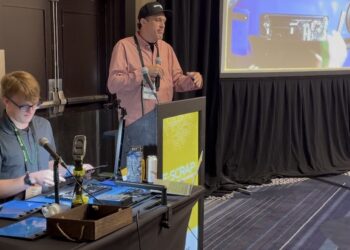
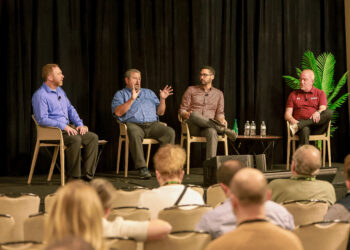
Uriah: Absolutely, here in New Orleans. By the way, I forgot to mention, we are at E-Scrap at the Hyatt Regency in New Orleans. A great annual conference, and that’s where I get to meet you for the first time.
It’s interesting you say that, because so many who fought in World War II got to get out of their hometowns and do things on equipment they had never done before. We were talking the other day about how, for some of them, it was almost like being in a science fiction movie. One day they’re on the farm, and the next they could be up in the sky. So when they got back, I guess they may have felt an attachment to the things they used, and as you said, didn’t want to see them go to waste.
Gigi: Exactly. One of the great things about being an American manufacturer with almost 300 years of combined manufacturing in our country is that we’re big. We’re not as nimble, but we really listen to the applications needed. In the recycling space, those applications range from very small retail users through paper producers, shredders, plastic scrap and metal recycling. We have a way to accommodate all of those needs across the board, in four locations across the country. We’re application-driven. It has to be responsive to the application, because if recycling can’t be done profitably, it’s not going to be done.
Uriah: Because you have people who want to do it and want to profit from it. It is an industry. And then you have to give people reasons to want to do the sustainable thing. It has to be a cycle. Over the past 10 or 15 years, what has changed in the equipment you make and sell, and in the habits of your customers? What are they asking for today that they maybe weren’t asking for 15 or 20 years ago?
Gigi: I think the big thing today is operational awareness. We’re making smarter machines. The labor force is a challenge in our industry. You want it to be smart, and it has to be safe. People need to go home after every shift. Nobody wants to be responsible for an unsafe machine. So over 10 years, we’ve seen a modernization of reporting, of applications and of how you communicate with the machine, and it’s making things safer.
But I will tell you, right over in Georgia, one of the first metal presses was put into service in 1957, and it’s still recycling metal.
Uriah: Oh, wow.
Gigi: Longevity. Harris is built for it, for a long time.
Uriah: That was my next question. Of course, you built it, so there you go. That’s an amazing thing to be able to do.
Gigi: Build them right the first time and let them go the distance. Then respond with the upgrades that are needed, giving operations and facilities the reports they need to prove they’re being efficient, or to be smart about electrical draw. Manufacturers face a lot of things, and recycling is no different: inputs and outputs. At the end of the day, recyclers are manufacturers. We’re just using waste as a raw material and putting it back out there for use.
Uriah: I assume you have customers across the country, and potentially across the globe. Do different countries and different states want different things? Do they handle recycling in different ways? Do some not handle it at all, and you’re trying to reach them? You said people are talking more and being more aware. What’s that conversation like?
Gigi: At the regional and municipal level, you have rural recycling challenges, and you’re always going to have them, because accessibility is key and getting the bin to the consumer is a challenge. At the industrial level, more and more ordinances are requesting or requiring recycling in certain cities and urban areas. So the response is going to have to be regional, which is smaller than the state, because transportation is our largest cost.
People don’t understand that I have to send a truck. My baler goes on a truck. Your material goes to the foundry on a truck. Transportation is everything. A hub-and-spoke system to manage recyclables, both post-consumer and post-industrial, is probably one of the strongest things you can offer. It’s hard to get true recycling numbers. Input and output aren’t the same.
So we do our best to communicate at the community level, and also with manufacturers and business owners about what they’re doing and how. E-Scrap is a great sounding board for addressing the digital divide. We have an entire generation, ages 15 to 25, who may not even have a laptop or computer. We met organizations here that take recycled laptops, clean them up and distribute them in the community to help bridge that. Recycling has a hand in everything we do, however we grow as a community. And what we can offer as industry representatives and advocates is an ear, and an opportunity to use our influence to do what’s right.
Uriah: So many people I’ve met at this conference tell me they fell into this industry. They were doing something else, and then they landed here. But you have a very personal story about how you got into sustainability, and you go way back. I’ll let you share it.
Gigi: I stayed home raising children for a while, which was very intentional, and I was an organic gardener. That’s very important to me. When I returned to the workforce, what I was going to do mattered to me. I have a personal mission, and mine is to increase recycling in the state of Texas. I’ve served on the State of Texas Alliance for Recycling (STAR) board, working on improving processes. And I’m in a part of the industry I think is kind of cool. I love the equipment. I love the machinery, and helping it get where it needs to be so recyclable material finds an end market.
Then I stepped in and became involved on the legislative side, both in Texas and nationally. Educating our legislators and helping them understand that recycling goes beyond the blue bin is so important. It’s a manufacturing staple in our country, with the jobs and resources tied to it. I’m very passionate about it, but I chose it. And it’s easy to get excited about something you know makes a difference.
Uriah: Okay, let’s put you on the spot and leave all your neighbors out of it. What’s the best city in Texas? What’s your favorite spot?
Gigi: Fort Worth.
Uriah: There it is. I give you Fort Worth. Great town. Gigi, this has been a lot of fun. Thank you for coming on the Resource Recycling Podcast, and for everything you’re doing in Texas and for the industry.
Gigi: Thank you very much. I appreciate the opportunity and the platform, and anything we can do to serve each other. If you’re not in service to each other, what are you really doing?
Uriah: That’s right. And thank you for watching and listening to this episode of the Resource Recycling Podcast, wherever you get your podcasts. If you want more conversations like this, like the video, share it, and hit that bell notification and subscribe button so you know when we’re talking about sustainability, ITAD and circularity, right here from E-Scrap: The Longevity Conference in New Orleans. I’m Uriah Kiser, and we’ll see you on the next Resource Recycling Podcast.