This article appeared in the August 2021 issue of Resource Recycling. Subscribe today for access to all print content.
More and more companies and communities are taking steps to move away from the “take-make-waste” linear model of consumption to a circular economy loop. While it’s an important transition for the environment, it will also have an impact on supply chains.
As more products are diverted from landfills and move from producer to consumer to recycler and back again, more recycled products (or waste products headed for recycling) will need to be transported along every step of the circular economy. For instance, global demand for recycled plastic resin is projected to reach 77 million metric tons by 2030. That alone translates to the equivalent of 902,900 rail cars or 3.6 million trucks.
Why does that matter? The transportation mode companies and communities use to move waste and recycled products can be the difference between increasing or lowering their total carbon footprint.
Critical decision
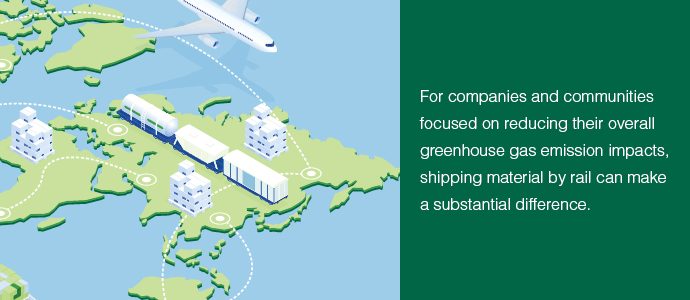
Transportation plays a key role in the circular economy, and the choices producers and consumers of recycled products make about transportation are paramount. Shipping by train, rather than truck, reduces the carbon footprint associated with shipping the products that cycle through circular economies.
The reason is that on average, railroads are three to four times more fuel efficient than trucks on a ton-mile basis. Railroads can move 1 ton of freight more than 480 miles on a single gallon of fuel, generating a carbon footprint up to 75% less than that of trucks, according to analysis from the Association of American Railroads.
Shipping recyclables by rail presents a sizable opportunity to reduce greenhouse gas emissions. Union Pacific Railroad’s Carbon Emission Estimator reveals just how significant the difference can be. For simplicity’s sake, let’s say the 77 million metric tons of recycled plastics resin projected for 2030 shipped by rail instead of truck from Dallas to Los Angeles. Choosing rail over truck would reduce the carbon footprint of shipping by 5,657,610 metric tons.
This reduction in the carbon footprint would be equivalent to:
- The carbon removed by 1,205,071 acres of U.S. forests.
- The carbon removed by 144,834,816 tree seedlings grown for 10 years.
- Greenhouse gas emissions avoided by recycling 1,968,848 tons of waste instead of sending it to the landfill.
Virtually all types of recyclables can ship by rail, and rail shippers can move residential waste, industrial waste, materials ready to be recycled into new products and finished products made from recyclables.
Union Pacific, for instance, has experience shipping all of the following items: recycled plastics, bottle caps, cullet, used oil, scrap metal, scrap paper, used carpet and more. Rail can also be used to ship hazardous waste to incineration plants, where it is then recycled as a fuel source for incinerators.
“Union Pacific has been shipping recycled scrap paper from recycling facilities and box plants to paper mills located on their network for over a decade,” said Jacque Bendon, vice president-Industrial at Union Pacific Railroad. “The company regularly works with mills that only accept recyclable materials to produce 100% recycled content packaging, but shippers of all kinds can take advantage of the existing infrastructure to begin realizing the benefits of rail transportation in their supply chains.”
Of course, even in the circular economy, some waste will still be generated. That can ship by rail, too, regardless of whether it’s municipal solid waste or hazardous waste. In fact, as communities run out of space in their landfills, rail allows them to ship farther distances to partner sites in an economical and environmentally responsible way.
Cost, simplified logistics and safety
It’s also important to note that shipping by rail offers benefits beyond sustainability.
“On average, rail offers a lower cost per ton mile than truck, and that’s important because cost is currently a major issue for over-the-road shipments,” said Bendon. “According to DAT Freight & Analytics, spot market truck rates have risen 48% since last year, and truck rates are projected to increase by 30% year-over-year in 2021 – a trend that is likely to continue.”
Rail can also lower logistics costs. One rail car can carry the same amount of cargo as 3 to 4 trucks, reducing logistics management and administrative costs.
Rail is a safer option as well. According to the National Highway Traffic Safety Administration, in 2018 a total of 4,862 large-truck vehicles were involved in fatal crashes in the United States. Railroad fatalities, on the other hand, totaled 806 in that same year, making trucks more than six times more likely to be involved in a fatal crash.
When products are shipped by rail instead of truck, it reduces the number of trucks on the nation’s highways, which in turn reduces the impact to public safety.
Logistics of connecting with rail
If you’re interested in connecting with rail service, you have options.
If you want to establish a rail connection at an existing facility, completing the AccessUP questionnaire is the first step to get started.
For companies and communities building new facilities to serve the circular economy, Union Pacific offers the Site Solutions Tool, which allows users to search from nearly 500 locations that offer rail service.
Another option for new construction is building at a Union Pacific Focus Site. These are shovel-ready sites that are already located on the Union Pacific rail network. This is the best option for a quick solution. As new facilities come online to serve the circular economy, it’s important for shippers of recycled materials to consider rail from the beginning.
Alternatively, if your facility has tracks but they aren’t currently in use, contact the connecting rail carrier to see if the connection is active and in good working condition. If it is, the rail carrier will help you get a track agreement in place, which will allow your facility to get rail service. If it’s not, the rail carrier can help with the process to bring the track back into service.
You can use a Union Pacific tool called the Serving Carrier Reciprocal Switch (SCRS) to identify the carrier.
Finally, if you don’t have tracks at your facility, you have two options to gain access to rail.
Using a concept called transloading, recycled materials can be transferred seamlessly between trucks and trains so you can receive the long-haul benefits of rail and transload close to your origin or destination. “Union Pacific has relationships with transload facilities across North America, allowing our customers to gain access to our rail network without the capital investment in tracks,” said Bendon.
Alternatively, intermodal shipping refers to moving freight by two or more modes of transportation (e.g., truck and train). Where the transloading process involves unloading freight out of a truck trailer and into a rail car or vice versa, with intermodal, products stay in the same container for the entire haul, and the container is moved between trucks, trains and/or cargo ships.
Union Pacific’s logistics subsidiary, Loup, offers an interactive “Find a Transload Facility” map that serves as a good starting place to see some of the transload locations available throughout North America.
This is available in the Resources section at louplogistics.com.
The missing piece
Instead of shipping truck after truck, which increases carbon emissions, raises costs and complicates logistics, converting shipments from truck to train helps companies reduce their carbon footprint while also lowering costs and simplifying the supply chain. “Adopting rail sooner than later will help shippers and receivers of all types be prepared for the surge in recycled products to come,” Bendon said.
As more recycled products move through the circular economy, rail offers the biggest sustainability return from a supply chain standpoint. Fortunately, plastics producers already know the benefits of rail, and their plants are already set up to ship the vast majority of their resin by train. It stands to reason that the rest of the supply chain will follow suit in order to handle the magnitude of products being shipped.
Shelley Ernst is the editor in chief of Track Record, Union Pacific’s online magazine for transportation and logistics professionals. If you have questions about shipping by rail, email recycling@up.com or call 402-660-9561. For additional transportation and logistics tips and insights, subscribe to Track Record.