
Resource Recycling
  • The Latest
  • Analysis
    • All
    • Certification Scorecard
    • Industry Announcements
    • Opinion
    From claims to custody: PCR procurement grows up

    Certification scorecard — week of September 7

    iFixit launches 2-week circuit board training course

    Printed circuit board (PCB) recycling explained

    Sims: Parts reuse helped offset 2020 cloud challenges

    ITAD providers should choose their data-center niche

    Dell expects PC refresh to extend into next year

    Dell, HP show enterprise PC spending separating from unit volume

    Update of e-Stewards to be released for comment

    Certification scorecard for the week of Aug. 31

    HP receives ocean plastics certification

    How HP’s strategy shift affects ITAD

  • Conferences
    • Resource Recycling Conference
    • Plastics Recycling Conference
    • E-Scrap: The Longevity Conference
    • Textiles Recovery Summit
  • Publications
    • E-Scrap News
    • Plastics Recycling Update
    • Policy Now
    • Resource Recycling
    • Other Topics
      • All Topics
      • Brand Owners
      • Critical Minerals
      • Glass
      • Grant Watch / RFPs
      • Markets
      • Organics
      • Packaging
      • Research
      • Technology
      • Textiles
Subscribe
No Result
View All Result
Resource Recycling
  • The Latest
  • Analysis
    • All
    • Certification Scorecard
    • Industry Announcements
    • Opinion
    From claims to custody: PCR procurement grows up

    Certification scorecard — week of September 7

    iFixit launches 2-week circuit board training course

    Printed circuit board (PCB) recycling explained

    Sims: Parts reuse helped offset 2020 cloud challenges

    ITAD providers should choose their data-center niche

    Dell expects PC refresh to extend into next year

    Dell, HP show enterprise PC spending separating from unit volume

    Update of e-Stewards to be released for comment

    Certification scorecard for the week of Aug. 31

    HP receives ocean plastics certification

    How HP’s strategy shift affects ITAD

  • Conferences
    • Resource Recycling Conference
    • Plastics Recycling Conference
    • E-Scrap: The Longevity Conference
    • Textiles Recovery Summit
  • Publications
    • E-Scrap News
    • Plastics Recycling Update
    • Policy Now
    • Resource Recycling
    • Other Topics
      • All Topics
      • Brand Owners
      • Critical Minerals
      • Glass
      • Grant Watch / RFPs
      • Markets
      • Organics
      • Packaging
      • Research
      • Technology
      • Textiles
Subscribe
No Result
View All Result
Resource Recycling
No Result
View All Result
Home Policy Now

PFAS, EPR reshape waste and recycling policy

Stefanie ValenticbyStefanie Valentic
August 19, 2026
in Policy Now, Recycling
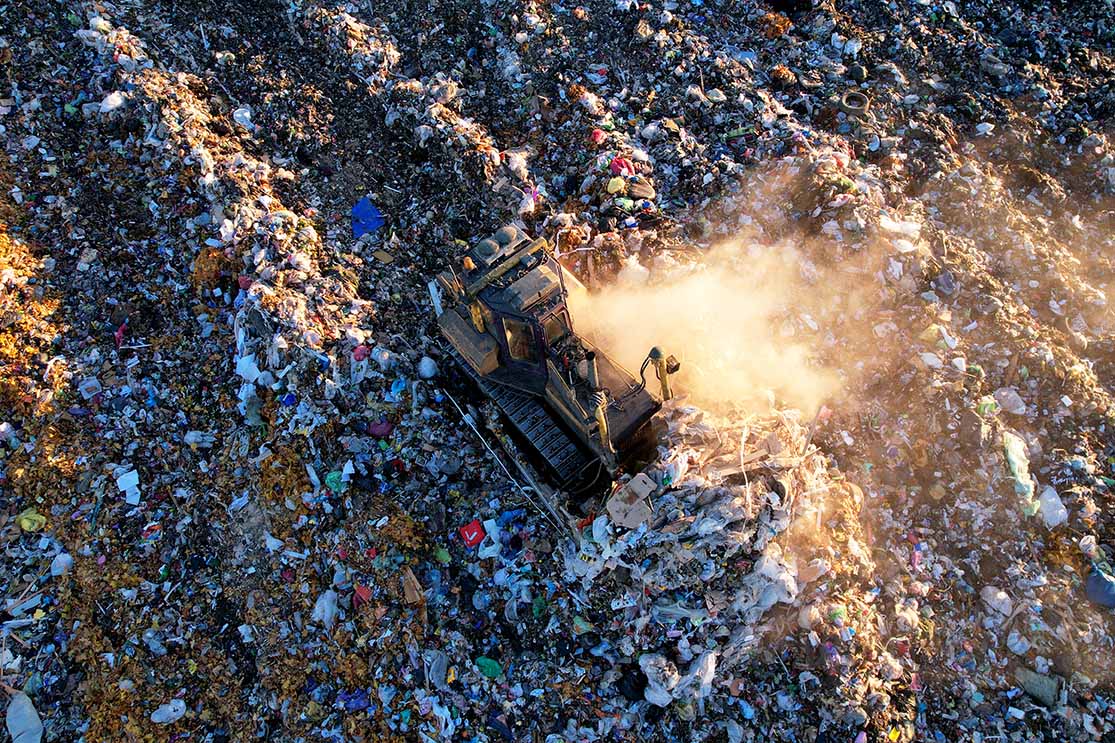
Landfill seen from above with equipment moving materials.

Maksim Safaniuk/Shutterstock

A federal deregulatory pullback is colliding with a patchwork of state environmental rules, and litigation is now doing the work that agencies won’t, according to David Biderman, founder of Biderman Consulting and former executive director of SWANA and vice president of government affairs at the National Waste & Recycling Association (NWRA).

Biderman said EPA has scaled back enforcement, thinned staffing at the Justice Department’s environmental section and pulled back funding relative to prior years, while western states  and parts of the Midwest and Northeast push forward on packaging EPR, organics diversion and PFAS restrictions.

“We have the federal government in active retreat from regulating environmental protection, and we have states, not all 50 states, but many states, moving forward with more pro-environment, progressive activities,” Biderman said during a regulatory trend session at the inaugural WR Expo in Fort Lauderdale, Florida.

PFAS liability under Superfund legislation remains the industry’s biggest legal exposure, Biderman said.

EPA’s 2024 rule designating PFOA and PFOS as hazardous substances under the Comprehensive Environmental Response, Compensation, and Liability Act (CERCLA) did not include an exemption for landfills as “passive receivers” of the chemicals, which landfill operators neither manufacture nor sell.

“Do landfills make the product that has PFAS in it? No. Do they sell the product that has PFAS in it? No. That’s Walmart and Target and everybody else,” Biderman said. “Those are the folks who the waste industry believes should be liable for PFAS liability under Superfund, not landfills and other waste companies.”

NWRA and other groups sued EPA over the rule. The agency has since said it won’t pursue government-owned landfills for PFAS liability, but that carve-out doesn’t cover private companies or block private lawsuits, he noted. 

On Aug. 18, 2026, the US Court of Appeals for the DC Circuit ruled on the case, upholding EPA’s designation of PFOA and PFOS as hazardous substances under CERCLA and rejecting the industry’s challenges.

A broader congressional exemption is unlikely this session and would have to restart with the next Congress in 2027, Biderman said.

On drinking water, the Trump administration has pushed compliance deadlines for utilities under the Biden-era PFAS rule out to 2031 and dropped four of the nine regulated compounds, Biderman said.

He also noted a proposal to eliminate Subpart HH of EPA’s greenhouse gas reporting program, which covers landfill methane data.

Packaging EPR laws are now on the books in seven states: three on the West Coast, including Oregon’s Recycling Modernization Act (SB 582) plus Colorado, Minnesota, Maryland and Maine.

New York has failed to pass EPR legislation in five legislative sessions, most recently the Packaging Reduction and Recycling Infrastructure Act (S1464), despite what Biderman described as strong disposal-capacity and political rationale for the state to act.

“New York is a logical state for having EPR, both for political and disposal capacity reasons, but they haven’t been able to get it over the finish line,” Biderman said, adding that Massachusetts and, more recently, Tennessee have weighed packaging bills.

Legal challenges are now shaping how, or whether, those programs move forward. Biderman pointed to the Oregon EPR trial testing due process, First Amendment and dormant commerce clause arguments against the state’s EPR law, brought in part by the National Association of Wholesaler-Distributors (NAW).

“I’m not a betting man, but I am pretty sure a ruling is going to come out before Labor Day,” he said, noting that the outcome is being watched by other states defending similar programs, including a parallel Colorado case and newer California litigation.

A former lawyer, Biderman stressed how much courts now control the pace of policy.

“The lawyers are driving the train right now,” he said.

Biderman also flagged several other state-level trends such as organics diversion mandates modeled on California’s SB 1383 and expanding bottle bill deposits. Connecticut doubled its deposit to a dime and added water containers to its program.

He also pointed to recycled-content mandates, single-use plastic and foam bans, and early-stage right-to-repair activity following a congressional hearing last month.

Chemical recycling remains contested, he said. Chemical companies are seeking exemptions from Clean Air Act rules that would otherwise treat some facilities as incinerators. However, financial struggles at several such facilities over the past 18 months have eased some of that pressure in Washington, he added.

His takeaway for waste and recycling companies: plan for a state-by-state compliance patchwork rather than a uniform federal standard, and track pending litigation closely, since court rulings, not agency rulemaking, are likely to determine the scope of PFAS liability and the durability of state EPR programs for the foreseeable future.


Tags: EPRLegislation & EnforcementPolicy Now
TweetShare
Stefanie Valentic

Stefanie Valentic

Stefanie Valentic is an award-winning journalist who has covered the waste and recycling industry for more than five years. Throughout her career, she has led editorial teams and served as a keynote speaker, moderator and panelist at numerous trade shows and conferences.

Related Posts

Lawsuits hover days after SB 54 approval

Preparing for SB 54 design compliance

byAntoinette Smith
September 8, 2026

A recent webinar explored the upcoming implementation of California's packaging EPR bill, which embeds the APR Design Guide in its...

State slaps aluminum recycling company with fine

Electronics EPR proposal nixed in Oregon

byPaul Lane
September 4, 2026

State leadership asked MRM to offer more specifics before it will be named Oregon’s PRO in 2027.

SB 54 Unpacked: Can film catch up to cartons?

byStefanie Valentic
September 4, 2026

Flexible film, generating 550,000 tons/year of waste, has end markets for only about 10% of it, panelists said at a...

Study explores cleanliness of food packaging in bins

SB 54 Unpacked: REMs, reimbursements remain moving targets

byStefanie Valentic
September 3, 2026

California's list of SB 54 responsible end markets won't exist until four days before the state's Jan. 1 compliance deadline,...

Analysis: CA climate rules set off ripple effect for thousands

SB 54 Unpacked: California jurisdictions face scramble to comply

byStefanie Valentic
September 2, 2026

Of California's 56 SB 54-covered packaging categories, Alameda County jurisdictions collect fewer than a third of them uniformly, and the...

Removing an eBike battery pack.

California battery EPR bill heads to Newsom’s desk

byStefanie Valentic
September 1, 2026

Editor's note: Policy for batteries and electronics is among the sessions at the 2026 E-Scrap Conference, Oct. 26-28 in New...

Load More
Next Post
The Maine state capitol in Augusta.

Circular Action Alliance won't bid on Maine's PRO contract

2026 Buyers’ Guide

Equipment, services and technology suppliers serving the recycling industry.

Browse the Guide

More Posts

Alpek closing Pennsylvania RPET plant

Alpek seizing on war-related opportunity 

July 27, 2026
Live selling presents pathway to ITAD sales

Live selling presents pathway to ITAD sales

September 3, 2026
Analysis: CA climate rules set off ripple effect for thousands

SB 54 Unpacked: California jurisdictions face scramble to comply

September 2, 2026

SB 54 Unpacked: Can film catch up to cartons?

September 4, 2026
Minnesota EPR program advances in budget bill

Oregon’s EPR law survives first constitutional test

August 28, 2026
Lawsuits hover days after SB 54 approval

Preparing for SB 54 design compliance

September 8, 2026
Bipartisan reps introduce bill on recycling claims

House subcommittee advances PACK Act

September 1, 2026
Study explores cleanliness of food packaging in bins

SB 54 Unpacked: REMs, reimbursements remain moving targets

September 3, 2026
Auto Draft

R3 Lithium launches pioneering mineral processing facility

September 4, 2026
Removing an eBike battery pack.

California battery EPR bill heads to Newsom’s desk

September 1, 2026
Load More

About & Publications

About Us

Staff

Archive

Magazine

Work With Us

Advertise
Jobs
Contact
Terms and Privacy

Newsletter

Get the latest recycling news and analysis delivered to your inbox every week. Stay ahead on industry trends, policy updates, and insights from programs, processors, and innovators.

Subscribe

Welcome Back!

Login to your account below

Forgotten Password?

Retrieve your password

Please enter your username or email address to reset your password.

Log In

Add New Playlist

No Result
View All Result
  • The Latest
  • Analysis
  • Recycling
  • E-Scrap
  • Plastics
  • Policy Now
  • Conferences
    • E-Scrap Conference
    • Plastics Recycling Conference
    • Resource Recycling Conference
    • Textiles Recovery Summit
  • Magazine
  • About Us
  • Advertise
  • Archive
  • Jobs
  • Staff
Subscribe
This website uses cookies. By continuing to use this website you are giving consent to cookies being used. Visit our Privacy and Cookie Policy.