






This article originally appeared in the Spring 2020 issue of E-Scrap News. Subscribe today for access to all print content.
Manufacturers of devices are central to the evolution of electronics recovery. These are the companies creating the products that will define the future stream for e-scrap recycling and reuse businesses.
But OEMs also play a key role in the industry by funding legislated e-scrap programs in roughly half of U.S. states and participating in a range of voluntary efforts aimed at recovering and processing devices in responsible and efficient ways.
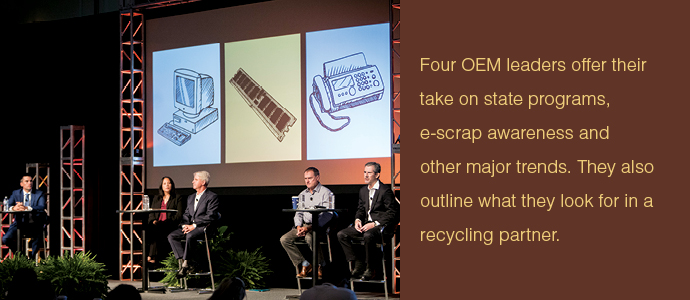
To bring the manufacturer voice deeper into the industry conversation, the opening session of the 2019 E-Scrap Conference and Trade Show brought representatives from four major OEMs to the stage for a wide-ranging discussion.
It featured Dell’s Erika Chan (director of corporate sustainability), TCL North America’s Jonathan King (vice president of corporate and legal affairs), Samsung America’s Mark Newton (head of corporate sustainability), and Sony’s Doug Smith (director of corporate environmental safety and health).
The dialogue was moderated by Kevin Dillon, co-founder of nationwide electronics processor ERI.
The following is a condensed transcript of the session. It has been edited for clarity.
Kevin Dillon: How do we best get the word out about electronics recycling opportunities, both in states with extended producer responsibility (EPR) programs and elsewhere?
Erika Chan: The biggest change we need to make is to shift the consumer mindset around relinquishing their used electronics. I know people hold onto things because they think they’ll maybe use it as a backup someday or they are concerned about the data on a device. I don’t think it’s a lack of opportunities or avenues. It’s shifting the mentality behind it.
Mark Newton: Recycling is very tactile. It’s easy to understand, and it directly impacts you. The other sustainability initiatives we have that are perhaps more important are really not ones that resonate as strongly with consumers. So we don’t really find that there’s a problem in terms of the audience caring about this issue. We find we need to do a much better job making it as easy as possible for consumers to access the recycling programs we do have. We need to make it as easy as purchasing a product and cheaper than purchasing a product.
Doug Smith: In California, anyone who buys a TV or computer sees it right there on the receipt – that they just paid a recycling fee. It also gives you information on how to access recycling in California. That’s an extremely effective communication tool.
Jonathan King: TCL has been one of the fastest growing TV brands, so we know we’re good at what we do in terms of brand awareness. We feel we can use that to our advantage to try to enhance consumer awareness of recycling, and we’re starting a number of initiatives to try to take that marketing component and use it not just to sell products but to raise awareness about the options consumers have. It is one of the largest challenges we have and it’s going to take a combination of manufacturers doing it as well as working with state agencies and recyclers and everyone coming together to broaden that message.
Does anyone foresee a national system around e-waste recycling ever taking hold?
King: A national system would be fantastic if it had the right elements. But I’m not optimistic that is going to occur.
Newton: I also don’t see that happening in the near future, and part of that is because the train has left the station. Now we’ve got 25 states with individual requirements, and preemption is a significant issue. You can’t just kind of roll in and put something on top of that and not address the existing requirements that are there in some states.
How do current EPR programs drive impact and social responsibility and sustainability initiatives at your companies? Are they topics of discussion at executive meetings or are they viewed more as just a line item?
Smith: I’ll just say that the one myth that’s completely blown up is that making manufacturers pay for recycling influences our product design. It does not. We redesign for other reasons – for the European rules about elimination of toxics in the products, of for energy efficiency. Those are the drivers. Us paying for old CRTs has no influence over the design of anything modern.
Chan: Recycling requirements are part of understanding the external landscape, but when it comes to goal-setting, it’s not exactly one specific area we highlight. I think we look at it at a broader level. We’re setting our 2030 goals currently, and we need to think about recycling more holistically and what the broader impact is across the entire value chain.
Beyond cost, what criteria do you look at to choose recycling and collection partners?
King: It’s trust. If we’re going to work with a recycler we have to feel that we can trust the recycler. I think everyone is aware of what happens when things go wrong – when people don’t follow the rules or take shortcuts. For us, it’s about finding the right partner who will do what is supposed to be done, who is certified and accredited, but who we feel we can 100% trust today and tomorrow. Cost plays a role, don’t get me wrong. But cost is secondary to trust.
Newton: For us, it is a significant amount of money – the amount of material we’re recovering is significant. But what we’re really looking for is a relationship, a collaboration partner. You all out there are experts in what you do. We’re not experts in this. So it’s really important for us to choose partners that can help co-create ideas that we need to help develop our programs.
Chan: Be as transparent as you can be. That helps reaffirm our trust in the relationship with a particular recycler. When I say transparency, I mean transparency in the downstream, with data. We partnered with Basel Action Network last year to implement an asset tracking program so we could get better transparency in our downstream. That in and of itself will go a long way in developing that trust.
Smith: Innovation comes with investment. So we are looking at vendors that are investing in new technologies and equipment. The other thing I’ll add about what we look for in a vendor is compliance help. There are numerous things to track for state programs. Vendors that have a really nice platform to manage compliance bring a big benefit for us.
What are some emerging opportunities where recycling and ITAD companies might be able to work with OEMs in a closer way?
Chan: I would encourage companies to look at whether there are specific initiatives or areas of focus where you have a shared value or benefit with an OEM. That could be a potential future investment in how we want to partner moving forward. How many of you have read Dell’s sustainability reports? There aren’t many hands going up. Look at our report, look at the things we’re investing in over the next 10 years and beyond.
Newton: We’re a global company and are based outside of the U.S. We have significant operations internationally, and we struggle to find partners that are as good as the ones that are in this room. So I would say the number one thing we could use help with is to identify partnerships to expand opportunities in some of these markets.
King: Building the awareness with the consumer is something we could work together with the recycler to do. But there are very few recyclers that are actually really good at marketing what they do. I think that’s because in electronics recycling, it’s a difficult message – it’s a complicated business. But communicating that effectively is something I think could be done a lot better.
How has the trend of data security changed your decision-making process around your entire electronics recycling supply chain? And how has it changed internally? Are there new stakeholders within your organizations that never used to care about electronics recycling but now do?
Smith: If you follow Sony, you know we’ve been hacked several times in the last decade. It’s a big issue. Internally, our hard drives are collected by the IT department and we require them to be shredded. In some cases, someone will accompany the load and stand there and watch it be shredded. So that’s for the Sony stuff. But looking at the wider recycling market, it’s worth noting e-Stewards has added a NAID certification requirement. I know most of the takeback laws say we’re not responsible for data, but by having your recyclers certified to NAID, you’re taking the nice step of securing consumers’ data for them if they don’t know how to erase it themselves.
Chan: At Dell, if you looked 10 years ago at our materiality assessment, you would find data security and privacy was on the list. But in our most recent assessment, it’s in the top three. So it’s always been an issue of importance but now we’re seeing it start to rise. And how has it changed internally? We’ve seen more engagement with internal departments. For sure, that landscape is changing.
King: I’d also add the upcoming California Consumer Privacy Act is going to have a huge impact on all of us in terms of what we do and how we handle data. It’s going to provide consumers with really some unprecedented abilities to learn what companies know about them. They will have the ability to have companies delete data upon request. And there is a component to it that will see companies punished if they don’t comply.
Newton: We know how to handle this issue in respect to the electronics recovered. We grind them up and the data’s gone, at least on the physical device. But that’s not what we ultimately want to do. We ‘d love to be able to take the value from a product at a higher level. Of course, we’re going to do everything we can to ensure the data is protected, but we’d love to continue to find ways to clean these materials before having to actually destroy them.
Another trend we hear a lot about is the circular economy. What does this term mean to your companies?
Chan: So for those of you not as familiar with circular economy, it’s basically shifting from the linear take-make-waste model to a circular approach where hopefully nothing goes to waste. Dell five years ago did the first UL-certified program around plastics, getting that material back in monitors and desktops. And then we’ve done a closed loop gold pilot and also one with rare earths, having magnets get put back into hard drives. But really I think we’re just at the beginning. I think there’s so much potential for innovation around material usage.
Newton: We’re in the electronics industry so plastics are important, but not the most important thing. That’s probably metals – strategic metals, rare earths, cobalt. All of that is a big deal for us. If we forecast our business, we see we could be running out of cobalt, for instance, even if we mine it in the Congo, which nobody wants to do. We have to start thinking about the materials that are already out there in commerce as a source for us.
Smith: The fact is recycling sophisticated materials is difficult. There’s no silver bullet out there. It’s technical, and it requires new equipment, such as artificial intelligence for sorting and things like that. That’s all in the future and it’s what it will take to get a nice flow of materials back into products.
For more exclusive insight from the full range of electronics recycling and reuse stakeholders, be sure to attend the 2020 E-Scrap Conference and Trade Show. It’s scheduled for Oct. 28-28 at the Hyatt Regency in New Orleans. Go to e-scrapconference.com for complete information.