
This article appeared in the February 2019 issue of Resource Recycling. Subscribe today for access to all print content.
Earth Friendly Products is known by its customers as a brand that provides thoughtfully sourced cleaners that are safer for people and the planet. So it’s little surprise that in 2015, the brand certified all its U.S. operation facilities as TRUE zero waste.
TRUE, which stands for Total Resource Use and Efficiency, is a certification program administered by Green Business Certification Inc. (GBCI) and supported by the U.S. Green Business Council. More corporate entities are joining the program as they try to operate in an increasingly sustainability-focused business climate and leverage the economic value of waste diversion.
In addition to Earth Friendly Products, companies like Sierra Nevada Brewing Co. and HP have recently found value in certifying their zero waste efforts, both in office and manufacturing environments.
TRUE focuses on more than just keeping end-of-life materials out of the disposal stream. Like the wider recycling industry, businesses are beginning to understand the environmental and economic advantages of minimizing waste and materials usage in the first place. TRUE sets an important bar in this realm by going beyond diversion numbers and focusing on upstream policies and practices that make the deeper objectives of zero waste possible.
With TRUE, a facility or building can achieve its zero waste goals, cut their carbon footprint and support public health.
The case for action by big businesses
According to a 2016 report from the U.S. Chamber of Commerce Foundation’s Corporate Citizenship Center (CCC), the 5,589 largest publicly traded companies in the U.S. sent 342 million metric tons of waste to landfills and incinerators in 2014. The research also concluded that if the 5,589 companies reduced just paper waste by 1 percent, they would save nearly $1 billion combined.
Equally important is the upstream waste that a manufacturing-based economy creates.
According to the World Resources Institute, for every can of garbage at the curb, there are 87 cans worth of materials that came from extraction industries that manufacture natural resources into finished products, such as timber, agriculture, mining and petroleum. That is why waste minimization and prevention is a vital part of the discussion – the most environmentally beneficial waste management strategy is to never create that waste in the first place.
 That holistic focus is on display at Earth Friendly Products. The company works to eliminate waste at the source and at all points down the supply chain at five U.S. operations facilities.
The supply chain strategy allows the products manufacturer to mitigate inefficient use of resources and provides economic benefits from decreased handling and disposal costs. As part of the company’s zero waste goals, Earth Friendly Products worked with its vendors, service providers and guests visiting facilities to create a recycle-friendly environment that includes bins and signage so there is no confusion about where waste should go.
And, as noted earlier, the company verifies its system and progress through comprehensive certification from TRUE.
TRUE is focused on diversion from landfills and incineration sites, but it also emphasizes restructuring production and distribution systems to prevent waste from being manufactured in the first place. This approach aligns TRUE with the definition of zero waste adopted by the Zero Waste International Alliance (see sidebar).
TRUE certification is available for any physical facility and their operations, anywhere in the world. Companies may certify a single facility or part or all of a portfolio. Whole Foods Markets, for instance, has certified 28 stores.
The TRUE Zero Waste certification program is assessor-based. A facility or building must officially register to pursue certification, and a GBCI assessor then reviews the facility’s compliance with the TRUE Zero Waste Rating System.
From there, the company will implement strategies, perform analyses and prepare documentation demonstrating that it is meeting the requirements and selected credits in the rating system. Once a project team submits their documentation to GBCI, a site tour will be scheduled for the assessor to verify credits and requirements.
Facilities can be certified at four levels – Certified, Silver, Gold or Platinum – depending on how many points out of 81 the facility has achieved (Earth Friendly Products’ sites have hit the Platinum status).
There are now more than 160 registered and certified projects around the world, representing more than 305 million gross square feet of space in 13 countries.
Collectively, certified projects have diverted more than 1.5 million tons of waste as of Dec. 31, 2018.
Benefits for brewer and others
A variety of different types of businesses have found value in pursuing TRUE.
Sierra Nevada Brewing Co., for instance, has two TRUE Platinum certifications, one for its Mills River, N.C. brewery and another for the Chico, Calif. brewery.
The company was the first in the world to certify and puts a focus on employee education. With a robust training program that reaches every single employee, Sierra Nevada’s zero waste efforts have generated a net savings of nearly $400,000 a year. In Mills River, the brewery partners with a local composter to divert organic materials and is also LEED Platinum.
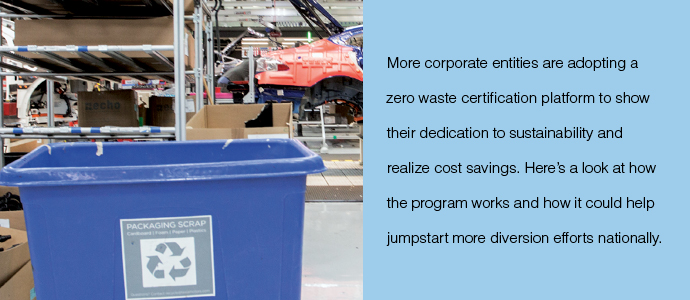
Another case study comes from the Fremont, Calif. factory of automaker Tesla. With a team of recycling technicians servicing the factory, compost bins in all office and café areas, as well as several sorting and separation areas at the plant, Tesla consistently diverts over 99 percent of waste from ending up in the landfill, and achieves 97 percent diversion from landfill and waste-to-energy combined. Most of the material is sorted and sold to third party recyclers. The site is certified to TRUE’s Gold level.
In 2016, Tesla’s reduction in waste hauling fees, the revenue generated from recycling and the costs avoided through product reuse programs amounted to over $30 million in economic benefit for the company.
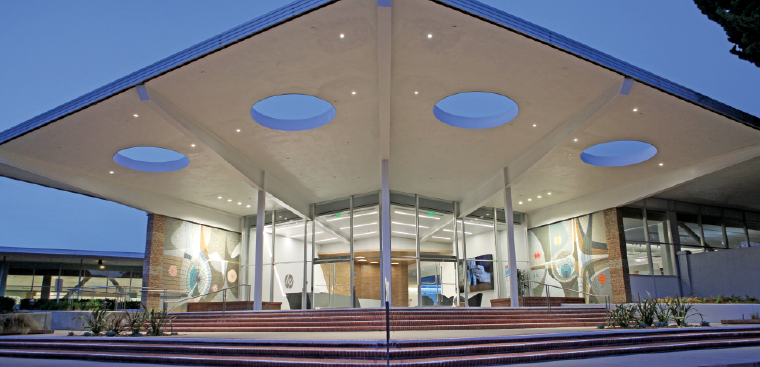
Commercial offices have also found value in the program. HP Inc.’s headquarters in Palo Alto, Calif. is a 449,800-square-foot building that became certified to TRUE Gold in 2018. HP has a global environmental stewardship approach, which includes waste reduction solutions.
In Palo Alto, the office works closely with the city as well as with local hauler and MRF operator GreenWaste Recovery to significantly lower the amount of waste generated. The efforts have reduced waste-related operational costs by more than 20 percent over the past two years.
Further, to reduce its cafeteria waste at its headquarters, HP has switched to reusables, eliminating single-use plastics, and donates leftover food. Reuse programs have also been established to extend the life of office supplies, furnishings and computer equipment. A vital part of the success has been employee engagement and consistent training and events that allow employees to feel a sense of pride and ownership over the progress.
For these companies and others working under the TRUE framework, it is very important to connect with local recycling coordinators and understand the materials diversion dynamics in the community. If certain infrastructure does not exist, there are resources that can help companies move forward. Technical assistance and guidance is often available through government agencies, state recycling organizations and sustainability business groups.
In addition, to assist companies in the certification process, GBCI created the TRUE Advisor professional certificate. It allows companies to train their employees or hire consultants who are experts on TRUE certification. Currently, there are more than 400 TRUE Advisors across 23 countries.
Local connections
Corporate leadership on waste issues can help pave the way for local improvements. For example, food scrap composting was not available in Orange, Calif. and Cincinnati. But companies in those regions worked with local haulers, government agencies and other businesses to start food scrap composting programs.
Such examples can serve as inspiration for other communities that may want to unlock the potential of working with the business sector to grow materials diversion across a municipality or region.
And as we look to push forward nationally on waste diversion, the business sector, with its focus on economics and efficiency, is a natural place to build partnerships and explore new ideas.
What’s more, increases in diversion have clear benefits to the wider business sector. Implementing zero waste policies is proven to expand, attract and support green businesses and green collar jobs. For every 10,000 tons of solid waste sent to disposal, one job is created, but composting the same amount of material can create five to 10 jobs.
The recycling industry is similar in size to the auto repair industry in terms of its economic activity, yet we’re only diverting a little over 30 percent of our resources nationwide. Imagine how many jobs could be created if we were recycling 50, 60 or 90 percent of materials. Clearly, the corporate world has incentive to be part of the transformation of the waste industry.
To support companies in pursuing their zero waste goals, TRUE offers online resources and opportunities to connect with experts at true.gbci.org. When considering a zero waste policy, the only question to ask is: if you’re not for zero waste, how much are you for?
Stephanie Barger is director of TRUE at the U.S. Green Building Council. She can be contacted at sbarger@usgbc.org. Find more at the TRUE website: www.true.gbci.org.