This story originally appeared in the May 2016 issue of Resource Recycling.
Subscribe today for access to all print content.
The idea of sustainable materials management has caught the attention of many forward-thinking U.S. recycling leaders in recent years.
The concept refers to policy and practices that keep the entire life cycle of a product in mind. In essence, sustainable materials management, or SMM, helps stakeholders make decisions from a truly holistic standpoint as they aim to curb greenhouse gas emissions and use innovative packaging techniques wisely.
But though many companies, governments and groups are embracing SMM, the industry as a whole continues to use weight-based recycling rates as a barometer for progress. This article will explain why it’s time to shift away from our reliance on recycling rates and find innovative assessment models. This evolution can ensure materials truly are used for their highest and best uses.
Relevancy of rates
In the U.S., there has been much discussion about the stagnant recycling rate. As a nation, we are hovering around 34 percent, and many articles and stakeholder statements have bemoaned our collective inability to “move the needle.”
But judging the success or failure of an entire industry based on this single statistic is problematic. For one thing, the recycling rate is affected by the changing material mix taking place in the U.S. market. Packaging has been on an increasingly strict diet over the past decade as manufacturers lightweight their materials and switch from heavier materials like glass to lighter substitutes. Even if the volume of recovered material were to grow, the weight-derived recycling rate would not necessarily reflect that fact.
Recycling rates sometimes also fail to capture other elements of program success, like convenience, accessibility, transportation efficiencies and program cost. And trying to compare different jurisdictions on the basis of recycling rates is difficult because definitions of recycling vary from place to place.
It’s also true that a reliance on this metric can lead to decisions that actually move us away from environmental improvement. Higher value uses for a given material may be overlooked because they won’t contribute to a higher recycling rate. Batteries are a prime example of this phenomenon.
Both in Canada and in Europe, there is much discussion regarding what constitutes battery recycling. Should converting used batteries into roadbed slag be considered recycling? What about recovering manganese, zinc and phosphorus for use as fertilizer? Stakeholder discussions on these very topics are currently underway in both regions.
It’s a complicated state of affairs. In Ontario, for instance, recovering manganese, zinc and phosphorus for use as fertilizer is considered recycling whereas in Europe it is not. In certain U.S. states, such as Minnesota, use as fertilizer is considered a “beneficial use,” a distinct category of material recovery regarded as less desirable than recycling.
In Ontario, battery recyclers must recover 80 percent of an alkaline battery’s weight for use in the manufacturing of new products (this metric is known as the recycling efficiency rate, or RER). Recyclers can achieve the 80 percent level by using a variety of recovery methods, some of which result in a one-time use of the recovered product and others which keep the recovered materials in a closed loop for potential use again and again.
 For instance, an alkaline battery could be processed using an eco-friendly battery technology whereby battery material is refined and transformed back into an active ingredient to be used in the production of new batteries. This process would generally be regarded as a superior form of recovery. However, in Ontario, processors using this method are not given any additional credit. It is weighted the same as harvesting battery material for use in adhesives, tires, paint additives or fertilizer.
In this case, high RERs are being achieved. But because a number of recovery methods are considered equally valuable, recyclers may be sacrificing higher value applications to attain the mandatory recycling target. This example highlights how putting too much emphasis on a single metric can lead to suboptimal outcomes.
This begs the following questions: Have we missed the point? Is it time to go beyond tons recycled?
A more holistic assessment
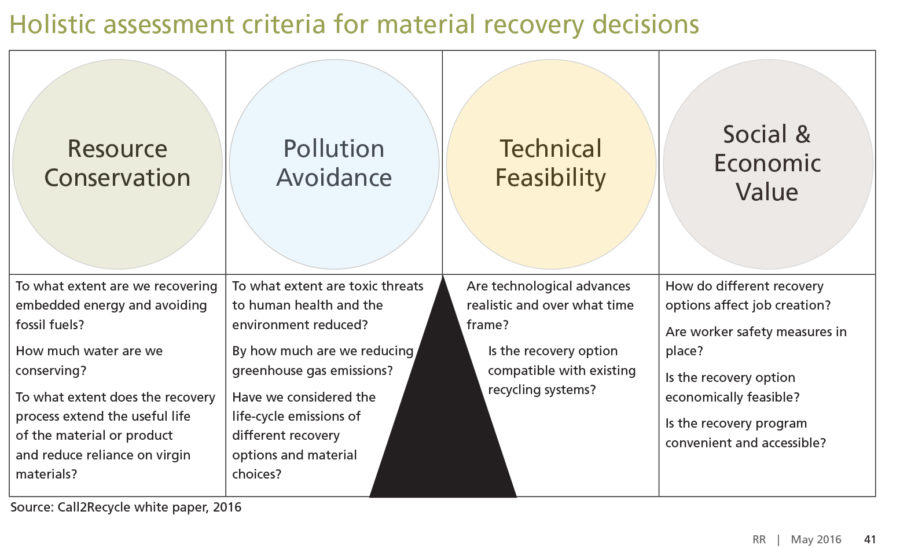
A broader evaluative model is emerging to properly assess the sustainability of recovery activities. A diverse set of stakeholders has begun to flesh out criteria that should be considered when evaluating options.
The diagram in the figure below reflects a compilation of the criteria referenced in recent publications of leading stakeholder groups, including the U.S. Environmental Protection Agency, the Oregon Department of Environmental Quality (DEQ), the Canadian Standards Association and the Sustainable Materials Management Coalition (a group convened by Waste Management with representatives from academia, government, industry, and community and environmental organizations).
Essentially, a holistic assessment of material choices and recovery options is being proposed that considers both “macro” and “micro” concerns and attempts to create balance among multiple objectives that at times are actually competing with one another.
A one-size-fits-all approach to applying the assessment criteria in the figure is not practical. We will likely never have consensus on the relative importance of one factor versus another. Inevitably, some stakeholders will be louder than others and they will almost always have differing goals and objectives. Furthermore, the resources needed to evaluate the merits and drawbacks of different approaches are often lacking.
However, what we do have is a place to start. If we can agree that it’s worthwhile to shift focus from managing waste at end of life to identifying the impact “hot spots” over the full product life cycle, then we can begin to take action in a more informed, systematic manner.
For instance, the Oregon DEQ has released examples that how SMM can help us understand the different actions that can be taken across the full life cycle of materials. One such example compares different methods of delivering drinking water.
The DEQ found that a narrow focus on increasing the recycling rate of single-use PET water bottles would in fact reduce greenhouse gas emissions, energy use and respiratory pollutants over the life cycle of the package. However, taking a broader view, researchers found that making the bottles thinner improved results further. But what made the most dramatic impact on resource conservation and pollution avoidance was switching from using single-use PET bottles to drinking tap water using reusable bottles. Even when a consumer washed the reusable bottle at home every day using the worst performing dishwasher on the market, this action maximized environmental performance.
If the evaluation is weighted to favor resource conservation and pollution avoidance, reusable bottles (cleaned at home) are the clear winner based on this analysis. However, if maximizing consumer convenience, meeting consumer demands for recyclability or increasing financial benefit were more heavily weighted, would the preferred outcome be different? It likely would have.
What’s important is having the information necessary to fully understand the trade-offs inherent in SMM decision-making. This requires both a sharper pencil and an open mind.
Revisiting what motivates us
Our one-dimensional focus on managing waste at end of life blinds us to oftentimes more impactful phases of a product’s life cycle. According to the National Recycling Coalition, disposing materials in landfills represents only 2 percent of U.S. greenhouse gas emissions. We must therefore look upstream and consider a material’s full life cycle from extraction to end of life. This means that actors along the entire value chain, from product designers to recycling program managers, have a role to play in SMM strategies.
 This new way of analyzing material choices may lead us to settle on lower rungs of the classic waste hierarchy in order to maximize environmental outcomes elsewhere in the product life cycle. For instance, a packaging producer may decide that a difficult-to-recycle package composed primarily of renewable materials may be more beneficial from a life-cycle perspective than a recyclable package. A recycling manager may implement policies and initiatives that increase the quality of collected recyclables rather than the quantity. A procurement specialist may remove requirements for post-consumer recycled content and add guidelines that give preference to products that demonstrate a broader set of environmental qualities.
The key is striking a balance between micro and macro considerations where each project is evaluated on its own merit. This will take cooperation among a diverse group of sectors, industries and institutions. When evaluating recovery methods, we need to be clear about what our goals are and be frank about the interests at play. A guiding set of principles could help all stakeholders view these evaluations through the same lens.
The goals behind materials management may change depending on who you ask – a recycling manager will likely be motivated by different goals than a packaging producer, for instance. But from a larger policymaking perspective, we generally recover materials in order to reduce pollution and maintain stable supplies of materials to produce the goods and services we rely on long into the future.
With this in mind, it is in our best interest to accelerate the transition to an SMM approach. And if we are to achieve an SMM framework, there is a collective need to replace our myopic focus on recycling with life-cycle thinking that includes recycling as a means to an end but does not view recycling as the end in and of itself.
Betsy Dorn is director of Reclay StewardEdge USA, a sustainable packaging and product solutions consulting firm serving U.S. clients. She has over 30 years of experience managing, designing and implementing recycling and solid waste management projects. Becky MacWhirter is a consultant who works with the City of Belleville, Ontario. For more information on Reclay StewardEdge, go to reclaystewardedge.com.