






This story originally appeared in the May 2016 issue of Resource Recycling.
Subscribe today for access to all print content.
Measurement is becoming a more prominent issue for recycling professionals.
Some of the impetus behind this focus on data comes from concerns about the performance of recycling programs in an era of tight budgets and constrained commodity markets. At the same time, industry professionals know they need to better understand the performance of the overall recycling system in the U.S.
One example of measurement activity can be seen at the U.S. Environmental Protection Agency, which has recently worked to rally state materials management programs into a single voluntary reporting process compiling numbers annually. In addition, the Sustainable Packaging Coalition (SPC), with support from an impressive array of commodity groups and trade associations, is now conducting a definitive study on recycling availability nationwide, which will in turn help benchmark product recyclability against Federal Trade Commission standards.
In general, the recycling world understands better data can help communities and companies take the next steps in materials recovery. This article seeks to contribute to that endeavor by posing a crucial question: How many pounds of recyclable material does an American household generate per year?
In the text below and in a companion article appearing in Resource Recycling next month, we will show how a few core statistics can lead us to that average recyclables-generation number. From there, we’ll aim to demonstrate the ways this data can help us better understand the municipal recycling stream on a national scale.
The four numbers to know
Here are the four pieces of data that should be known by the leaders of every curbside waste and recycling program in the U.S.:
- How many households are served by the solid waste collection program
- How many household tons are collected per year through the solid waste collection program
- How many households are served by the curbside recycling program
- How many household tons are collected per year through the curbside recycling program
With these basic factors, any local curbside program can calculate two very important metrics for each service: pounds of solid waste collected per household served per year and pounds of recyclable material collected per household served per year.
Communities can use this data to measure the baseline performance of their programs. They can also use the information for planning and budgetary purposes as well as for identifying and implementing efficiencies and for making service adjustments.
First, though, it’s important to address some questions about why we’ve chosen these specific metrics.
The first question: Why would it be important to measure pounds per household served rather than pounds per household participating? Although the latter metric is highly useful in its own right and should also be determined, the pounds-per-household-served number is an absolutely fundamental service benchmark. Recycling collection programs need to budget and plan for possible 100 percent participation by their served households, as can be expected in solid waste collection. By measuring against the served population, a local program can analyze its waste and recycling services on an apples-to-apples basis and can further compare program performance to communities across the country.
In addition, the number of households served is more readily known than a participation rate – in fact, one cannot produce a participation rate without knowing the served household denominator.
Another possible question: Why is it important to measure the weight of recyclables in solid waste collected per household? After all, it’s the recycling aspect we care about.
 Calculating recycled pounds per household served provides an excellent snapshot of how a curbside recycling program is doing, but it is also important to know how well the program could do be doing – and that’s where the solid waste numbers come in. Measuring only the pounds recovered is like getting a test score without knowing the maximum possible points in the test. If the best possible score on a test is 70, then 62 is pretty good. If the test is out of 100 points, however, then a score of 62 indicates clear room for improvement.
By determining the solid waste numbers and then conducting waste audits (or using data from already-completed audits), a community can ascertain the total available amount of household recyclables. This is akin to knowing the total possible test score and provides a meaningful context for understanding a curbside program’s effectiveness.
Putting theory into practice
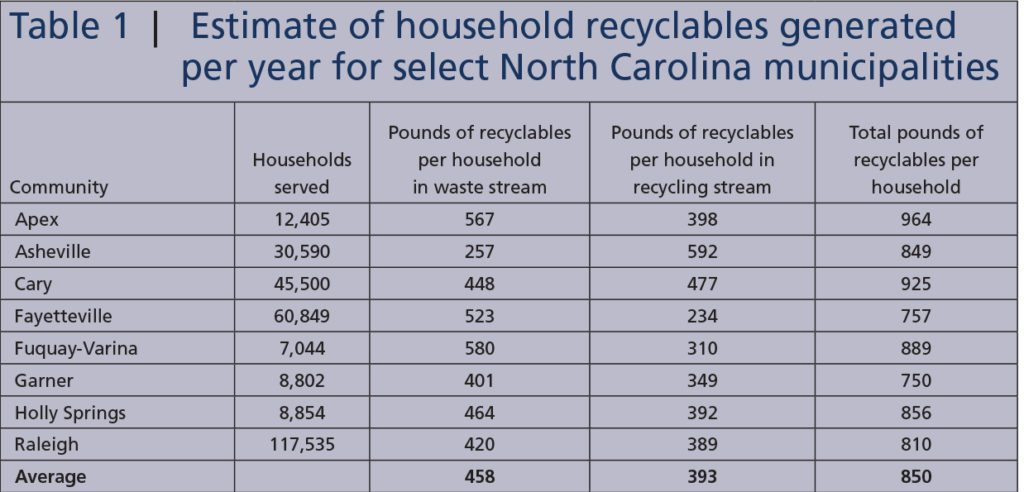
The North Carolina Division of Environmental Assistance and Customer Service (NC DEACS) recently conducted research involving the waste metrics mentioned above. By compiling the data from a select number of communities in North Carolina and nationwide, researchers aimed to determine how much recyclable material is generated each year by the average American home.
 To start, NC DEACS sought out communities that had the right combination of inputs to do the analysis. The calculation required two pieces of essential data: a reliable count of household pounds recovered in the curbside waste and recycling programs and a recent waste composition study that showed the amount of household recyclables in the disposed stream. Those two pieces of information allowed us to produce a simple equation:
Pounds recycled per household per year
+ Pounds of recyclables in waste per household per year
= Total pounds of recyclables per household per year
Wake County in North Carolina provided the initial source of data for the research – the county had conducted a waste-composition study that broke down household streams for six individual municipalities. The results of that study were combined with detailed statutory report data from these same local governments, and the findings were also supplemented by similar information from two other North Carolina municipalities.
 All of this information made it possible to estimate the amount of recyclable material generated by a typical North Carolina home. The finding: 850 pounds per household per year (see Table 1).
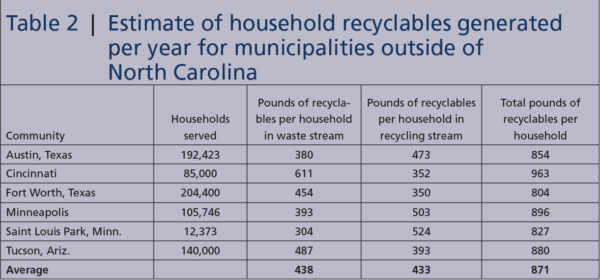
To bolster and test this result, we searched for municipalities around the country that also had the right combination of data points. We were able to find another six communities with data sets that allowed an analysis similar to the one conducted for North Carolina municipalities. For these six nationwide cities, the average estimated household generation of recyclables per year was 871 pounds (see Table 2).
It is remarkable to see how closely the straight averages from the two data sets align, and the estimate seems to be further validated by a study from DSM Environmental Services’ Ted Siegler, the results of which were published in the January 2015 edition of Resource Recycling
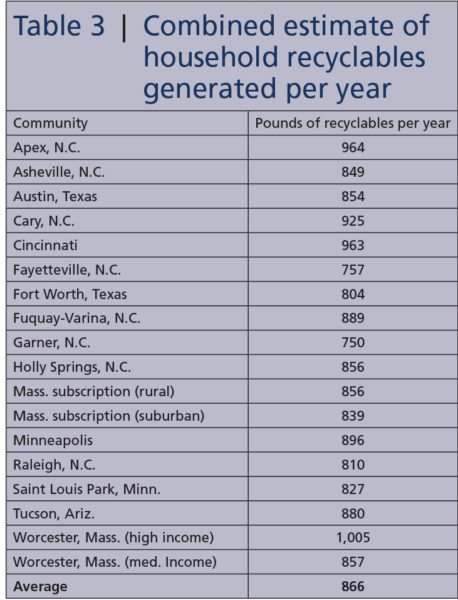
(tinyurl.com/Siegler-Rates). Siegler used waste composition studies to determine recovery rates in a few key Massachusetts communities. Combining Siegler’s Massachusetts data with the findings from our other cities offered an even deeper look at national materials generation.
As indicated by Table 3, the estimated national average of recyclables generated per household per year is 866 pounds.
Caveats about the data
It is important to note that the results produced in this study carry some assumptions and key limitations. First, study data were focused mostly on single-family households, the typical target of curbside programs. Few statistics seem to be available on multi-family generation, but what information there is seems to point to substantially lower recyclable weight per household per year, possibly as low as 600 pounds.
Second, the data set is skewed urban, leaving the question of whether rural or small-town households generate the same levels of recyclables.
Third, the rarity of instances in which the necessary combination of data is available for any given jurisdiction translates into an overall small data set, testing the bounds of statistical inference.
These are all areas that need to be addressed to push the analysis to more reliably predictive levels. Still, the numbers for the selected jurisdictions seem to point in a very common direction as to the dimensions of the household recyclables stream. One can see a comfortable and acceptable range in the current data that allows it to be used confidently in a number of interesting ways.
Scaling up and connecting to commodities
The analysis detailed above indicates the average American home generates 866 pounds of recyclable materials per year. Is this number right or wrong? And what is the ultimate utility of this number?
In the second half of this article, we will explore how this data can be put to work to understand more about a curbside program’s performance, linking it back to the pounds-per-household-served analysis. We will also show how the data can offer insights as to the size of a regional, state or even national household recyclables stream, and how it can be used for estimating sources of generated commodities.
Scott Mouw is state recycling director at North Carolina Division of Environmental Assistance & Customer Service and can be contacted at scott.mouw@ncdenr.gov. Rob Taylor is team leader of local government recycling at the state agency and can be contacted at rob.taylor@ncdenr.gov.