Editor’s note: Resource Recycling, Inc., is hosting the 2027 Textile Recovery Summit March 1-3, 2027, at the Gaylord National in National Harbor, Maryland. The summit will be co-located with the Plastics Recycling Conference and Resource Recycling Conference.
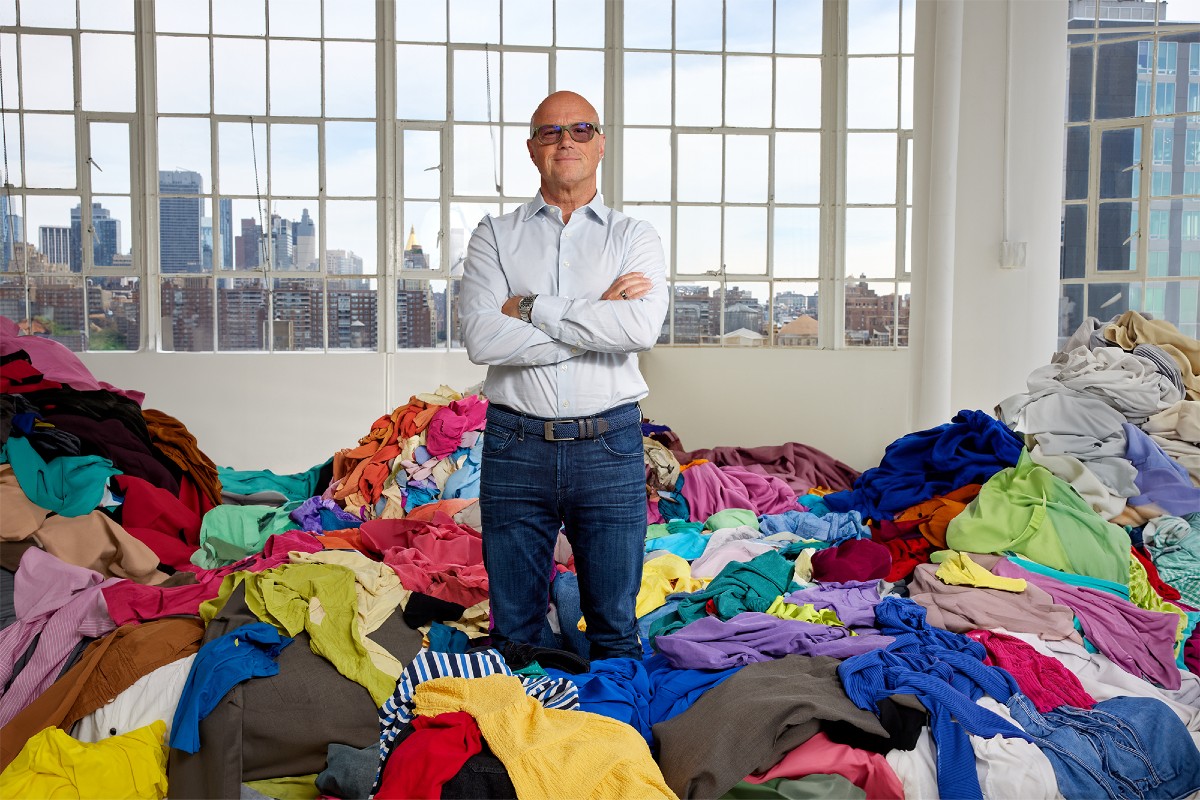
Patrik Frisk, the CEO of textile-to-textile chemical recycler Reju, has spent the last 35 years running global textile brands like Under Armour, The North Face and Gore-Tex.
Now, he told Resource Recycling, it’s “time to get the broom out.” He said, “I’m trying to make sure that I help the textile industry transition into a better future.”
When Frisk was CEO of Under Armour a few years ago, the company was one of the world’s largest manufacturers of high-performance polyester garments. “We had started to incorporate a lot of recycled content from bottles into polyester in our garments, to make sure that we were prepared for a recyclable future,” said Frisk. “But we found that it was getting harder to get the volumes we needed, and also we realized that using bottles into textiles was not an optimal way.
“We also needed to start to deal with the problem we were creating in terms of textile waste,” said Frisk.
One day in 2019, the materials team at Under Armour came to Frisk excited. They had learned that IBM Research in San Jose, California, had been developing a new technology to process textile waste. “It had the properties to be able to deal with post-consumer mixed textile waste with all of the 10,000 chemicals we have to deal with, with the mixes of synthetic and natural fibers, and could be industrialized,” said Frisk.
A joint venture between Under Armour, IBM and French engineering firm Technip Energies began work in 2021 to commercialize the technology. Frisk left Under Armour in 2022 and was subsequently asked to come on board the new company, to see “if we can get the whole industry to move into this new era of using technology to solve one of the biggest problems we have been able to create with the textile industry, which is waste,” he said.
Spun off in 2023, Reju is now based in Paris and fully owned by Technip Energies. Reju’s first demo plant opened in Frankfurt, Germany, in October 2024. Now it is working on setting up three commercial-scale textile recycling plants, first in Sittard, Netherlands, then in Rochester, New York and later Lacq, France. The first plant is expected to open by the end of 2028 or into 2029, said Frisk. Once operational, it will take in about 60,000 tons of textile waste a year — around 300 million garments — that will be broken down and repolymerized into about 40,000 tons of RPET.
Remaking polyester
Reju’s proprietary chemical recycling process begins by shredding fabrics that can no longer be worn. Buttons and zippers are stripped away. The fibers that made up the clothes are then separated — cotton, wool, elastane, nylon, polyester and so on. The target right now is polyester, which is a dominant material in today’s wardrobes.
The petroleum-derived material is then broken down into a monomer, rBHET, in a glycolysis and catalyst process that takes less than two minutes. The rBHET is then repolymerized into RPET, which is then pelletized. The pellets can then be extruded into fiber and yarn, which can be made back into new polyester.
The long-term goal is to partner with brands to get the new fabric into consumer products, closing the loop.
“We would argue that the polyester that comes out at the end of our process is actually better than new,” said Frisk.
The Reju process also has advantages over mechanical recycling for textiles, said Frisk. In that process, the polymer is heated up until it melts and then extruded into new yarn. It isn’t broken down into monomers. But the heating can cause the fibers to become brittle, said Frisk, meaning it often has to be mixed with virgin material to be made into new clothes. It also can only be recycled a few times before it breaks down too much. The Reju process can be used indefinitely, said Frisk, making for better circularity.
As for pricing, Frisk didn’t get specific, but he said, “of course it’s going to be more expensive than what virgin would be, and also what mechanical would be.” That’s because so much infrastructure needs to be built up before the first product ships, compared with more established industries, he said.
But the fashion business has hidden costs, Frisk said, in its largely “linear model.” In 2024, more than 78 million tons of polyester entered the global waste stream. Less than 1% is recycled back into new clothing.
As far as sustainability, Frisk said Reju’s plants will be fully closed loop. “Any components that cannot be recycled will be treated as waste, which will then be disposed of in accordance with applicable law,” he said. The process emits 50 percent less carbon dioxide than making polyester from oil, he said.
‘Reindustrialization’
Frisk said he is particularly excited about the plant planned for Rochester, in part because it will be located on the former grounds of a historic Eastman Kodak factory. Frisk called this 18.9-acre site “reindustrialization” and said it is expected to open in 2029. He also noted his company’s developing partnerships with Goodwill and WM to source feedstock for the plant.
In announcing the Rochester facility, New York Gov. Kathy Hochul said, “Reju’s ambitious project, that will create approximately 70 new jobs at Eastman Business Park, shows how smart investments can turn waste into opportunity, further supporting our state’s overall green economy efforts and creating a brighter future for everyone.”
Jennifer Lake, president and CEO of Goodwill of the Finger Lakes, which covers the Rochester region, said in a statement, “Reju will address one of the fastest-growing yet least understood waste streams in the United States: post-use textiles. Their breakthrough approach will divert discarded materials from landfills and transform them into valuable, sustainable resources, giving them new life.”
Lake noted that the Northeast Goodwill Circularity Hub, a collective of 11 Goodwills, led by Goodwill of the Finger Lakes, will supply Reju with polyester-rich materials.
“Reju is investing in a future where post-consumer textile waste becomes a resource, not a liability,” added Frisk.
Reju is also working on setting up a research and development lab near Philadelphia, in Conshohocken, located within Technip Energies’ existing Advanced Materials and Catalysts research center. Work there will include research on more efficiently processing the other fibers that Reju is going to separate out from the polyester, said Frisk.
Frisk said he is sensitive to arguments that recycling could allow people to feel better about overconsumption, and to perpetuate reliance on plastics. To the first point, he said the scale of his company’s business — even projected out a decade — is unlikely to make a dent in overall consumption. And plastics are too useful and too ingrained in our economy and society to be ousted anytime soon.
“What we can decide to do though is to do it in a much better, more sustainable way,” said Frisk.