
In 2017, Brendon Pantano’s plan for Coastal Waste & Recycling didn’t extend past Miami-Dade, Broward and Palm Beach counties in the state of Florida.
“It wasn’t anywhere in the plan or the investment thesis,” he said of the company’s current footprint: 45-plus locations, three states and 1,800 employees.
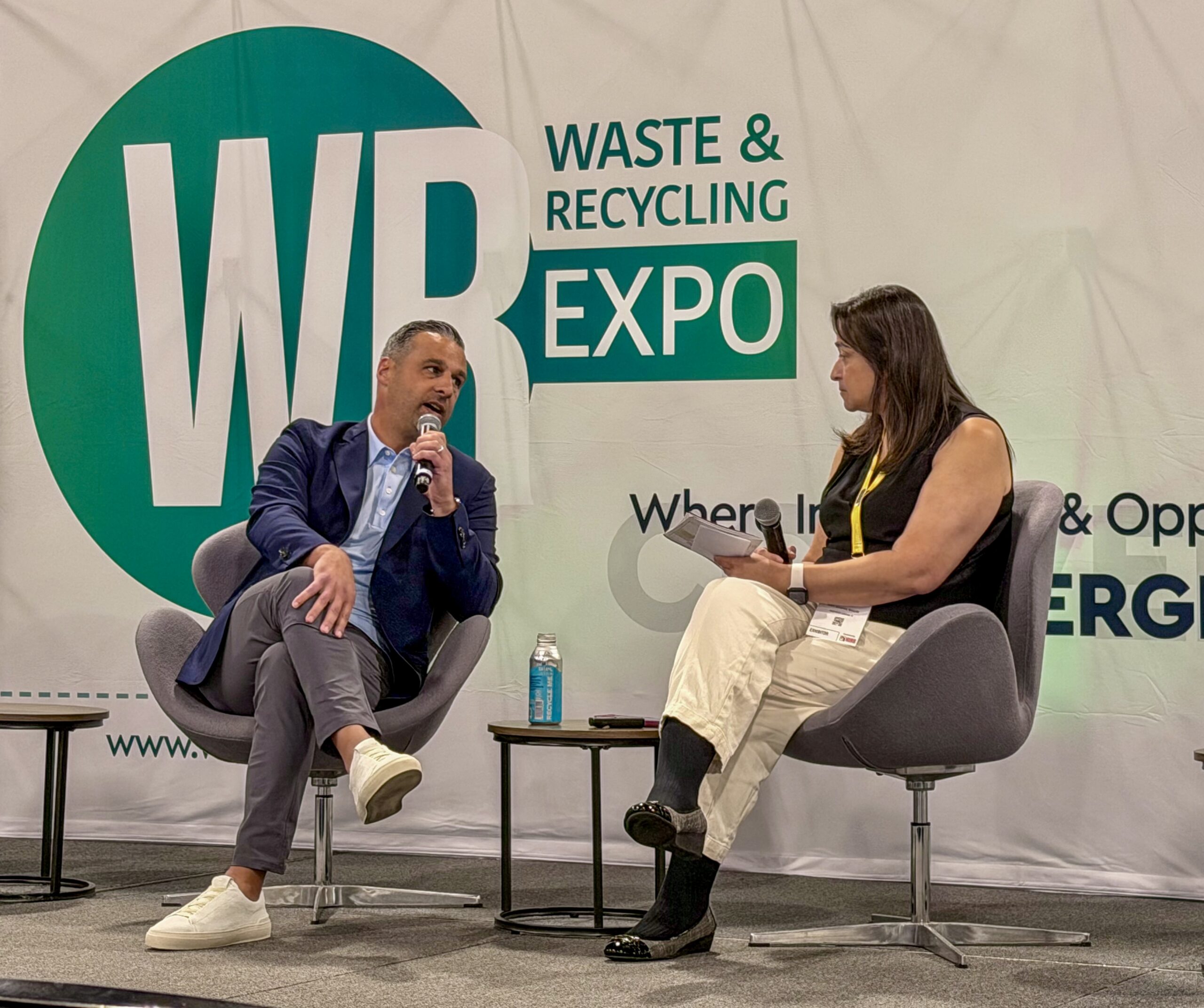
The founder and CEO of Coastal detailed the path from a Tri-County start to interstate collection at the inaugural WR Expo in Fort Lauderdale, Florida.
“That’s really where we got,” Pantano said of the Tri-County footprint, before describing how the southeast Florida model became a template the company later replicated across Georgia and South Carolina.
Screening and blueprint
Pantano said Coastal doesn’t chase acquisitions. The company screens markets first, then decides how to enter them.
“We look for high growth areas,” he said. “It’s always easier to build a company when you’re kind of going up with the tide versus trying to chop away your competitors to build your business.”
The second step is whether a market is open enough that Coastal doesn’t have to dominate it to turn a profit.
“Is the market negative for one to where we don’t have to be the biggest hauler in there to make a nice business?” he said. “Is it growing and is it an open market?”
Only after a market clears both tests does Coastal decide on an entry strategy via municipal franchise, open-market sales or a recycling facility build.
Pantano said making different locations such as Fort Lauderdale, Pompano Beach, Panama City and Tampa feel like the same company starts with the physical environment, not operations. A worker should be able to transfer between sites and recognize the place.
“It sounds small, but even down to the office space or the shops, the break rooms, we try to run consistent – similar floors, the same furniture, the same basic look to every site,” he said. “So, if you decide, hey, I’m in [one market] and I want to transfer to Fort Myers, they should be able to pick up what they do, and it should feel very similar wherever they go.”
Vice President of Branding and Culture Patty Hamilton leads the internal team responsible for holding that consistency together as the company adds sites, Pantano added.
Growing into leadership
Pantano described how his own role has changed. In the earliest days, he was at the yard painting containers and putting on stickers.
“For three months I was a CEO of absolutely nothing,” he said of the pre-revenue stretch spent on purchase agreements, contracts and defining what the company wanted to be before it had a customer.
He said the foundational systems of accounting, capital planning and people planning had to be built before they were urgently needed, or the debt comes due later.
“If you think about these things after you’ve already grown, you’re going to have kind of like a perpetual mess that you’re always cleaning up,” he said.
The bigger shift was personal.
“Where I used to be the best operator in the company, that’s not important anymore,” Pantano said. “I need to be the best leader in the company.”
That meant hiring people he described as smarter than himself into functional roles and stepping back from the operational work he’d built the company on.
A listening ear
Pantano said he still visits sites regularly, but not the way corporate leadership typically does.
“I don’t put an entourage of corporate people together and get in a car or a plane and travel sites,” he said. “I generally like to just go out to sites. I oftentimes, almost always, don’t tell anybody I’m coming. I don’t want a scripted tour of a facility.”
The point, he said, is to hear directly from the people doing the work rather than filtered through a general manager.
“I’m generally going to be talking to the frontline staff, the sorters, the drivers, the technicians, the supervisors,” he said. “I’m more keen to understand what’s the pulse of the team that’s on the ground. Is there anything I can do to help make their jobs easier?”
Where the company’s core values of safety, integrity and customer service get tested hardest, Pantano points to complacency, not defiance.
“I don’t think anybody came in this morning and said, ‘I’m going to break rule number 14 and 22,'” he said, adding that drivers are managing cameras, tablets, heat and dozens of stops a day.
“Things get in the way of keeping that at the forefront. It’s distractions,” he stated.
Rather than layering on more rules or discipline, Pantano said Coastal gives employees a culture of: can it be done safely, with integrity, in service of the customer? If not, call a supervisor.
“While there’s not going to be someone there telling you every little last piece of what the safety policy and procedure is, just think of it that way,” he said.
He said values only stick if leadership visibly follows them, which includes being corrected in public. Pantano described a shop visit where a technician stopped him for wearing sunglasses instead of safety glasses, then handed him a proper pair.
“That’s where I know it’s working, right?” he said. “I have to award or reward those types of behaviors.”
Integrating acquired companies complicates that consistency. Pantano said timelines for a new team to absorb Coastal’s standards range from three months to well over a year, depending on how closely the acquired company’s culture already lines up. “There’s some that we’re looking back, you know, 12, 18 months, and we still have work to do,” he said.
Marketing to recruit, not sell
Facing what he called an industrywide shortage of frontline drivers, Pantano said Coastal’s social media is deliberately not built around selling waste services.
“Our social media, regardless of the platform, was never built, designed or geared to ever sell a single product in the world,” he said. “The marketing is all geared towards attracting talent into our industry.”
Part of the pitch is correcting what he sees as a blind spot in how driving jobs get talked about.
“A garbage truck driver can make 75 to 100 grand a year,” Pantano said, “and ones that are really ambitious over time can make well over $100,000 a year.”
He contrasted that with friends who graduated college into $35,000-to-$40,000 entry-level jobs.
“I think we’ve got to do a better job educating people on the real trajectory of what that position can look like.”
A sustainable workforce
On the leadership side, Coastal’s management-training program grew out of an informal favor. About four years ago, a friend asked Pantano to give his two sons, new college graduates, a shot.
That conversation grew into a formal pipeline in which trainees are paid at a working-supervisor rate from day one, rotate through field operations, customer service, finance and accounting over 12 to 18 months, then interview for open roles like any other candidate.
“It’s not that you’re granted a position,” Pantano said. “It’s like a draft.” The company brings on five to seven trainees a year and plans to expand the program.
Coastal’s community involvement used to run through corporate. As the company grew past southeast Florida, he said that model stopped making sense.
“Three years ago was very different,” Pantano said. “It was very centrally controlled.”
“We want to engage in what’s important to the community, not what we think sitting over here in the [corporate] office thinks is important, but what the local leaders do.”
He also said the company prioritizes employee participation.
“We’re really focused on making sure that our team is involved in the activities, not just sending checks,” he said. “It’s a touch point for engagement to build relationships.”
Breaking the misconceptions
When asked about how Coastal builds public trust given persistent skepticism that recycling “works,” Pantano stated the company’s model starts with a structural difference. It owns just one landfill, in South Carolina, that handles roughly 4% of the company’s daily volume.
“We were built on recycling,” he said. “We’re not a big landfill owner.”
He said Coastal keeps an open-door policy at its recycling plants for residents and municipal staff who want to see the process firsthand, and pushed back on the idea that recycling doesn’t work.
“The reality of it is, many things can be recycled,” he said. “The question is, can it be done in an economically feasible way?”
Contamination remains the practical obstacle, he said, and it’s made the economics harder even as new sorting technology, such as AI-enabled optical sorters at a residential single-stream facility the company launched roughly six months ago, improves throughput.
“It’s just become tremendously more expensive to do it,” Pantano said, adding that closing the gap depends on the industry doing more consumer education, not any one operator’s technology.
The billion-dollar question
When he was asked about how Coastal avoids losing its identity as it scales, Pantano didn’t hesitate.
“That’s the billion-dollar question, right?” he said. “It’s the hardest thing we have to deal with.”
His answer is repetition by reinforcing the same values at every new-hire orientation, running leadership training for every manager and using his own tenure, as well as his relationships with long-serving employees, to pull people back to why they joined.
“We kind of have those handshake or verbal type agreements on what the mission is here,” he said, “and we quickly kind of recall them back to why we’re here and what we’re doing.”
As for the most expensive lesson of the past nine years, Pantano landed on people, not capital.
“You can be the smartest person in the room for a while, but it’s not sustainable,” he said.
He added that “I think our industry and probably many others have a tendency to say, ‘Oh, well, they’ve done this before, just let them rip. My advice would be to go slow.”
Rushing a new leader into a district role, he said, confuses a frontline team that has spent years absorbing a consistent set of expectations. Investing the time up front is expensive, and the hire may leave anyway, but Pantano said that cost is still lower than what it takes to undo the damage of a bad fit who stays.
“The poison of that staying is worse than the investment in them and then leaving,” he said.