



Resource Recycling
  • The Latest
  • Analysis
    • All
    • Certification Scorecard
    • Industry Announcements
    • Opinion
    From claims to custody: PCR procurement grows up

    From claims to custody: PCR procurement grows up

    What the NAND flash crunch means for remarketing, refurbishment and residual values

    Telamon acquires ITAD consultancy Retire-IT

    Certification Scorecard — Week of July 6, 2026

    Tech giant pens detailed ‘plastic-free packaging’ guide

    What Google’s latest report means for ITAD

    Unpacking the Starbucks cup data

    Unpacking the Starbucks cup data

    Amazon cutting out more flexible packaging

    Amazon’s AWS hardware reuse is measured

  • Conferences
    • Resource Recycling Conference
    • Plastics Recycling Conference
    • E-Scrap: The Longevity Conference
    • Textiles Recovery Summit
  • Publications
    • E-Scrap News
    • Plastics Recycling Update
    • Policy Now
    • Resource Recycling
    • Other Topics
      • All Topics
      • Brand Owners
      • Critical Minerals
      • Glass
      • Grant Watch / RFPs
      • Markets
      • Organics
      • Packaging
      • Research
      • Technology
      • Textiles
Subscribe
No Result
View All Result
Resource Recycling
  • The Latest
  • Analysis
    • All
    • Certification Scorecard
    • Industry Announcements
    • Opinion
    From claims to custody: PCR procurement grows up

    From claims to custody: PCR procurement grows up

    What the NAND flash crunch means for remarketing, refurbishment and residual values

    Telamon acquires ITAD consultancy Retire-IT

    Certification Scorecard — Week of July 6, 2026

    Tech giant pens detailed ‘plastic-free packaging’ guide

    What Google’s latest report means for ITAD

    Unpacking the Starbucks cup data

    Unpacking the Starbucks cup data

    Amazon cutting out more flexible packaging

    Amazon’s AWS hardware reuse is measured

  • Conferences
    • Resource Recycling Conference
    • Plastics Recycling Conference
    • E-Scrap: The Longevity Conference
    • Textiles Recovery Summit
  • Publications
    • E-Scrap News
    • Plastics Recycling Update
    • Policy Now
    • Resource Recycling
    • Other Topics
      • All Topics
      • Brand Owners
      • Critical Minerals
      • Glass
      • Grant Watch / RFPs
      • Markets
      • Organics
      • Packaging
      • Research
      • Technology
      • Textiles
Subscribe
No Result
View All Result
Resource Recycling
No Result
View All Result
Home Recycling

Analysis: Recycling needs more voices in the room

byStratton Kirton, Liberty Tire Recycling
November 10, 2025
in Recycling
Analysis: Recycling needs more voices in the room
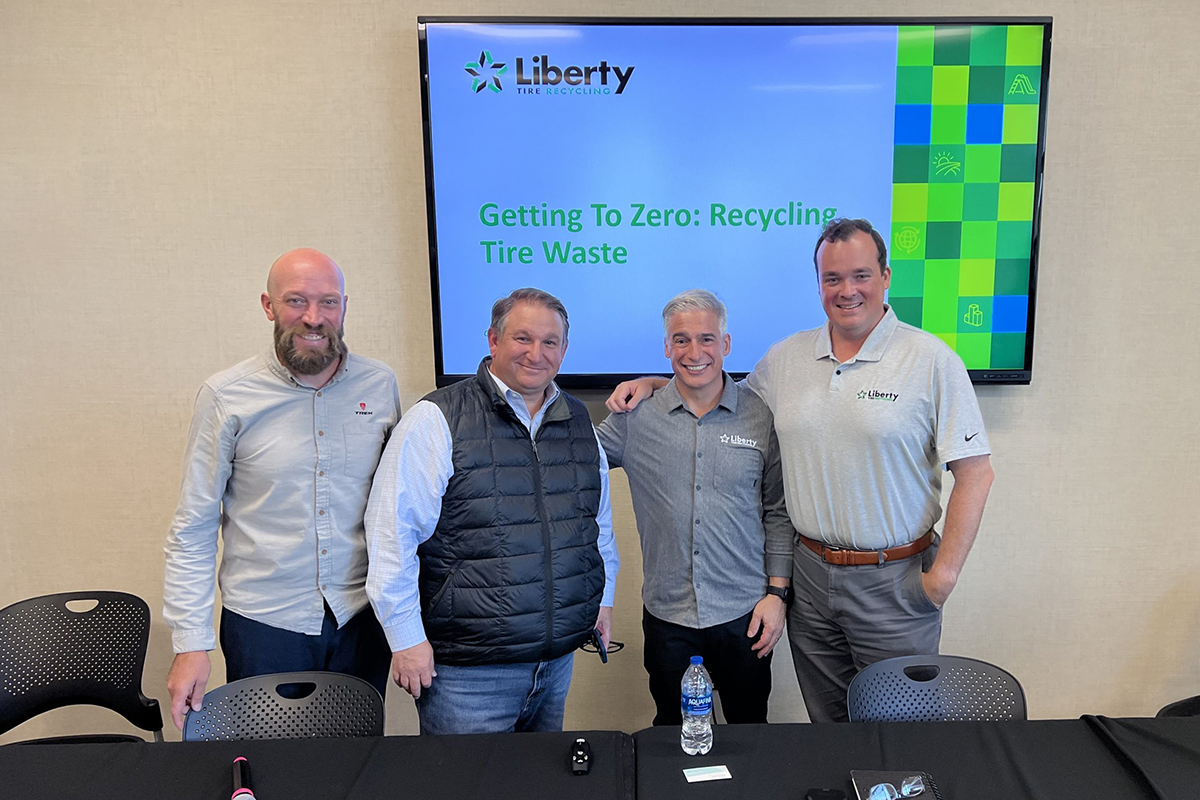
Left to right: Josh Borgmeyer, Trek Bicycle; Scott Gerber, Better Play Initiative; Steve Callahan and Stratton Kirton, Liberty Tire Recycling, at the NRC panel Getting to Zero: Recycling Tire Waste. | Courtesy Stratton Kirton

At this year’s National Recycling Congress, I had the privilege of moderating a panel of industry and advocacy leaders for a conversation on recycled rubber. This topic may sound narrow but it mirrors the broader challenges facing recycling across every material type. 

Tires, it turns out, are a perfect case study in why recycling still struggles to scale and why more dialogue between the private sector and public advocates is essential if we are ever going to achieve a truly sustainable economy.

Our panel brought three very different perspectives: Trek Bicycle, which launched the first nationwide bike‑tire recycling program; Liberty Tire Recycling, which manages more than 200 million end-of-life tires each year; and the Better Play Initiative, which educates communities about the safety and benefits of recycled rubber products used in parks and athletic fields. Together, they shared a common theme: success in recycling takes more than technology—it requires coordination, communication and trust.

From Trek’s side, the lesson was about organizational courage and ambition. As Trek explained, building sustainability into a corporate structure demands internal champions who can push past the inertia of “that’s how we’ve always done it.” 

What began as a pilot at a few retail stores has now grown into a national network collecting thousands of used tires and tubes for recycling. Trek’s experience underscores an important truth for any recycling sector: Before we can scale, we must start by creating excitement within our own teams about what is possible if we think bigger.

From Liberty’s perspective, the challenge scales up exponentially. Collecting, transporting and processing 215 million passenger tires a year involves hundreds of drivers, thousands of trailers and collection sites, and tens of thousands of customer sites. That infrastructure exists because Liberty has treated logistics and market diversification not as headaches to be managed but as the engines of sustainability. 

Each tire has to have somewhere to go when it is collected as well as when it is recycled: for use as mulch, aggregate, fuel, molded products or new materials entirely. Without steady, confident demand at the other end of the pipeline, recycling programs stall. 

And then there’s the public dimension, represented by the Better Play Initiative. Its work focuses on the most basic barrier of all: trust. Years of scientific research, by the US EPA, CDC, California’s public‑health agencies and others show no meaningful health risks from recycled‑rubber surfaces. Yet misinformation endures, and market growth lags as a result. 

As Better Play reminded our audience, data alone doesn’t change minds—dialogue does. People need to see and hear from those who choose and use these materials every day.

That emphasis on dialogue may have been the most important takeaway of all. There was thoughtful discussion during the Congress on the need to involve the private sector, though I found myself wishing to see even broader representation in the room. Public agencies and advocates play indispensable roles in shaping recycling policy and awareness, but so do the recyclers, manufacturers and logistics operators who make recycling happen. 

Working together ensures policy remains grounded in practice and allows innovation to reach its full potential. This observation isn’t a criticism but an invitation—one that all sectors share responsibility for answering.

At Liberty, I’ve been thinking about what that collaboration looks like in practice. One example is our growing partnership with Keep America Beautiful and its affiliates. 

For years, Liberty serviced community cleanups and tire amnesty days led by KAB affiliates, but those activities weren’t connected in a strategic way. Over the past year, we’ve made an intentional effort to change that—inviting KAB leaders into our facilities, seeking their input on policy and legislation, and exploring how our work can better complement theirs. 

We’ve participated in their national conference and built relationships with affiliates in half a dozen states with more to come in 2026. We’ve co‑hosted events, sponsored Earth Day activities and shared knowledge on tire recycling and litter prevention. 

These partnerships show how industry and community organizations can align their strengths—KAB’s grassroots reach and our ability to push for policy changes—to achieve outcomes that last.

Going forward, we must all redouble our efforts to make forums like the National Recycling Congress opportunities to bridge the divide. Meetings like this should reflect the full ecosystem of recycling: local governments that facilitate greater collections, companies that run and scale operations, non‑profits that educate and innovate in our communities, and researchers and advocates who hold us all accountable to environmental and health goals. 

One best practice I plan to carry forward is to look at every interaction—whether with policymakers, contractors, or nonprofits—as a potential partnership to strengthen. When we approach relationships that way, conversations lead to real progress.

Recycling has never had more potential or more partners ready to act. Let’s use that momentum to shape a future where every material, and every idea, finds a second life.


Tags: Industry Groups
TweetShare
Stratton Kirton, Liberty Tire Recycling

Stratton Kirton, Liberty Tire Recycling

Related Posts

APR adds PCR content verification to cert program

APR adds PCR content verification to cert program

byAntoinette Smith
July 9, 2026

The Association of Plastic Recyclers (APR) is expanding its PCR Certification Program to verify the percentage of PCR content in...

Unpacking the Starbucks cup data

Unpacking the Starbucks cup data

byAntoinette Smith
July 8, 2026

Upon close examination, data casting doubt on the coffee giant's recycling claims raises more questions than it answers.

SCS launches chem recycling standard

SCS launches chem recycling standard

byAntoinette Smith
July 1, 2026

SCS Global Services now provides third-party verification of responsible non-mechanical recycling processes, in line with a new global standard.

Groups call for end to e-scrap imports to Philippines

Groups call for end to e-scrap imports to Philippines

byPaul Lane
June 30, 2026

A task force claims hundreds of containers of material have illegally entered the country since last year.

Bipartisan reps introduce bill on recycling claims

Congressional hearing focuses on opening US mineral market

byPaul Lane
June 29, 2026

Stakeholders spoke on behalf of legislation that would bolster domestic mineral recovery efforts.

Bottlers open recycling center on Mexican isle

Bottlers open recycling center on Mexican isle

byAntoinette Smith
June 26, 2026

The transfer center will separate and process recyclables on Isla Holbox, a pristine island off the northern coast of the...

Load More
Next Post
Novelis posts steady Q2 amid tariffs, fire recovery

Novelis posts steady Q2 amid tariffs, fire recovery

More Posts

Oregon’s Recycling Modernization Act faces injunction

Oregon’s EPR program posts first-year results

July 6, 2026
Two recycled-content bills gain approval in California

California agriculture seeks SB 54 repeal

July 7, 2026
Unpacking the Starbucks cup data

Unpacking the Starbucks cup data

July 8, 2026
In Our Opinion: Coalitions: The EPR Differentiator

Inside NAW’s constitutional case against packaging EPR

July 6, 2026
Tech giant pens detailed ‘plastic-free packaging’ guide

What Google’s latest report means for ITAD

July 8, 2026
EPR fees are a market signal. Here’s what they’re telling you.

Building the infrastructure behind EPR

July 6, 2026
SB 54 draft rules generate debate on rates, review

California increases PET market payments

July 7, 2026
MP Materials breaks ground on rare earth magnet campus in North Texas

ERI confirms ITAD shift toward minerals

July 3, 2026
ITAD firm wins spot for NASA purchasing

ITAD firm wins spot for NASA purchasing

July 6, 2026
Auto Draft

Digital product passports offer gateway into secondary market

July 7, 2026
Load More

About & Publications

About Us

Staff

Archive

Magazine

Work With Us

Advertise
Jobs
Contact
Terms and Privacy

Newsletter

Get the latest recycling news and analysis delivered to your inbox every week. Stay ahead on industry trends, policy updates, and insights from programs, processors, and innovators.

Subscribe

Welcome Back!

Login to your account below

Forgotten Password?

Retrieve your password

Please enter your username or email address to reset your password.

Log In

Add New Playlist

No Result
View All Result
  • The Latest
  • Analysis
  • Recycling
  • E-Scrap
  • Plastics
  • Policy Now
  • Conferences
    • E-Scrap Conference
    • Plastics Recycling Conference
    • Resource Recycling Conference
    • Textiles Recovery Summit
  • Magazine
  • About Us
  • Advertise
  • Archive
  • Jobs
  • Staff
Subscribe
This website uses cookies. By continuing to use this website you are giving consent to cookies being used. Visit our Privacy and Cookie Policy.