




Resource Recycling
  • The Latest
  • Analysis
    • All
    • Certification Scorecard
    • Industry Announcements
    • Opinion
    Colorado regulators suggest mid-range EPR scenario

    Why collaboration on plastic waste still matters

    Battery processors lay out latest moves

    Battery recycler Ascend Elements files for bankruptcy

    EPR fees are a market signal. Here’s what they’re telling you.

    EPR fees are a market signal. Here’s what they’re telling you.

    Wolframite ore, the primary ore of tungsten from Altai, Russia

    Tungsten scrap export controls draw industry attention

    Certification Scorecard — Week of April 6, 2026

    Closed Loop Partners acquires Sutter Metals, connecting electronics disposition to metals recovery

    Certification Scorecard — Week of March 30, 2026

    Industry announcements for January 2026

    Industry announcements for April 2026

    Certification scorecard – Week of March 23, 2026

  • Conferences
  • Publications

    Other Topics

    Textiles
    Organics
    Packaging
    Glass
    Brand Owners

    Metals
    Technology
    Research
    Markets
    Grant Watch

    All Topics

Subscribe
No Result
View All Result
Resource Recycling
  • The Latest
  • Analysis
    • All
    • Certification Scorecard
    • Industry Announcements
    • Opinion
    Colorado regulators suggest mid-range EPR scenario

    Why collaboration on plastic waste still matters

    Battery processors lay out latest moves

    Battery recycler Ascend Elements files for bankruptcy

    EPR fees are a market signal. Here’s what they’re telling you.

    EPR fees are a market signal. Here’s what they’re telling you.

    Wolframite ore, the primary ore of tungsten from Altai, Russia

    Tungsten scrap export controls draw industry attention

    Certification Scorecard — Week of April 6, 2026

    Closed Loop Partners acquires Sutter Metals, connecting electronics disposition to metals recovery

    Certification Scorecard — Week of March 30, 2026

    Industry announcements for January 2026

    Industry announcements for April 2026

    Certification scorecard – Week of March 23, 2026

  • Conferences
  • Publications

    Other Topics

    Textiles
    Organics
    Packaging
    Glass
    Brand Owners

    Metals
    Technology
    Research
    Markets
    Grant Watch

    All Topics

Subscribe
No Result
View All Result
Resource Recycling
No Result
View All Result
Home Recycling

How AI sorting tech can help meet emerging EPR needs

byAndrew Sposato
July 22, 2025
in Recycling
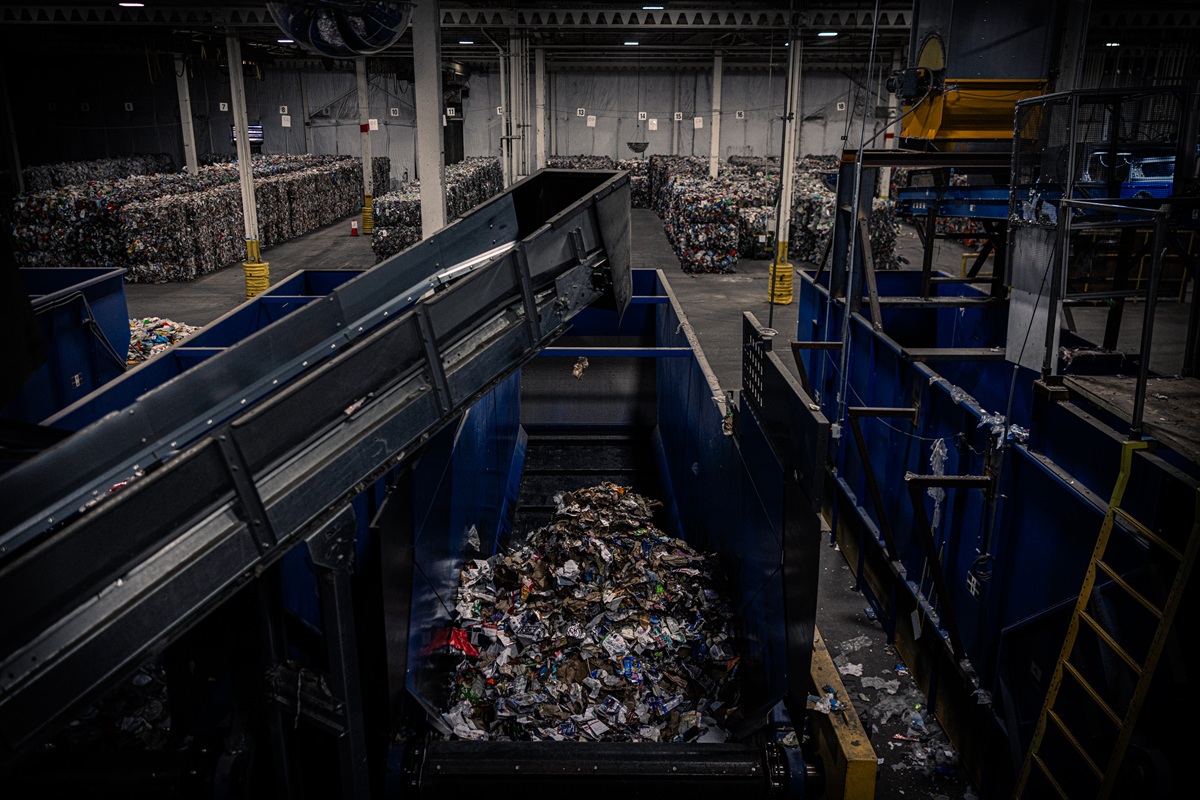
AMP started out producing robotics but now supplies entire sorting facilities with advanced sorting equipment. | Photo courtesy AMP

Emerging extended producer responsibility programs for packaging are creating demand for more accurate data, higher diversion rates and a flexible infrastructure to handle changing material streams. An equipment supplier recently laid out how its artificial intelligence-equipped sorting systems can meet this need.

Louisville, Colorado-headquartered AMP, which started as a robotics company but has expanded to supply entire sorting facility systems, last month hosted a presentation on the opportunity advanced sorting equipment presents in the new world of U.S. packaging EPR.

The company provides a variety of equipment that combines AI with optical sorting systems to identify, track and sort materials in mixed recycling streams with high precision. As materials pass under near-infrared (NIR) camera systems, the technology analyzes each item’s polymer type, color, form factor and size, creating a detailed characterization report. AMP then uses bulk density equations the company has developed to produce composition estimates with a reported 90-98% accuracy. When this data is combined with mass balancing efforts on the finished goods side, AMP gains a full picture of what is getting recycled and what is lost to residue or contamination, said Justin Davis, the company’s director of commercial origination and business development, during the webinar.

Davis described his previous employment with a company that was hired by the city of Fort Wayne, Indiana, to sample some of its collection trucks. The sampling method involved spreading the materials out on the floor and hand-weighing the load. It’s not only a labor- and time-intensive process, but it also exposes facilities to sampling bias due to their inability to characterize the entire stream, Davis said.

In addition to making sampling more efficient, advanced sorting equipment can also provide essential data for EPR compliance. 

“Once we have the producer responsibility organization in place, and funded, and the legislation is adopted, how do we know who to charge?” Davis said. “How do we know who to pay and how much? And do we ultimately know if we’re making an impact? Well, that is where the idea of AI helps to assist with compliance.”

Carson Potter, head of product for AMP, added that the company’s sorting systems allow operators to make rapid adjustments, which will be key to meeting EPR requirements. For instance, AMP’s equipment can be quickly reprogrammed to sort different material streams, meaning it can respond to variances in EPR frameworks like quality standards, end-market demands, and recovery rate thresholds, Potter explained.

AMP has also promoted its equipment’s ability to “recirculate” materials on the sorting line, meaning material passes under the cameras several times. That allows the system to choose the best moment to pick the items it is programmed for, to improve bale composition accuracy. 

Potter noted the idea of recirculation systems was widely abandoned in the industry due to issues of residue build-up and contamination. But he said AMPs technology can track, sort out and purge residue build-up from the line.

However, recirculation can help existing MRFs increase material recovery rates, Potter said, in turn helping producers meet diversion targets under EPR programs without requiring major facility overhauls.

Potter noted density separation is another component of advanced sorting systems that may be well-suited for meeting the recovery rates needed under EPR systems, because it allows sorting systems to better distinguish two-dimensional materials. That can help address sorting problems that are coming about due to packaging design changes: Potter gave an example of e-commerce giant Amazon’s shift to smaller-format containerboard boxes, noting that older sorting systems have had trouble identifying this type of packaging. Density separation could ease that challenge.

Tags: Technology
TweetShare
Andrew Sposato

Andrew Sposato

Related Posts

Amazon, DOE partner on critical materials recovery

byScott Snowden
April 13, 2026

DOE and Amazon will study recovery of graphite from textiles and gallium from IT hardware, aiming to strengthen US supply...

Packaging sector sees shift from AI pilots to wider use

byScott Snowden
April 1, 2026

AI adoption is expanding across packaging operations as costs fall and use cases widen, though concerns around accountability, ROI and...

ReElement, Mitsubishi partner on rare earth supply chains

byScott Snowden
March 31, 2026

ReElement and Mitsubishi Materials form a US-Japan partnership to expand rare earth refining, targeting supply chain gaps with recycling, feedstock...

Circularity push meets internal behavior hurdles

byScott Snowden
March 30, 2026

At PRC, former Jabil executive Cassie Gruber argued circular economy efforts often stall on internal habits and culture, as she...

Report pegs fire losses at $2.5b in US and Canada recycling industry

byScott Snowden
March 27, 2026

A new fire report estimates $2.5b in damage across US and Canadian recycling facilities in 2025, with lithium-ion batteries still...

#ESC2025 Speaker Spotlight: Matthew Young

From bootstrap to boom: EVR poised for growth after capital injection

byStefanie Valentic
March 26, 2026

Baltimore e-recycling company Electronics Value Recovery (EVR) is accelerating nationwide expansion into the ITAD and enterprise markets after securing a...

Load More
Next Post

News from Agilyx, TOMRA Recycling and more

More Posts

EPR fees are a market signal. Here’s what they’re telling you.

EPR fees are a market signal. Here’s what they’re telling you.

April 10, 2026
End markets, policy key to RPET viability

End markets, policy key to RPET viability

April 8, 2026

Trafigura signs $1.1b deal for recycled battery metals

April 8, 2026
Wineries help create model for film recycling

Wineries help create model for film recycling

April 7, 2026
With RPET in crisis, focus turns to solutions

With RPET in crisis, focus turns to solutions

April 2, 2026
Wolframite ore, the primary ore of tungsten from Altai, Russia

Tungsten scrap export controls draw industry attention

April 9, 2026

WM opens new $60m MRF in Indy

April 10, 2026
Plastics Recyclers Have the Capacity to Recycle More. Now Let’s Use It.

Study finds most recycling occurs within 30 miles of access

April 8, 2026

GFL acquires SECURE Waste for $6.4bn

April 13, 2026
Solarcycle starts up Georgia recycling plant

S3399 signals a shift in how states are tackling solar panel waste

April 6, 2026
Load More

About & Publications

About Us

Staff

Archive

Magazine

Work With Us

Advertise
Jobs
Contact
Terms and Privacy

Newsletter

Get the latest recycling news and analysis delivered to your inbox every week. Stay ahead on industry trends, policy updates, and insights from programs, processors, and innovators.

Subscribe

Welcome Back!

Login to your account below

Forgotten Password?

Retrieve your password

Please enter your username or email address to reset your password.

Log In

Add New Playlist

No Result
View All Result
  • The Latest
  • Analysis
  • Recycling
  • E-Scrap
  • Plastics
  • Policy Now
  • Conferences
    • E-Scrap Conference
    • Plastics Recycling Conference
    • Resource Recycling Conference
    • Textiles Recovery Summit
  • Magazine
  • About Us
  • Advertise
  • Archive
  • Jobs
  • Staff
Subscribe
This website uses cookies. By continuing to use this website you are giving consent to cookies being used. Visit our Privacy and Cookie Policy.