





Advertisement Header Ad
Resource Recycling
  • The Latest
  • Analysis
    • All
    • Certification Scorecard
    • Industry Announcements
    • Opinion

    Industry Announcements for Week of December 8

    Certification Scorecard for December 3, 2025

    Industry Announcements for Week of December 1

    News from Dynamic Lifecycle Innovations, Precision E-Cycle

    News from Northeast Recycling Council, Plastipak and more

    News from Northeast Recycling Council, Sortera Technologies and more

    News from MKV Polymers, Metallium Ltd. and more

    Certification Scorecard for November 19, 2025

    News from American Beverage, Inteplast Group and more

  • Conferences
  • Publications

    Other Topics

    Textiles
    Organics
    Packaging
    Glass
    Brand Owners

    Metals
    Technology
    Research
    Markets
    Grant Watch

    All Topics

Subscribe
No Result
View All Result
Resource Recycling
  • The Latest
  • Analysis
    • All
    • Certification Scorecard
    • Industry Announcements
    • Opinion

    Industry Announcements for Week of December 8

    Certification Scorecard for December 3, 2025

    Industry Announcements for Week of December 1

    News from Dynamic Lifecycle Innovations, Precision E-Cycle

    News from Northeast Recycling Council, Plastipak and more

    News from Northeast Recycling Council, Sortera Technologies and more

    News from MKV Polymers, Metallium Ltd. and more

    Certification Scorecard for November 19, 2025

    News from American Beverage, Inteplast Group and more

  • Conferences
  • Publications

    Other Topics

    Textiles
    Organics
    Packaging
    Glass
    Brand Owners

    Metals
    Technology
    Research
    Markets
    Grant Watch

    All Topics

Subscribe
No Result
View All Result
Resource Recycling
No Result
View All Result
Home Recycling

NYC study finds lower capture rates, higher contamination

Marissa HeffernanbyMarissa Heffernan
April 9, 2024
in Recycling
Share on XLinkedin
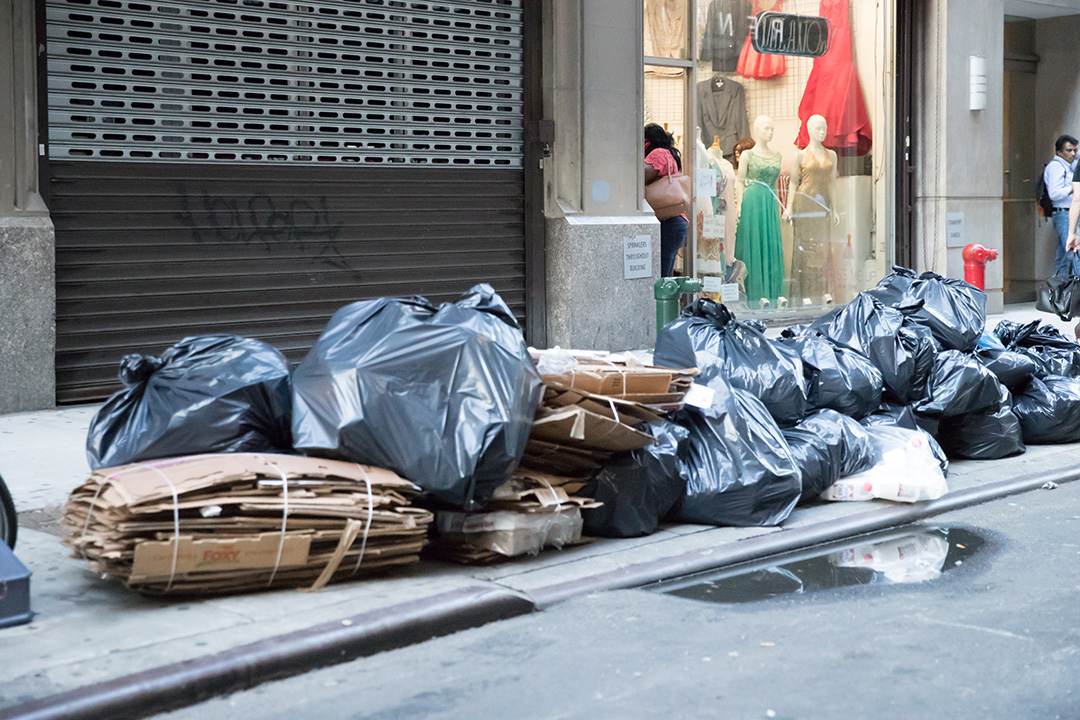
The study, conducted in fall 2022 and spring 2023, sorted samples from residential households, New York City Public Schools, the New York City Housing Authority and on-street litter baskets into 96 main categories. | Helen89/Shutterstock

A waste characterization study in New York City found that recycling rates for metal, glass, plastic and paper declined from previous study years. It also found capture rates decreased and contamination rates increased.

The study, conducted in fall 2022 and spring 2023, sorted samples into 96 main categories and then further into 826 unique material categories. It drew from residential households, New York City Public Schools, the New York City Housing Authority and on-street litter baskets. 

It found that in 2023, 75% of New York City residential waste was made of up materials that can be diverted from landfill with currently available sanitation department managed programs and private recycling operations. However, the city’s 2023 diversion rate was 20.2%. 

Jessica Tisch, New York City Department of Sanitation commissioner, said in the study that the findings will “provide significant guidance to the next steps of the Trash Revolution.” 

“There is new information about the success of universal, easy-to-use composting programs, and actionable information about the relationship between waste generation and density that will be useful in the long-overdue effort to containerize all of New York City’s trash,” Tisch wrote. “In addition, the study found that since bans on expanded polystyrene and plastic shopping bags went into effect, both of these items have declined substantially in the waste stream, validating bans as an effective strategy and lending credence to the fight to enact extended producer responsibility at the state level.” 

The last waste characterization study in the city was done in 2017. Since then, New York enacted a statewide ban on most plastic bags and certain expanded polystyrene products. From 2017 to 2023, expanded polystyrene in the stream decreased by 54% by weight, while plastic shopping bags decreased by 67.8%, by weight, from 38.2 pounds per household to 12.3 pounds per household.

Specifically, plastic bags decreased from 1.9% to 0.6% as a percent of all material when compared to 2017, and foam decreased from 0.7% of the stream to 0.3%. 

However, in those years, lithium-ion batteries have become “a new, widespread occurrence in the waste stream,” the report noted. 

Contamination on the rise

The study found that in 2023, the residential stream was 32% curbside recyclables, 36% organics suitable for composting, 7% other divertable materials and 25% other, which includes construction and demolition debris. 

Of the curbside recyclables, 16.6% were metal, glass, plastic and cartons, while 15.8% was clean paper and cardboard. Of the organics suitable for composting: 21.1% were food scraps, 9.0% food-soiled paper and 5.7% was yard waste. 

Breaking down the 7% that were other divertable materials, 5.0% were textiles, 0.5% e-scrap, 0.6% plastic shopping bags and 0.4% harmful household products. 

The final quarter of the residential stream are non-divertible other items, including “diapers, foam, garden hoses and different types of film plastics,” the study noted. 

On a per household basis, annual generation of all aggregate material is down to 1,899 pounds in 2023, compared to 1,988 pounds in 2017. 

Paper contamination rates increased by an average of 1.9% between study periods since 2005, but increased by 6% between 2017 and 2023, the study found. 

“Rates of contamination in 2023 are higher than in 2013, when all rigid plastics were not designated as recyclable,” the study noted. “Despite designating more plastic categories as recyclable in 2023, the contamination rate in MGP recycling – including organic material, paper, and non-recyclable film plastic – has increased to 27.5% in 2023 from 18.7% in 2017.”

The 2023 study also included a data breakdown by density and income, finding that higher income areas tended to recycle more and higher density areas tended to generate less material. 

Fiber capture rate reverses longtime trend

Delving into capture rates by material type, both the amount of clean paper and cardboard generated and collected has decreased since 2017. Further, 2023 was the first year in which paper capture rates declined since measurements began in 2005.

In 2005 the clean paper and OCC capture rate was 45.8%, growing to 46.8% in 2013 and 51.3% in 2017 before falling in 2023 to 48.8%. 

The capture rate for metal, glass and plastic in 2023 was 40.9%, down from 43.5% in 2017. In 2005 and 2013, the capture rates were 44.3% and 47.4%, respectively, though those years did not include non-bottle rigid plastics.

Broken out by specific material, in 2023 the capture rate for HDPE colored bottles was 57.9% and HDPE natural bottles came in at 54.7%. Clear and green PET bottles were captured at a rate of 39.3%, while all other PET bottle colors were captured at 46.7%. Other resin type bottles were captured at a rate of 35.8%. 

The 2023 rate for thermoforms was 31.9%, and about 9.7% of single-use plastics were captured. Beverage cartons and aseptic boxes had a rate of 35.5%, while aluminum cans and bottles came in with a rate of 25.5%.

Glass capture rates in 2023 were 53.3% for clear container glass; 47.8% for brown container glass; 57.7% for other color container glass and 27.7% for other glass in general. 
Tags: DataLocal ProgramsResearch
Marissa Heffernan

Marissa Heffernan

Marissa Heffernan worked at Resource Recycling from January 2022 through June 2025, first as staff reporter and then as associate editor. Marissa Heffernan started working for Resource Recycling in January 2022 after spending several years as a reporter at a daily newspaper in Southwest Washington. After developing a special focus on recycling policy, they were also the editor of the monthly newsletter Policy Now.

Related Posts

Global recycling patent trends may reflect legislative push

Global recycling patent trends may reflect legislative push

byAntoinette Smith
November 25, 2025

Patent applications for chemical recycling technologies have reached a record high globally with government initiatives among the factors driving innovation,...

EU to drive global demand for recycled plastics

EU to drive global demand for recycled plastics

byAntoinette Smith
November 4, 2025

A new study from commodity intelligence firm ICIS and a Chinese industry association explores the impacts of European regulations on...

State of Washington studies bag ban effectiveness

State of Washington studies bag ban effectiveness

byStefanie Valentic
October 15, 2025

The Washington State Department of Commerce released a report on the effectiveness of the state’s retail carryout bag policy prohibiting...

Study maps barriers to firms’ supply chain climate goals

byAntoinette Smith
October 14, 2025

Publicly articulating clear sustainability goals helps ensure company follow-through, according to an annual supply chain study from the Massachusetts Institute...

Study links tagging tactics to lower contamination rates

byStefanie Valentic
October 14, 2025

A new report from the Solid Waste Association of North America (SWANA) examines the role penalties and education play in...

ADS recycled plastic purchase share sinks to 3-year low

byAntoinette Smith
October 8, 2025

Major buyer Advanced Drainage Systems reached its lowest level of recycled plastic purchases since its fiscal 2022 baseline, according to...

Load More
Next Post

The Future of Plastic Recycling: Four Key Trends in 2024 for Plastic Recycling

More Posts

Analysis: Q3 earnings confirm new industry priorities

Analysis: Q3 earnings confirm new industry priorities

November 12, 2025
Iron Mountain raises ITAD guidance on strong growth

Iron Mountain raises ITAD guidance on strong growth

November 12, 2025
ERCC outlines shift toward convenience benchmarks

ERCC outlines shift toward convenience benchmarks

November 12, 2025
Analysis: EU softens ESG rules as compliance pressure builds for US

Analysis: EU softens ESG rules as compliance pressure builds for US

November 19, 2025
Sector holds wide gaps in environmental standards

Sector holds wide gaps in environmental standards

November 19, 2025
From crawl to run: a clear roadmap for ITAD ESG

From crawl to run: a clear roadmap for ITAD ESG

November 19, 2025
New entrepreneurs bring renewed energy to e-cycling

New entrepreneurs bring renewed energy to e-cycling

November 19, 2025
The Re:Source Podcast Episode 1: E-Scrap look-back and 2026 outlook

The Re:Source Podcast Episode 1: E-Scrap look-back and 2026 outlook

November 21, 2025
ERI and ReElement partner on rare earth magnet recovery

ERI and ReElement partner on rare earth magnet recovery

November 26, 2025
Cyber risks confront ITAD work, contracts, coverage

Cyber risks confront ITAD work, contracts, coverage

November 26, 2025
Load More

About & Publications

About Us

Staff

Archive

Magazine

Work With Us

Advertise
Jobs
Contact
Terms and Privacy

Newsletter

Get the latest recycling news and analysis delivered to your inbox every week. Stay ahead on industry trends, policy updates, and insights from programs, processors, and innovators.

Subscribe

Welcome Back!

Login to your account below

Forgotten Password?

Retrieve your password

Please enter your username or email address to reset your password.

Log In

Add New Playlist

No Result
View All Result
  • The Latest
  • Analysis
  • Recycling
  • E-Scrap
  • Plastics
  • Conferences
    • E-Scrap Conference
    • Plastics Recycling Conference
    • Resource Recycling Conference
    • Textiles Recovery Summit
  • Magazine
  • About Us
  • Advertise
  • Archive
  • Jobs
  • Staff
Subscribe
This website uses cookies. By continuing to use this website you are giving consent to cookies being used. Visit our Privacy and Cookie Policy.