





Resource Recycling
  • The Latest
  • Analysis
    • All
    • Certification Scorecard
    • Industry Announcements
    • Opinion
    The electronics recycling industry is undergoing a transformation from labor-intensive manual operations to highly automated, AI-driven facilities that use advanced robotics, cleaner chemistry and digital tracking systems to extract critical materials.

    The cyber-physical MRF: AI and robotics reshape e-waste recovery

    Certification scorecard for the week of Feb. 9, 2026

    Meta-Corning deal signals IT hardware retirement wave

    Meta-Corning deal signals IT hardware retirement wave

    Malaysia clamps down on illegal e-waste imports amid probes

    Malaysia clamps down on illegal e-waste imports amid probes

    URT builds alliance to remake electronics plastics at scale

    ICYMI: Top 5 e-scrap stories from January 2026

    The electronics recycling industry is undergoing a transformation from labor-intensive manual operations to highly automated, AI-driven facilities that use advanced robotics, cleaner chemistry and digital tracking systems to extract critical materials.

    Certification scorecard for the week of Feb. 2, 2026

    Auditors warn EU may fall short on critical metals

    Auditors warn EU may fall short on critical metals

    Industry announcements for January 2026

    Industry announcements for February 2026

    ICYMI: Top 5 recycling stories from January 2026

  • Conferences
  • Publications

    Other Topics

    Textiles
    Organics
    Packaging
    Glass
    Brand Owners

    Metals
    Technology
    Research
    Markets
    Grant Watch

    All Topics

Subscribe
No Result
View All Result
Resource Recycling
  • The Latest
  • Analysis
    • All
    • Certification Scorecard
    • Industry Announcements
    • Opinion
    The electronics recycling industry is undergoing a transformation from labor-intensive manual operations to highly automated, AI-driven facilities that use advanced robotics, cleaner chemistry and digital tracking systems to extract critical materials.

    The cyber-physical MRF: AI and robotics reshape e-waste recovery

    Certification scorecard for the week of Feb. 9, 2026

    Meta-Corning deal signals IT hardware retirement wave

    Meta-Corning deal signals IT hardware retirement wave

    Malaysia clamps down on illegal e-waste imports amid probes

    Malaysia clamps down on illegal e-waste imports amid probes

    URT builds alliance to remake electronics plastics at scale

    ICYMI: Top 5 e-scrap stories from January 2026

    The electronics recycling industry is undergoing a transformation from labor-intensive manual operations to highly automated, AI-driven facilities that use advanced robotics, cleaner chemistry and digital tracking systems to extract critical materials.

    Certification scorecard for the week of Feb. 2, 2026

    Auditors warn EU may fall short on critical metals

    Auditors warn EU may fall short on critical metals

    Industry announcements for January 2026

    Industry announcements for February 2026

    ICYMI: Top 5 recycling stories from January 2026

  • Conferences
  • Publications

    Other Topics

    Textiles
    Organics
    Packaging
    Glass
    Brand Owners

    Metals
    Technology
    Research
    Markets
    Grant Watch

    All Topics

Subscribe
No Result
View All Result
Resource Recycling
No Result
View All Result
Home Recycling

WM details MRF investment plans, profit forecasts

byJared Paben
February 6, 2023
in Recycling
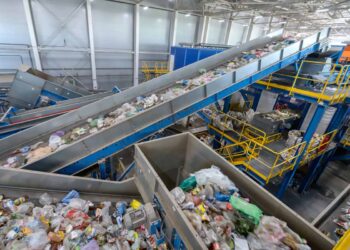
Despite falling earnings from its recycling business in 2022, Waste Management is planning significant MRF investments. | Create Jobs 51/Shutterstock

Waste Management will spend $1 billion over four years upgrading and building new MRFs, with much of the spending occurring this year, the company disclosed last week. 

Already North America’s largest MRF operator, Waste Management (WM) said it will invest $1 billion from 2022 through 2026, up from the $800 million the publicly traded company previously planned to spend over that period. The capital investments are expected to greatly boost the recycling business’ profitability.

“Our portfolio of projects to automate existing and build new material recovery facilities have three key financial benefits: reduced labor costs, improved product quality that commands a price premium and capacity growth,” said Jim Fish, WM’s CEO, during a Feb. 1 call with investors. 

The forward-looking capital investment details were included in a presentation released alongside the company’s fourth-quarter and full-year 2022 financial results. 

Over a year ago, the company announced it would spend big to improve its MRFs by installing automated sorting technologies. But with the latest disclosure, WM revised upward its expectations, while also revealing new details about the profitability of its recycling business. 

Meanwhile, WM reported that lower commodity prices hurt its recycling revenues and profits in 2022, with earnings falling by about 80% from the year prior. 

Big spending ahead

WM’s supplemental presentation, released Jan. 31, explained what factors accounted for the 25% increase in how much the company plans to invest in MRFs from 2022 through 2026. 

For one, company leaders decided to add more projects, including four additional MRF upgrades and the construction of two new MRFs in markets currently not served by WM. It has also expanded the scope of some previously planned projects. 

The presentation notes that the company expects municipal recycling program expansions to recover additional commodities and that inflation is driving up the tab for the projects. 

That $1 billion will be spent over four years, with a lot of checks being cut this year. WM spent $321 million in recycling capital expenditures in 2022. It plans to spend another $455 million this year, $180 million in 2024 and $45 million in 2025. 

WM also published financial projections showing how much additional profit the recycling expansion might bring, as measured by operating earnings before interest, taxes, depreciation and amortization (EBITDA). 

According to the presentation, the $1 billion in investments will boost the company’s recyclables sorting and marketing capacity by about 2.8 million tons by 2026. Relying on a number of assumptions, including that the blended average value of a ton of recyclables will be about $125 over that time, that additional capacity could boost WM’s total recycling operating EBITDA to $240 million per year by 2026. 

Of course, that estimate depends on recyclables prices. If the blended average recyclables price is closer to $75 a ton, then WM’s recycling EBITDA would be about $200 million a year, the company forecast. 

For comparison, in 2022, WM’s recycling operating EBITDA was $15 million. 

According to WM’s presentation, the additional profits will come from four main improvements to its recycling business: automating MRFs and reducing labor costs; improving materials separation, which allows the company to capture more material and fetch better prices; increasing its sorting capacity at existing MRFs, allowing it to sell more material; and building single-stream, C&D and commercial sorting plans in communities that currently lack recycling access, unlocking volumes of recyclables WM could sell. 

With regard to labor costs, Fish said during the Feb. 1 conference call that MRF automation projects allowed the company to reduce its headcount by 137 positions through attrition in 2022. This year, the company expects to reduce another 200 positions. 

Impacts of down recyclables prices

Meanwhile, looking backward, WM’s recycling business brought in $360 million in revenue during the fourth quarter of last year, down 25% year over year. For the full year 2022, WM’s recycling business tallied $1.70 billion in revenue, up 1% from 2021. 

According to a press release, recycling operating EBITDA in the fourth quarter was down by $51 million compared with the fourth quarter of 2021. And for the full year, EBITDA was down by $59 million compared with 2021. 

“The decline in both periods was primarily driven by a sharp decline in market prices for recycled commodities in the fourth quarter and persistent inflationary pressures on operating costs, particularly for labor at non-automated facilities, throughout the year,” the press release states.

Fiber grades, in particular, have felt the pinch. According to RecyclingMarkets.net, a ton of OCC averaged about $100 throughout 2022, down from an average of $122 the prior year. But the price slipped throughout 2022 and ended the year at a low of $29, which was down a whopping 80% from a year earlier. 

During the conference call, John Morris, the company’s chief operating officer, said WM saw an average commodity price of about $47 per ton in the fourth quarter. Tara Hemmer, WM’s chief sustainability officer, said December ended with recyclables averaging just over $50 a ton. 

WM is forecasting more pain. For 2023, the company is expecting recycling EBITDA to be down another $40 million to $50 million, again because of lower commodity prices. That projection is based on an assumption that the average value of a ton of recyclables will hover around $70 this year. 

Recycling now makes up nearly 9% of WM’s total revenue. Overall, the company tallied operating revenue of $4.94 billion and $19.70 billion during the fourth quarter and full year 2022, up 5% and 10%, respectively.

Tags: MarketsMRFs
TweetShare
Jared Paben

Jared Paben

Related Posts

NERC: Blended average prices fell 40% in third quarter

HDPE, PP bales rise as paper fiber and cans stabilize

byRecyclingMarkets.net Staff
February 12, 2026

National average prices of post-consumer material bales were flat to higher on the month.

Terex beats ESG integration targets as REV group merger closes

byStefanie Valentic
February 11, 2026

Terex exceeded $25 million in ESG integration synergy targets and completed its REV Group merger, expanding its specialty equipment platform...

Packaging Corp. to buy Greif containerboard segment

Export trends offset containerboard production decline

byStefanie Valentic
February 6, 2026

AF&PA reported a 4% decline in containerboard production for 2025, while packaging paper shipments rose 2% in December and boxboard...

States push recycling reform forward in new year

byStefanie Valentic
February 2, 2026

New Jersey just passed a bill restricting single-use plastic items, California has opened another round of public comment on SB...

WM: Upgrades temporarily slow tons recovered

WM sees ‘notable growth’ despite low recycling commodity prices

byStefanie Valentic
January 30, 2026

WM has battled headwinds from low recycling commodity prices with strategic automation and facility upgrades, the company told investors in...

New entrepreneurs bring renewed energy to e-cycling

Europe pulls ahead on ITAD now while US growth remains slower

byDavid Daoud
January 28, 2026

Early 2026 shows Europe accelerating IT asset disposition investment through facilities, acquisitions and regulation, while US ITAD growth continues in...

Load More
Next Post

Oregon counties collect batteries at curbside

More Posts

Oregon’s Recycling Modernization Act faces injunction

Court partially blocks Oregon EPR law, dismisses bulk of lawsuit

February 10, 2026
Chinese processing group details goals for US visit

AMP lays out vision of next-generation, AI-driven MRFs

July 24, 2024
Malaysia clamps down on illegal e-waste imports amid probes

Malaysia clamps down on illegal e-waste imports amid probes

February 6, 2026

REUSE Act heads to US House for consideration

February 9, 2026

ecoATM recycled 7.5M phones in 2025 as payouts hit $1.5B

February 10, 2026
Meta-Corning deal signals IT hardware retirement wave

Meta-Corning deal signals IT hardware retirement wave

February 9, 2026

APR, industry create proactive guidance for PET caps

February 12, 2026
Texas sues over dumped wind turbine blades

Texas sues over dumped wind turbine blades

February 10, 2026

Alpek talks PET overcapacity, soft demand

February 11, 2026
The electronics recycling industry is undergoing a transformation from labor-intensive manual operations to highly automated, AI-driven facilities that use advanced robotics, cleaner chemistry and digital tracking systems to extract critical materials.

The cyber-physical MRF: AI and robotics reshape e-waste recovery

February 12, 2026
Load More

About & Publications

About Us

Staff

Archive

Magazine

Work With Us

Advertise
Jobs
Contact
Terms and Privacy

Newsletter

Get the latest recycling news and analysis delivered to your inbox every week. Stay ahead on industry trends, policy updates, and insights from programs, processors, and innovators.

Subscribe

Welcome Back!

Login to your account below

Forgotten Password?

Retrieve your password

Please enter your username or email address to reset your password.

Log In

Add New Playlist

No Result
View All Result
  • The Latest
  • Analysis
  • Recycling
  • E-Scrap
  • Plastics
  • Policy Now
  • Conferences
    • E-Scrap Conference
    • Plastics Recycling Conference
    • Resource Recycling Conference
    • Textiles Recovery Summit
  • Magazine
  • About Us
  • Advertise
  • Archive
  • Jobs
  • Staff
Subscribe
This website uses cookies. By continuing to use this website you are giving consent to cookies being used. Visit our Privacy and Cookie Policy.