



Clackamas County, Ore. is the latest county in the state to adopt a different approach to battery collection and fire prevention.
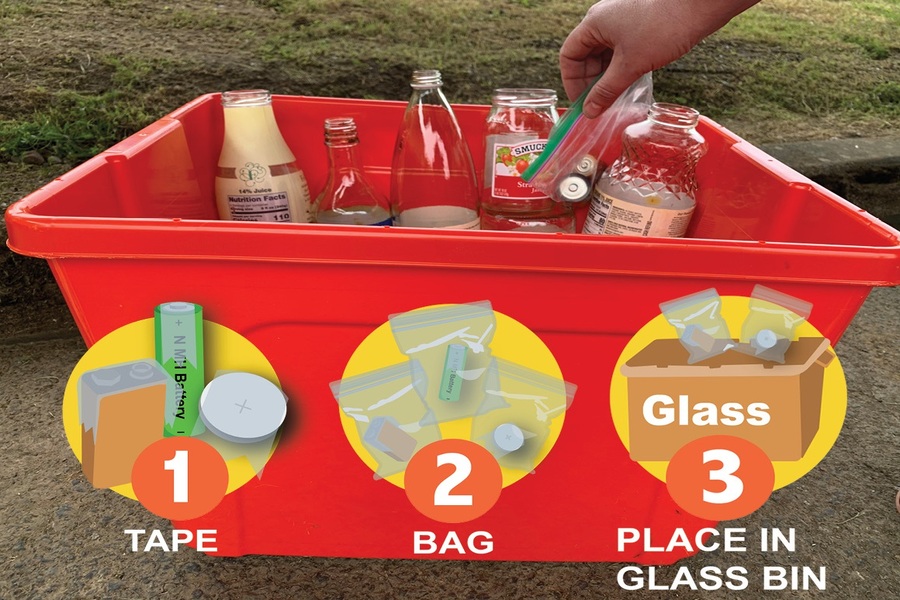
In late December, the county announced it would now accept alkaline, lithium-ion, button and rechargeable batteries curbside, as long as the terminal ends were taped and they were all put in a 1-quart sealed plastic bag in the separate glass recycling container. Lead-acid batteries and electric bike batteries cannot be recycled curbside.
Rick Winterhalter, a senior sustainability analyst for the Clackamas County Department of Sustainability and Solid Waste, said the change came after hearing about the programs that have been running in Marion County for years, and after a local collector experienced a battery-sparked fire.
“It had kind of been in our head and talked about among a lot of us around here,” he said. Then nearby Washington County started taking batteries curbside, and “it just makes a lot of sense.”
As batteries become ubiquitous in products, so too have fires in trucks and MRFs due to runaway thermal events. To avoid fire damages, risk to workers and higher insurance rates, many governments have banned batteries from curbside bins, requiring them to be dropped off at collection events or other collection points. However, some governments, such as these in Oregon, have decided to take a more unique approach and make it easier for consumers to safely dispose of batteries in curbside bins.
Those involved said the programs have been popular with the public and have not required a raise in rates.
A growing trend
The city of Gresham, Ore. started picking up batteries curbside in July 2022. Shannon Martin, solid waste and sustainability manager for the city, said it took plenty of coordination, because the city has five haulers that don’t all use the same MRF.
“That was step one, to make sure our MRFs could manage them if the drivers delivered them in a specific way,” Martin said. “And then we just got all in agreement with the haulers. All of them were very supportive of adding batteries to the program to reduce the amount of truck fires we’ve been seeing.”
Gresham also looked to Marion County and other communities for ideas, and decided putting batteries in the glass bin made the most sense.
“Given the bottle bill in Oregon, glass set outs are not that high and so we just felt like that was the natural place to have customers bag and tape the batteries and set them in there, given that they can easily be identified by the drivers,” Martin said.
Washington County started rolling out curbside battery collection at the end of 2021, said Thomas Egleston, solid waste and recycling manager for the Washington County Health and Human Services Solid Waste and Recycling Division. Marion County also served as inspiration.
“Marion County has been doing it similarly for years and we were hearing from community members that they wanted more opportunities to recycle at the curb,” he said. “Batteries came up as something that was fairly simple to implement.”
So far, the two MRFs that receive batteries from the county, Far West Recycling and Pride Recycling, have collected about 13 tons of batteries. Egleston said that was a higher number than he anticipated.
“We’ve been really impressed,” he said. “There were some concerns about them going in the glass bin – if the battery bags would get buried in the glass and end up at the glass recycler – but we haven’t seen any of that.”
There’s a smattering of cities in other states using the model. Call2Recycle, a rechargeable battery and cellphone collection program, said it doesn’t maintain a formal list, but at least three California cities – San Francisco, Sonoma and Monterey – have curbside battery collection programs, along with Santa Clara County.
A popular add-on
Winterhalter said the Clackamas community was enthusiastic about the service. Originally it was meant to start in the unincorporated county only, but city residents saw the news on Facebook and also started participating.
“I see it growing,” he said. “I see people definitely excited about using it.”
Martin and Egleston said there was an initial influx when the programs started of people clearing out years’ worth of stored batteries, but the programs have been running smoothly for the city, haulers and MRFs.
“For us, too, it was more of an equity thing,” Martin said. “Building equity into our program, since getting batteries to a household hazardous waste facility is difficult.”
In the first six months of collection, about 1,500 pounds of batteries have been put into the glass bins for pickup in Gresham, Martin said.
He does anticipate a need for a re-education campaign, because the city initially told residents to tape the ends of all batteries, including alkaline, to simplify the message. However, processors have since asked that only nickel-cadmium and lithium-ion batteries be taped.
Washington County is also seeing success, Egleston said, adding that the program was “an easy lift.”
“We didn’t have to raise rates to do it,” he said. “We have a little bit of excess revenue in the system. It does cost a little bit to process and sort them responsibly, but we’re not expecting it to be anything significant in terms of rate impacts.”
On the MRF side
Vinod Singh, outreach manager at Far West Recycling, said he was on board with curbside battery collection first and foremost from a safety standpoint.
“If we can help divert these items and avoid fires in garbage trucks, recycling trucks, transfer stations and MRFs, that’s a big win,” he said.
Singh said the start up has been slow and smooth, without significant problems.
“We’re trying to overmanage them a little bit to start, we’re touching basically every battery to make sure the right ones are taped and give feedback on the ones that don’t need to be taped,” he said.
After haulers bring in the batteries, Far West employees sort and tape them before sending them to certified downstream market battery recyclers.
Kristin Leichner, president of Pride Disposal & Recycling Company, is also processing a significant amount of the batteries coming in. For over a decade, her Sherwood, Ore. location has hosted a battery drop-off depot, which takes lead-acid batteries as well.
There was a learning curve for both customers and drivers, she said, but in 2022 Pride collected 7.5 tons of batteries curbside
“We do ask our customers to tape the ends of non-alkaline batteries. Not every one comes in taped, but if they don’t we do that taping here at our facility,” Leichner said. “It’s not a high percentage that end up taped,” so she’s planning to do more education and outreach to help improve the process.
Pride workers also sort and tape the batteries before sending them to Universal Recycling Technologies in Clackamas County.
All that processing does have a cost, but Singh and Leichner said it’s not a large amount and they see it as a preventative measure. Pride ran the numbers and decided not to increase the rate customers pay, Leichner said, because they simply added a bin for batteries to the trucks already running the glass routes.
“We look at it as in theory, we have saved 7.5 tons of disposal costs, so there is some cost savings there as well as the potential cost of losing a truck or a facility to a battery fire,” she said.
Fire prevention results
It’s hard to count fires that don’t happen, but those involved say that anecdotally, curbside pickup does seem to be reducing incidents.
Egleston said in the past five years there have been a few truck fires in Washington County, and “we haven’t had any since the battery program started, but I don’t know if we can credit the battery program with that.”
Leichner said although the frequency of fires has been increasing as more and more items that have batteries in them end up in the waste stream, it’s hard to say what impact the program has had.
“I like to think that if we have been able to get 7.5 tons of batteries out of the waste stream we’ve probably prevented at least one fire,” she said.