
Advertisement Header Ad
Resource Recycling
  • The Latest
  • Analysis
    • All
    • Certification Scorecard
    • Industry Announcements
    • Opinion

    Certification scorecard for Dec. 18, 2025

    Industry announcements for the week of Dec. 15

    Certification scorecard for December 10, 2025

    Industry Announcements for Week of December 8

    Certification Scorecard for December 3, 2025

    Industry Announcements for Week of December 1

    News from Dynamic Lifecycle Innovations, Precision E-Cycle

    News from Northeast Recycling Council, Plastipak and more

    News from Northeast Recycling Council, Sortera Technologies and more

  • Conferences
  • Publications

    Other Topics

    Textiles
    Organics
    Packaging
    Glass
    Brand Owners

    Metals
    Technology
    Research
    Markets
    Grant Watch

    All Topics

Subscribe
No Result
View All Result
Resource Recycling
  • The Latest
  • Analysis
    • All
    • Certification Scorecard
    • Industry Announcements
    • Opinion

    Certification scorecard for Dec. 18, 2025

    Industry announcements for the week of Dec. 15

    Certification scorecard for December 10, 2025

    Industry Announcements for Week of December 8

    Certification Scorecard for December 3, 2025

    Industry Announcements for Week of December 1

    News from Dynamic Lifecycle Innovations, Precision E-Cycle

    News from Northeast Recycling Council, Plastipak and more

    News from Northeast Recycling Council, Sortera Technologies and more

  • Conferences
  • Publications

    Other Topics

    Textiles
    Organics
    Packaging
    Glass
    Brand Owners

    Metals
    Technology
    Research
    Markets
    Grant Watch

    All Topics

Subscribe
No Result
View All Result
Resource Recycling
No Result
View All Result
Home Recycling

Study: Cart tagging reduces contamination, for a cost

Marissa HeffernanbyMarissa Heffernan
January 24, 2022
in Recycling
Share on XLinkedin
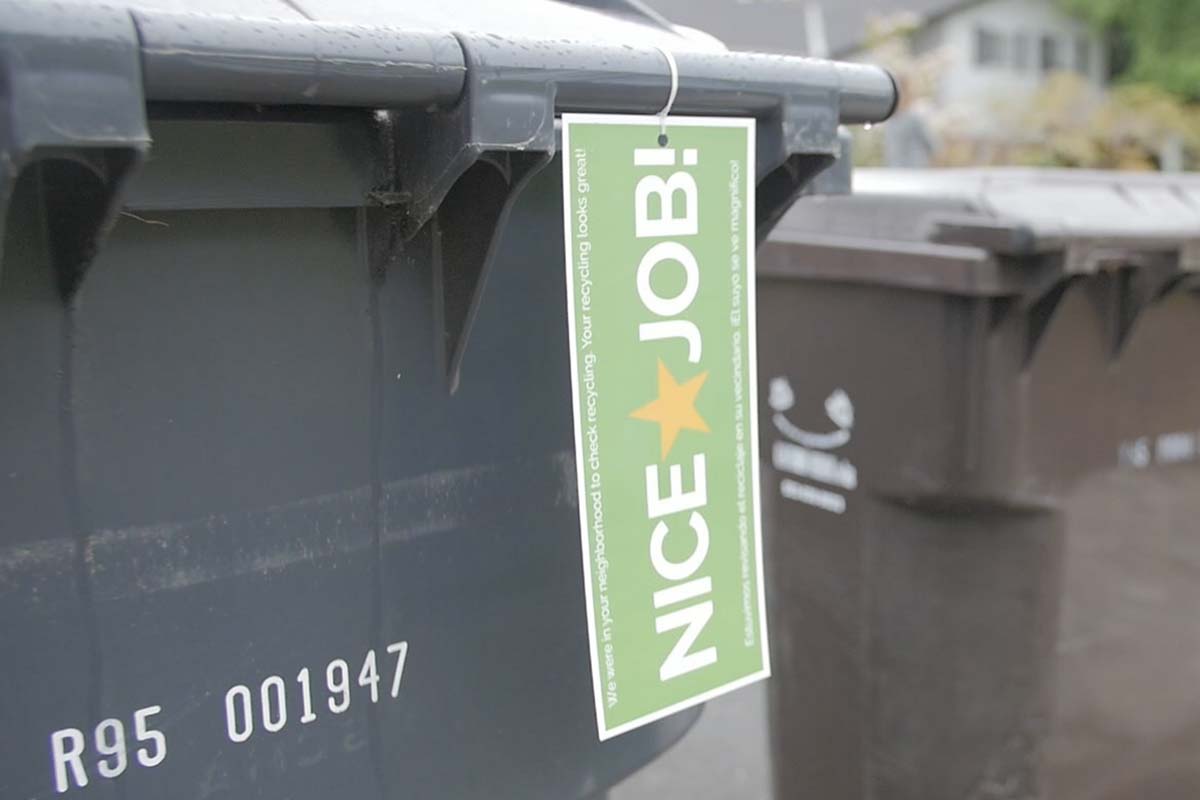
Clackamas County, Ore. was one of a number of case studies used to illustrate the data in SWANA’s report. | Clackamas Sustainability & Solid Waste Program/SWANA Report

Leaving “oops” tags on contaminated recycling carts and providing positive feedback to those with clean carts is one of the most effective ways to reduce contamination, though it can be pricey, according to a new report.

The Solid Waste Association of North America Applied Research Foundation (SWANA ARF) issued a report on the costs and effectiveness of “recycle right” educational programs. The report, “Encouraging Better Curbside Recycling Behaviors,” is a companion to an earlier SWANA ARF report released in March 2021, “Reducing Contamination in Curbside Recycling Programs.”

It includes summaries and cost analyses of The Recycling Partnership’s five recommended strategies to reduce curbside recycling contamination.

SWANA Executive Director and CEO David Biderman said the new report is a “powerful tool for local governments assessing how to improve their recycling programs and reduce contamination.”

“With the recent issuance of EPA’s National Recycling Strategy and its identification of reducing contamination as a key objective, the report is particularly timely,” he said in a press release. “SWANA will be working closely with EPA and other recycling stakeholders to implement the Strategy, using some of the lessons learned from this report.”

The five strategies are cart inspection and tagging, rejecting contaminated carts, sending direct mailers, general advertising and using social media.

SWANA ARF’s earlier report found that residents participating in curbside recycling programs can be divided into three groups: high-performers, learners and under-performers.

Over 50% of curbside contamination came from under-performers, the report said, and that group did not respond to education-only programs. The most effective way to reach under-performers was refusing to pick up contaminated carts and giving out cart contamination fines, the latest report found.

“In implementing these types of enforcement options, recycling and sustainability program managers must have the support of their local elected officials as there is likely to be pushback from under-performing residents,” the report said.

The report notes that while reliable data on the effectiveness of public outreach strategies are limited or non-existent, case studies were used to analyze each strategy.

Social media and mailers were the most effective ways to reach customers, and the least costly. The Recycling Partnership’s West Coast Contamination Initiative Research Report found that 50% of respondents in a survey of California, Oregon and Washington got their recycling program information from the internet and 10% from the cart label or mailed information.

While cart tagging is one of the most effective methods of actually reducing curbside recycling contamination, the report noted that it is labor-intensive. While costs vary by jurisdiction, the report estimates that a campaign including at least 5,000 homes ranges from $1.50 to $2.50 per household for direct engagement and mailings plus $5,000 for boosted social media and $20,000 for community signage.

However, money spent on inspecting and tagging can be recouped by the savings of lower contamination rates. In Fort Worth, Texas, the city expects to save about $475,000 per year by reducing its contamination rate from 28% to 21% through its cart inspection and tagging program, which costs $500,000 annually.

Some case studies found that carts did not necessarily need to be individually inspected and tagged to reduce contamination. Based on study findings, tagging every cart with a standard message was more effective at reducing a contaminant that is widely placed in recycling containers, like plastic bags. Direct feedback was more effective at reducing highly contaminated carts.

In 2018, in Snohomish County, Wash., Waste Management tested both generic cart tagging without cart inspection and individualized cart tagging following cart inspection to try to reduce the amount of plastic bags and bagged recyclables in recycling carts.

While the assumption at the outset of the study was that individualized cart tags would be more effective at reducing overall contamination, the study found that generic tags were actually more effective at reducing overall contamination. But if a recycling program is trying to persuade a specific household to stop putting a particular type of contaminant in the cart, then the individualized cart tags were more effective, the report found.

In Clackamas County, Ore., a six-week program in 2018 to tag clean carts with a “nice job” tag and contaminated carts with an “oops” tag improved contamination rates. Inspectors checked 11,809 set-out carts, and during the first week, only 37% got a “nice job” tag. By the sixth and final week of the study, that number had risen to 54%.

 

Tags: CollectionContaminationLocal Programs
Marissa Heffernan

Marissa Heffernan

Marissa Heffernan worked at Resource Recycling from January 2022 through June 2025, first as staff reporter and then as associate editor. Marissa Heffernan started working for Resource Recycling in January 2022 after spending several years as a reporter at a daily newspaper in Southwest Washington. After developing a special focus on recycling policy, they were also the editor of the monthly newsletter Policy Now.

Related Posts

Grant funds EPS foam recycling in Nebraska

Grant funds EPS foam recycling in Nebraska

byAntoinette Smith
December 16, 2025

First Star Recycling in Omaha and the City of Lincoln each received $25,000 grants from the Foodservice Packaging Institute's Foam...

landfill

Virginia opens comment for state solid waste plan

byPaul Lane
December 11, 2025

Virginia is taking public comment on a draft solid waste plan that updates decades-old rules, raises recycling goals, expands data...

New rules push OEMs to design for repair, reuse

byScott Snowden
December 11, 2025

Right-to-repair rules are pushing longevity and reuse deeper into product design, but thin hardware, device locks and weak data are...

electronic vapes

Vape fires cost waste, recycling sector $2.5B yearly

byScott Snowden
December 9, 2025

Waste and recycling operators are heading into another year of elevated fire risk as lithium-ion batteries from electronics and disposable...

NYC Commercial Waste Zones

IWS acquires Filco to expand in NYC commercial waste zones

byStefanie Valentic
December 3, 2025

Interstate Waste Services, Inc. is expanding its footprint in New York City through the acquisition of Filco Carting Corp. This...

WM rolling out curbside acceptance of PP cups 

WM rolling out curbside acceptance of PP cups 

byKeith Loria
November 25, 2025

While people may not think twice about throwing away a takeout cup, the nation's biggest hauler is looking to change...

Load More
Next Post

Recycling operators cheer list of problematic plastics

More Posts

ERI and ReElement partner on rare earth magnet recovery

ERI and ReElement partner on rare earth magnet recovery

November 26, 2025
Cyber risks confront ITAD work, contracts, coverage

Cyber risks confront ITAD work, contracts, coverage

November 26, 2025
Ohio start-up turns plastics into high-end furniture

Ohio start-up turns plastics into high-end furniture

November 24, 2025
WM adds PP and paper cups to curbside recycling lists

WM adds PP and paper cups to curbside recycling lists

November 24, 2025
Atlas acquisition boosts Circular Services’ organics reach

Atlas acquisition boosts Circular Services’ organics reach

November 24, 2025
Policy Now | December 2025 – Year-end nears, policy talks continue

Policy Now | December 2025 – Year-end nears, policy talks continue

December 1, 2025
WM rolling out curbside acceptance of PP cups 

WM rolling out curbside acceptance of PP cups 

November 25, 2025
Ohio startup creates end market for small challenging plastics

Ohio startup creates end market for small challenging plastics

November 25, 2025
Global recycling patent trends may reflect legislative push

Global recycling patent trends may reflect legislative push

November 25, 2025
Oregon’s Recycling Modernization Act faces injunction

Oregon’s Recycling Modernization Act faces injunction

December 2, 2025
Load More

About & Publications

About Us

Staff

Archive

Magazine

Work With Us

Advertise
Jobs
Contact
Terms and Privacy

Newsletter

Get the latest recycling news and analysis delivered to your inbox every week. Stay ahead on industry trends, policy updates, and insights from programs, processors, and innovators.

Subscribe

Welcome Back!

Login to your account below

Forgotten Password?

Retrieve your password

Please enter your username or email address to reset your password.

Log In

Add New Playlist

No Result
View All Result
  • The Latest
  • Analysis
  • Recycling
  • E-Scrap
  • Plastics
  • Conferences
    • E-Scrap Conference
    • Plastics Recycling Conference
    • Resource Recycling Conference
    • Textiles Recovery Summit
  • Magazine
  • About Us
  • Advertise
  • Archive
  • Jobs
  • Staff
Subscribe
This website uses cookies. By continuing to use this website you are giving consent to cookies being used. Visit our Privacy and Cookie Policy.