





Resource Recycling
  • The Latest
  • Analysis
    • All
    • Certification Scorecard
    • Industry Announcements
    • Opinion
    EPR fees are a market signal. Here’s what they’re telling you.

    EPR fees are a market signal. Here’s what they’re telling you.

    Wolframite ore, the primary ore of tungsten from Altai, Russia

    Tungsten scrap export controls draw industry attention

    Certification Scorecard — Week of April 6, 2026

    Closed Loop Partners acquires Sutter Metals, connecting electronics disposition to metals recovery

    Certification Scorecard — Week of March 30, 2026

    Industry announcements for January 2026

    Industry announcements for April 2026

    Certification scorecard – Week of March 23, 2026

    Certification Scorecard – Week of March 16, 2026

    Groups identify recovered plastics users in the Northeast

    Bale pricing for recycled plastics diverges

  • Conferences
  • Publications

    Other Topics

    Textiles
    Organics
    Packaging
    Glass
    Brand Owners

    Metals
    Technology
    Research
    Markets
    Grant Watch

    All Topics

Subscribe
No Result
View All Result
Resource Recycling
  • The Latest
  • Analysis
    • All
    • Certification Scorecard
    • Industry Announcements
    • Opinion
    EPR fees are a market signal. Here’s what they’re telling you.

    EPR fees are a market signal. Here’s what they’re telling you.

    Wolframite ore, the primary ore of tungsten from Altai, Russia

    Tungsten scrap export controls draw industry attention

    Certification Scorecard — Week of April 6, 2026

    Closed Loop Partners acquires Sutter Metals, connecting electronics disposition to metals recovery

    Certification Scorecard — Week of March 30, 2026

    Industry announcements for January 2026

    Industry announcements for April 2026

    Certification scorecard – Week of March 23, 2026

    Certification Scorecard – Week of March 16, 2026

    Groups identify recovered plastics users in the Northeast

    Bale pricing for recycled plastics diverges

  • Conferences
  • Publications

    Other Topics

    Textiles
    Organics
    Packaging
    Glass
    Brand Owners

    Metals
    Technology
    Research
    Markets
    Grant Watch

    All Topics

Subscribe
No Result
View All Result
Resource Recycling
No Result
View All Result
Home Recycling

SWANA: Safety figures headed in wrong direction

Colin StaubbyColin Staub
February 12, 2019
in Recycling

Waste and recycling industry safety has received elevated attention in recent years as injuries and fatalities have risen. Despite collaboration and the heightened focus, the numbers show little improvement.

“You would think with all of this activity and all of these relationships that the safety performance of the industry is great and probably getting better,” said David Biderman, executive director of Solid Waste Association of North America (SWANA). “You would be incorrect.”

SWANA recently hosted a webinar highlighting the state of safety. It featured multiple experts with tips on moving the waste and recycling industry off the list of deadliest jobs. The presentation came shortly after SWANA announced industry-related fatalities remain high in early 2019.

Statistics vary but show poor safety performance

Despite state Slow Down to Get Around laws and federal Electronic Logging Device mandate, fatality figures are moving in the wrong direction, Biderman said. Collection is currently the fifth deadliest job in the U.S. For reference, waste collectors carry a higher fatality rate than police officers and firefighters.

After a significant decade-long decline in deaths leading up to 2009, the fatality rate increased markedly, Biderman said. The federal Bureau of Labor Statistics (BLS) tracks deaths and publishes figures each year, and the 2017 BLS report showed 32 collection deaths, six deaths at landfills and four fatalities at MRFs.

But Biderman added that the federal government is likely not aware of all fatalities in the industry. For example, BLS counts temporary waste collection workers in a separate category specifically for temporary workers, meaning injuries and fatalities in that sector are not factored into the industry total.

In its most recent report, BLS indicated that MRF injuries significantly increased in 2017. However, BLS cautioned that it does not have sufficient data to determine whether the noted increase is “statistically meaningful,” Biderman added.

SWANA tracked a relatively similar fatality count as BLS for 2017, noting 40 worker deaths.  Additionally, SWANA tracks deaths of members of the public who are killed in incidents involving the waste sector, most of which are vehicular accidents. In 2017, the group tallied 95 third-party deaths, an increase from the previous year.

A disproportionate number of fatalities are occurring at small, private-sector companies, Biderman said. Outreach to that sector can be more difficult, particularly because there is a higher rate of companies that are not industry association members, Biderman said.

Tactics to reverse trend

On a larger scale, employers should look at their own facility safety records and identify patterns, Biderman said. Doing so provides direction on the safety priorities.

Visual aides are key when conducting safety outreach, Biderman said, and are particularly effective at grabbing attention during worker safety meetings.

“If a picture says a thousand words, a video is worth a thousand pictures,” he said.

Biderman was joined on the webinar by experts in vehicular and facility safety.

Ed Devries, Hamilton, Ontario project manager for the city’s waste collection department, described the results his department has experienced by implementing in-truck cameras. These cameras are triggered by specific driving behaviors, such as sudden braking or rapid acceleration, and can also be turned on manually by the driver.

From July 2015 to May 2018, the city witnessed a 72 percent decrease in collection incidents, Devries said. And for the events that occurred, the department observed a 74 percent decrease in incident severity — each incident is scored based on the specifics of what happened.

Hamilton has also used data to implement specific driving practices. For example, one campaign targeted following distance for collection vehicles, after receiving some statistics from a company providing drive cameras.

“If you’re driving a vehicle and you’re following with less than two seconds distance from the car in front of you, you’re 4.8 times more likely to be involved in a collision within the next six months than if you had a greater-than-two-second driving distance,” Devries said.

Kasem Cornelius, operations consultant for Blue Ridge Services, a consulting firm, spoke to safety in MRFs and other facilities. He described surveys indicating that 90 percent of solid waste facilities do not have safety planning documents in place or up to date. As such, adopting a plan and keeping it current is a key step facilities can take to improve safety records.

And he noted that lesser incidents, such as minor injuries, should not be ignored. They can be a harbinger of future safety problems.

“When we don’t properly address these at-risk behaviors and these near misses that are occurring every day, those unchecked behaviors are what lead to the medical incidents, lost time and fatalities,” Cornelius said.

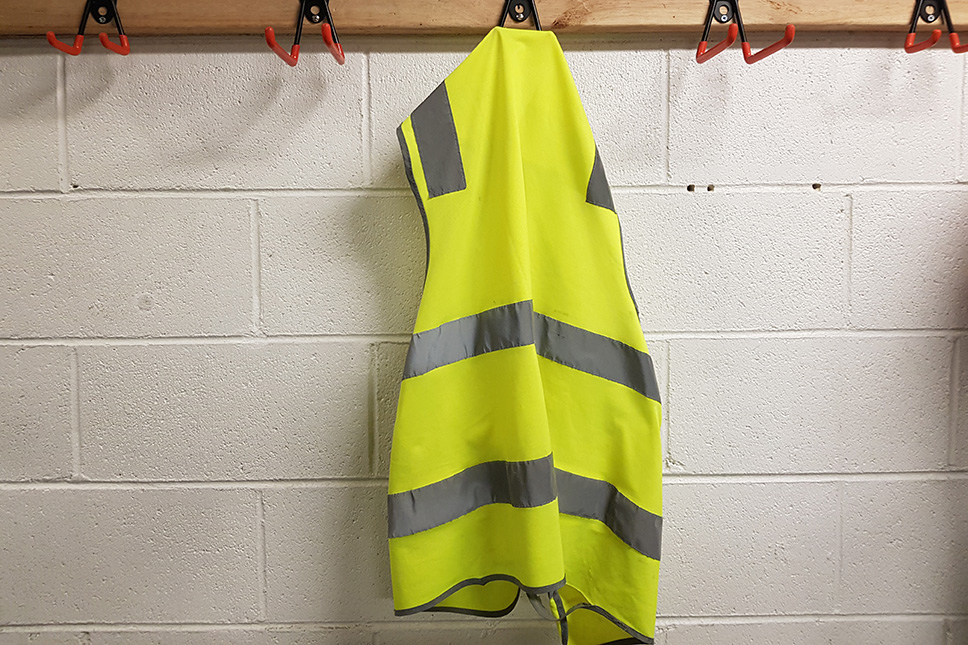
Photo credit: Gilyi Rung/Shutterstock

 

Tags: CollectionIndustry Groups
TweetShare
Colin Staub

Colin Staub

Colin Staub was a reporter and associate editor at Resource Recycling until August 2025.

Related Posts

Oregon’s battery EPR bill officially charged for implementation

byStefanie Valentic
April 10, 2026

Oregon Governor Tina Kotek signed HB 4144 into law on April 7, setting into motion the mechanics for an extended...

Plastics Recyclers Have the Capacity to Recycle More. Now Let’s Use It.

Study finds most recycling occurs within 30 miles of access

byBrian Clark Howard
April 8, 2026

Researchers at the University at Buffalo also found that Americans produce similar volumes of plastic package waste regardless of economic...

End markets, policy key to RPET viability

End markets, policy key to RPET viability

byAntoinette Smith
April 8, 2026

Longer-term actions support domestic RPET markets and can help prevent the loss of public trust in recycling systems, industry experts...

MRF equipment firm Machinex wins patent fight with rival

Judge blocks four groups from joining Oregon Recycling Act injunction

byStefanie Valentic
April 7, 2026

A judge has shut the door on four industry groups seeking to join NAW's Oregon EPR injunction and clarified who's...

UBC stakeholders report on recycling progress

Trump’s Section 232 tariff overhaul provides mixed results for recycling industry

byStefanie Valentic
April 7, 2026

A sweeping overhaul of the Section 232 steel and aluminum derivatives tariff program took effect April 6, slashing duty rates...

Independents complement primary PRO in state EPR

byAntoinette Smith
April 6, 2026

Separate producer responsibility organizations for specialized packaging such as petroleum products can help ensure success for everyone, according to the...

Load More
Next Post

How a tumultuous 2018 affected Republic Services

More Posts

Wineries help create model for film recycling

Wineries help create model for film recycling

April 7, 2026
With RPET in crisis, focus turns to solutions

With RPET in crisis, focus turns to solutions

April 2, 2026

Trafigura signs $1.1b deal for recycled battery metals

April 8, 2026
End markets, policy key to RPET viability

End markets, policy key to RPET viability

April 8, 2026
PCA closing Richmond plant

PCA closing Richmond plant

April 2, 2026
Oregon’s Recycling Modernization Act faces injunction

Why EPR’s biggest obstacle might not be legislation

April 6, 2026
EPR fees are a market signal. Here’s what they’re telling you.

EPR fees are a market signal. Here’s what they’re telling you.

April 10, 2026
Wolframite ore, the primary ore of tungsten from Altai, Russia

Tungsten scrap export controls draw industry attention

April 9, 2026

Apparel retailer organization challenges SB 707 textile PRO selection

April 2, 2026

Independents complement primary PRO in state EPR

April 6, 2026
Load More

About & Publications

About Us

Staff

Archive

Magazine

Work With Us

Advertise
Jobs
Contact
Terms and Privacy

Newsletter

Get the latest recycling news and analysis delivered to your inbox every week. Stay ahead on industry trends, policy updates, and insights from programs, processors, and innovators.

Subscribe

Welcome Back!

Login to your account below

Forgotten Password?

Retrieve your password

Please enter your username or email address to reset your password.

Log In

Add New Playlist

No Result
View All Result
  • The Latest
  • Analysis
  • Recycling
  • E-Scrap
  • Plastics
  • Policy Now
  • Conferences
    • E-Scrap Conference
    • Plastics Recycling Conference
    • Resource Recycling Conference
    • Textiles Recovery Summit
  • Magazine
  • About Us
  • Advertise
  • Archive
  • Jobs
  • Staff
Subscribe
This website uses cookies. By continuing to use this website you are giving consent to cookies being used. Visit our Privacy and Cookie Policy.