



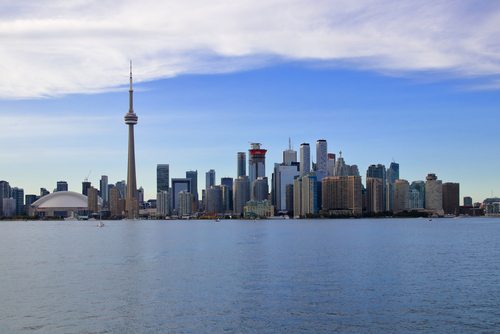
In Toronto, as in other cities, multi-family residential recycling rates have been stubbornly lower than their single-family counterparts. As Canada’s largest city works to boost recycling rates, a local MRF operator is experimenting with recovering recyclables from multi-family garbage streams.
Two presentations at last month’s WasteCon 2017 event in Baltimore touched on the recycling environment in Toronto. Jim McKay, general manager of solid waste management services for the city of Toronto, spoke during a keynote session focused on the experiences of mega-cities.
A separate breakout session presentation from Jake Westerhof, vice president of corporate strategy for Canada Fibers, explored his company’s new mixed-waste processing project, which shows promise for boosting multi-family recovery rates.
Putting it in context
When looking at recycling in Toronto and the province of Ontario, it’s important to remember the context – government there has been aggressive about using its power to support materials diversion.
Under provincial law, printed paper and packaging producers have been required to fund half of the costs of the Blue Box program, the name for Ontario’s curbside single-stream recycling service. The province, Canada’s most populous, is currently shifting to a full extended producer responsibility model in which producers will be required to manage and ensure full funding for the recycling systems.
McKay said he’s hoping the regulatory change will spur improvements in product design to aid recyclability.
In his presentation, Westerhof said he, too, was excited about the shift to full producer responsibility, and he thinks it will result in synergies for pulling materials through to enable a circular economy.
About 95 percent of province residents have access to single-stream service accepting a broad range of materials, including paper, metals, plastics, glass, polycoated containers and more, Westerhof noted. Canada Fibers’ Toronto MRF, for example, sorts material into 17 different fractions, Westerhof said.
The province is also highly involved in organics management: 37 municipalities provide source-separated organics, mostly to create compost but also, in some cases, biogas, Westerhof said. It is now considering imposing an organics disposal ban by 2023.
Westerhof also noted the province’s high disposal costs, with a tipping fee north of $100 Canadian dollars. Residents in the province are simply prepared to pay more to recover materials, he said.
Ontario’s residential diversion rate is about 48 percent, a number that counts Blue Box, organics recycling and other programs.
City’s multi-family challenges
With a population of 2.7 million, Toronto boasts a 65 percent diversion rate (not including contamination) in its single-stream, single-family program, McKay said. But the number falls to around 26-27 percent for multi-family, something the city wants to address.
While multi-family recycling performance generally lags curbside single-family in most communities, Toronto faces some unique challenges. It has a very high percentage of apartment dwellers. According to Statistics Canada, only 24 percent of the city’s population lives in single-detached houses, while 44 percent live in apartment buildings that are five or more stories tall and nearly 32 percent live in shorter apartment buildings, row houses, duplexes and other attached dwellings.
McKay noted that more than half of the city’s population wasn’t born in Canada, which presents language and cultural barriers in communications. It also has a lot of high-rise buildings built in the ‘60s and ‘70s that sport only garbage chutes.
Over the past few years, the city has learned some lessons the hard way. “We tried to apply a single-family model to multi-family buildings, and that hasn’t worked,” McKay said.
While buildings may look the same, the demographics can vary, he noted. “We really have to go building by building to identify what their needs are,” he said.
One change that has been successful is converting the buildings’ garbage chutes to source-separated organics chutes. Residents still have to carry their dry materials downstairs – both garbage and single-stream recyclables – but they don’t have to keep the putrescible materials around long. That change has led to some of the city’s highest-performing buildings.
Reasons for mixed-waste endeavors
Canada Fibers, a 27-year-old vertically integrated company, runs more than a dozen MRFs, including the largest in Canada: a five-year-old facility that sorts all of Toronto’s 200,000 tons of single-stream material annually, plus a little more. Upstream, the company is involved in collection. Downstream, it runs processing facilities that make recycled products, including one in Toronto producing compounded PE and PP pellets and washed PET flakes.
In all, it handles about 1 million tons of material annually, including about half of Ontario’s Blue Box material.
So tinkering with mixed-waste processing presents “a completely different animal,” Westerhof said during his presentation. Understanding the framework in Ontario is important, he said, because he doesn’t want people to think they’re “absolutely whacko” in what they’re trying to do with mixed-waste processing.
Political mandates are driving higher recycling performance standards in Ontario, but the needle seems stuck at around 50 percent, he said, so you start thinking about material that’s being missed in source-separation programs.
“We want to be clear that, for us, mixed-waste processing is not a replacement for source-separation programs; mixed-waste processing is a complement to source-separation programs,” he said. “The fact is the black bag still has organic material and recyclables in it.”
For multi-family housing, which has lower capture rates than for single-family, about 40 percent of the garbage stream is organics and about 10 percent is recyclables. Another 20 percent could be turned into an alternative, low-carbon fuel, while the rest is residual destined for disposal.
Canada Fibers last year began its first foray into mixed-waste processing. It embarked on a phase approach so it can learn and avoid big mistakes along the way, Westerhof said.
“The highway is littered with casualties in mixed-waste processing,” he said. “I’m sure everybody knows the names.”
One of those was the $35 million Infinitus Renewable Energy Park (IREP), which opened in 2014 in Montgomery, Ala. but closed the following year. During a session at WasteExpo 2017, experts discussed situations in which mixed-waste processing can work financially.
Results of pilot project
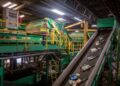
For its mixed-waste facility, Canada Fibers repurposed what was formerly a refuse-derived fuel plant. It has a shredder, trommel, air-drum separator and optical sorters.
Last year, Canada Fibers conducted two six-week pilot projects totaling 5,000 metric tons. Using MSW sourced entirely from multi-family housing, the facility achieved 40 percent diversion of organics and recyclables (about 35-36 percent organics and 4-5 percent recyclables, which were made up of ferrous and nonferrous metals, PET, PE and PP.
“Paper and paperboard were contaminated sufficiently that they were not able to be marketed,” he said. “We weren’t surprised by that.”
Urban Polymers, Canada Fibers’ sister company, took all of the recovered plastics. Because they were dirtier than those from a conventional MRF, Urban Polymers didn’t particularly like taking them, Westerhof said, but they were still able to recycle them.
Starting in late February, Canada Fibers embarked on a larger test. This time, it took 15,000 metric tons of MSW feedstock consisting of 65 percent multi-family and 35 percent single-family material. The facility ran at 22 tons per hour, purposefully dialing it down to get the separation outcomes the company sought, Westerhof said.
The result was about 36 percent recovered organics, 3.5 percent metals and 1.3 percent PET, PE and PP, he said. After processing the organics, the downstream digesters reported the feedstock had about 80 percent of the gas content they’re used to getting from source-separated organics, a number they were happy with, he said.
Still, Canada Fibers probably hasn’t figured out all of the metrics yet, he said, noting that the organics downstreams are hinting that they’re going to need more money in their pockets to manage the material. Canada Fibers also wants to invest to increase the quality of the organics fraction.
Officials are also still tinkering with the low-carbon fuel fraction and plan to test loads of it with cement producers.
Additionally, Canada Fibers plans to make further investments to increase the overall recovery at the facility. Westerhof said he thinks 40 percent recovery is a good step, but, in his mind, 50 percent or above is “what’s needed to be a winner.”