



Resource Recycling
  • The Latest
  • Analysis
    • All
    • Certification Scorecard
    • Industry Announcements
    • Opinion
    Malaysia clamps down on illegal e-waste imports amid probes

    Malaysia clamps down on illegal e-waste imports amid probes

    URT builds alliance to remake electronics plastics at scale

    ICYMI: Top 5 e-scrap stories from January 2026

    Server resale values surge in AI-driven markets

    Certification scorecard for the week of Feb. 2, 2026

    Auditors warn EU may fall short on critical metals

    Auditors warn EU may fall short on critical metals

    Industry announcements for January 2026

    Industry announcements for February 2026

    ICYMI: Top 5 recycling stories from January 2026

    Certification scorecard for week of Jan. 26, 2026

    New entrepreneurs bring renewed energy to e-cycling

    Europe pulls ahead on ITAD now while US growth remains slower

    Recyclers are facing unprecedented changes

  • Conferences
  • Publications

    Other Topics

    Textiles
    Organics
    Packaging
    Glass
    Brand Owners

    Metals
    Technology
    Research
    Markets
    Grant Watch

    All Topics

Subscribe
No Result
View All Result
Resource Recycling
  • The Latest
  • Analysis
    • All
    • Certification Scorecard
    • Industry Announcements
    • Opinion
    Malaysia clamps down on illegal e-waste imports amid probes

    Malaysia clamps down on illegal e-waste imports amid probes

    URT builds alliance to remake electronics plastics at scale

    ICYMI: Top 5 e-scrap stories from January 2026

    Server resale values surge in AI-driven markets

    Certification scorecard for the week of Feb. 2, 2026

    Auditors warn EU may fall short on critical metals

    Auditors warn EU may fall short on critical metals

    Industry announcements for January 2026

    Industry announcements for February 2026

    ICYMI: Top 5 recycling stories from January 2026

    Certification scorecard for week of Jan. 26, 2026

    New entrepreneurs bring renewed energy to e-cycling

    Europe pulls ahead on ITAD now while US growth remains slower

    Recyclers are facing unprecedented changes

  • Conferences
  • Publications

    Other Topics

    Textiles
    Organics
    Packaging
    Glass
    Brand Owners

    Metals
    Technology
    Research
    Markets
    Grant Watch

    All Topics

Subscribe
No Result
View All Result
Resource Recycling
No Result
View All Result
Home Plastics

FFP barriers continue to restrict recycling systems

Stefanie ValenticbyStefanie Valentic
October 15, 2025
in Plastics
FFP barriers continue to restrict recycling systems
Production of film and flexible packaging is growing while recycling rates remain low. | K M Hargreaves / Shutterstock

While film and flexible packaging represent about 34% of the total US plastic packaging industry by weight, abysmal recycling rates are requiring adjustments across the entire system.

Despite 4% annual growth in FFP production, less than 1% is recycled nationwide, a gap consisting of interconnected challenges across the recycling system, said Katherine Huded, executive director of material systems at The Recycling Partnership, during a recent webinar.

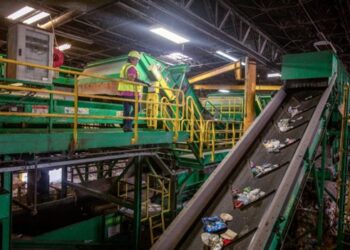
The barriers include insufficient end markets, high processing costs relative to commodity prices, limited residential program acceptance, contamination concerns, diverse packaging formats and sortation challenges at MRFs.

Recycling for film and flexible packaging remains largely inaccessible for most Americans. About 2% of households in the US can actually recycle FFP in their curbside or jurisdiction programs.

In the US, primary recycling access for these items usually is by way of return to retail or drop-off programs, she said. 

Extended producer responsibility (EPR) policy for packaging is “catalyzing change in the US recycling system,” with California emerging as a testing ground for other states looking to implement policy, Huded said.

One state, many lessons

All eyes are on California, the most populated state in the US and world’s fourth largest economy, as it enacts sweeping recycling reforms under SB 54.

“Ultimately, it’s requiring 25% source reduction, 100% recyclable or compostable packaging, a 65% recycling rate, and that all recyclables are headed to responsible end markets all by 2032 and that’s right around the corner,” Huded said.

The state has 13 covered material categories for film and flexibles. Now that policy is driving systemic change, what’s needed to support FFP in California and the rest of the US is on the horizon.

The objective is to build scalable pathways on existing systems, said Neil Menezes, vice president of material services at Circular Action Alliance (CAA), the producer responsibility organization (PRO) that administers California’s EPR program for packaging.

“We’re not looking to drop brand new MRFs across the US, because it’s not going to be the most effective and efficient way of our resources. We really want to get a better understanding of what’s happening today, and how do we leverage the expertise of the collective system,” he said.

In addition to California, CAA is managing EPR implementation in Colorado, Minnesota, Oregon and Maryland. Menezes said the organization is also petitioning to be PRO for both Washington and Maine, two more states working toward implementation.

“EPR is gaining momentum in the US, and it’s an important push that we need. And so, if not now, when, if not us, who? It’s go time,” said Rachel Lawrence, senior director of sustainability at PepsiCo.

Learn global, implement domestically

European and Canadian EPR systems effectively demonstrate that high FFP recycling rates are achievable, but the US needs solutions that build on existing infrastructure.

They are successfully capturing household, residential film and flexibles from mixed single streams, from bagged recyclables or through various MRF sortation methods.

“These countries are seeing higher residential participation rates and higher recycling rates, even for plastic packaging, upwards of 50% today in some places. So it is possible and we can learn from others around the world,” Huded said.

Belgium has achieved 50% recycling rates for film and flexibles while France is getting closer to a 30% recycling rate. Teo Medellin, director of corporate packaging sustainability for Procter & Gamble, said curbside collection is bringing larger volumes of FFP into circularity.

In Europe, operations are fine-tuned to grab and take away FFP to make bales and move the product.

“Now, we don’t have to reinvent the wheel. That’s very good news for everybody. It can be done,” he said. “The problem is, a business problem is, how do we move the bales?”

“If we want to get to high levels of performance, 60-65% recycling rate, we’re going to need to start thinking how we are going to recover those pellets in a way that they are going to provide future value,” Medellin said.

Economic incentives and end markets

Financial support throughout the supply chain and robust end markets are essential to make FFP recycling economically viable and scalable.

“If you can solve the demand side, I think a lot of these other issues are almost secondary,” Menezes said.

The brand-led US Flexible Film Initiative (USFFI) is focused on filling the gap for the financial support needed to catalyze FFP recycling, by providing funding to create and move bales.

“We’re entering into contracts with reclaimers and markets nationally… with payments structured on a per pound basis,” said Maite Quinn-Richards, executive director of USFFI. Quinn-Richards is also president of Resource Recycling, Inc., which publishes Plastics Recycling Update.

The approach ensures that MRFs can consistently produce film applications, and that the reclaimers have the stability to process bales.

“In our experience, there may be a small fraction of operators who can make it work without financial support, but most need that incentive to keep the system stable, scalable and sustainable, ultimately proving that flexible packaging can and should be recycled with the right incentives in place, we do have to incentivize everyone,” said Quinn-Richards.

Tags: EPRFilm & Flexibles
TweetShare
Stefanie Valentic

Stefanie Valentic

Stefanie Valentic is an award-winning journalist who has covered the waste and recycling industry for more than five years. Throughout her career, she has led editorial teams and served as a keynote speaker, moderator and panelist at numerous trade shows and conferences.

Related Posts

Amcor expects flat sales volumes to continue 

byAntoinette Smith
February 6, 2026

The global packaging giant said some brand owners have lost market share while navigating an inflationary environment, and now may...

Flexible Film Recycling Alliance releases first report

byAntoinette Smith
February 2, 2026

The Flexible Film Recycling Alliance has published its first report on progress made toward accelerating recycling rates, expanding access to...

States push recycling reform forward in new year

byStefanie Valentic
February 2, 2026

New Jersey just passed a bill restricting single-use plastic items, California has opened another round of public comment on SB...

Cirba Solutions: Battery fires stoking EPR bill movement

byStefanie Valentic
February 2, 2026

As batteries appear in everything from light-up shoes to electric vehicles, new EPR laws are reshaping recycling requirements.

Stakeholders respond to California recyclability report

CalRecycle opens SB 54 draft for comments

byStefanie Valentic
February 2, 2026

Editor’s Note: California EPR will be featured in sessions at the co-located 2026 Resource Recycling Conference and Plastics Recycling Conference,...

Dow makes case for PE price hikes amid layoffs

Dow makes case for PE price hikes amid layoffs

byAntoinette Smith
January 30, 2026

Persistently low virgin resin pricing has been a significant factor for PE recyclers, who have been unable to compete.

Load More
Next Post

Certification Scorecard for October 15, 2025

More Posts

Agilyx leaves US chem recycling, Houston sorting center

Agilyx leaves US chem recycling, Houston sorting center

February 4, 2026

Greenchip launches fund for community impact and trust

February 5, 2026
Stakeholders respond to California recyclability report

CalRecycle opens SB 54 draft for comments

February 2, 2026

Eastman looks to recycling plant to drive growth

February 2, 2026

Cirba Solutions: Battery fires stoking EPR bill movement

February 2, 2026
Third ExxonMobil recycling plant operational

Third ExxonMobil recycling plant operational

February 4, 2026
Chinese processing group details goals for US visit

AMP lays out vision of next-generation, AI-driven MRFs

July 24, 2024

Allied Industrial portfolio companies complete two early-year deals

February 5, 2026
Emerging state EPR shows trend toward harmonization

Emerging state EPR shows trend toward harmonization

January 29, 2026
Ace Metal and Metro Metals take the most weight in Washington

US-EU trade rift adds risk now for ITAD and e-scrap trade

February 2, 2026
Load More

About & Publications

About Us

Staff

Archive

Magazine

Work With Us

Advertise
Jobs
Contact
Terms and Privacy

Newsletter

Get the latest recycling news and analysis delivered to your inbox every week. Stay ahead on industry trends, policy updates, and insights from programs, processors, and innovators.

Subscribe

Welcome Back!

Login to your account below

Forgotten Password?

Retrieve your password

Please enter your username or email address to reset your password.

Log In

Add New Playlist

No Result
View All Result
  • The Latest
  • Analysis
  • Recycling
  • E-Scrap
  • Plastics
  • Policy Now
  • Conferences
    • E-Scrap Conference
    • Plastics Recycling Conference
    • Resource Recycling Conference
    • Textiles Recovery Summit
  • Magazine
  • About Us
  • Advertise
  • Archive
  • Jobs
  • Staff
Subscribe
This website uses cookies. By continuing to use this website you are giving consent to cookies being used. Visit our Privacy and Cookie Policy.