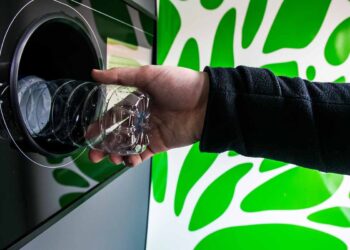







A bipartisan bill in Texas to introduce a bottle deposit return system ran out of time for a state House vote, but supporters see cause for optimism after a strong showing during the recently concluded biennial legislative session.
HB 2048 passed out of the House environment committee by a vote of 6-0 on May 2, but the legislative session expired at midnight May 15, effectively killing the bill along with hundreds of others. The next opportunity for a bottle deposit initiative will be in the 2027 legislative session, since Texas lawmakers meet only every other year.
“It got farther than ever before, and it also got more industry backing than ever before,” said Maia Corbitt, president of Texans for Clean Water, which spearheaded the effort to pass the bill. She added that progressing out of the environment committee and being put on the calendar “are almost the highest hurdles. Once you hit the House floor, you know you’re going to get passed.”
The bill had five joint authors, the maximum allowed, and seven co-authors from across the spectrum of caucuses, Corbitt said. The cross-aisle support “demonstrates that there’s both an understanding for and an appetite now for this kind of legislation.”
Republican State Rep. John Lujan, the bill’s lead author, did not respond to a request for comment.
The bill would have required beverage makers to form a producer responsibility organization, to establish labeling and quality standards for beverage containers and to collect and provide information for the Texas Commission on Environmental Quality to determine the biennial recycling rate for beverage containers. The PRO also would have had to implement a plan to reach at least a 75% biennial recycling rate by Jan. 1, 2035.
A recent survey from the Texas Department of Transportation indicated that beverage containers accounted for 74% of litter collected in the state, and a January 2025 study from Texas A&M University found that a deposit refund system could reduce trash imports into the state.
Texas is home to a vast array of chemical and polymer producers as well as large recycling operations. Indorama Ventures owns the former CarbonLite center near Dallas, and with an annual capacity of 94,000 metric tons of RPET resin, is among the biggest U.S. buyers of post-consumer PET feedstock. WM and Balcones Recycling also are both based in Texas.
The National Association of PET Container Resources put its support behind the bill. Other organizations in favor of the bill included the Container Recycling Institute, Dow, Primo Brands/Ozarka water, Advanced Drainage Systems and the Association of Plastic Recyclers, which owns Resource Recycling Inc.
Testimony in support of the bill included a plant supervisor at Knauf Insulation, who said that the company requires more glass cullet to feed its new McGregor facility in central Texas. “We presently must resort to importing glass from other states and countries because quite frankly, they do a better job of collecting it and recycling it,” he said.” The plant uses 70 to 90 tons of cullet each day, he added.
The identical SB 728 was left pending in committee. Previous bottle-bill efforts in Texas included HB 2425/SB 1450 in 2015, SB 645/HB 1473 in 2013, and HB2114/SB 1119 in 2011.
The legislature meets only 140 days every other year, “so it’s tough to get anything passed in Texas,” Corbitt said. Between now and early 2027, legislators will work on interim charges, and “hopefully come back next session with a bill that beer and the haulers or soda might get on board with,” she said.
Beer opposition pours in
Those opposed to the bill included beverage giant Anheuser-Busch, the Beer Alliance of Texas, Houston-headquartered hauler WM, the Recycling Council of Texas, and Texas-based Spec’s Liquors and Fine Wines, which operates more than 200 locations in the state.
“The two major obstacles were the beer brands. Beer really came out in forceful opposition,” Corbitt said.
In April 24 committee testimony, Corianna Baier, director of policy analysis at Anheuser-Busch, said on average the company saw about a 9% drop in volume when bottle bills were introduced in other states. “And given that Texas is our highest volume state and we have our brewery in Houston and all of the local workers, we would hate to see these added costs kind of trickle through the system and into the economy.”
But when Democrat Rep. Rafael Anchia asked whether that drop tended to persist, Baier said the industry normally sees an initial large decline “and then kind of continuing along with trends.” In response, Anchia said, “And we all know that correlation does not equal causation, right?”
He added, “Oftentimes, it’s not surprising that in a marketplace, you would see a dip when the rules of the market are changed,” followed by a “hockey stick” pattern of gradual recovery, to which Baier agreed.
Testifying in support of the bill, Susan Collins, president of the Container Recycling Institute, said, “Our analysis indicates that there is no definitive evidence that the introduction of new or changes to existing deposit programs in and of themselves impact sales, suggesting that opponents’ concerns about this are unfounded,” citing data from CRI’s 2023 Impact Report.
Collins added, “It is important to note that modern deposit systems also have two revenue streams that help pay for the programs: scrap materials and unclaimed deposits. In addition, the use of more recycled content can help to reduce costs in the supply chain for making new beverage containers.”
In other testimony against the bill, Logan Harrell, general counsel for the Texas Chemistry Council, said, “Our members can’t support a bill that assesses fees against our customers.” He added that TCC members prefer creating a voluntary incentive program that includes assembling an industry advisory council and updating recycling reports from the Texas Commission on Environmental Quality, whose most recent report was in 2021.
However, Harrell noted that TCC had not yet worked on building an advisory council in support of such a program.
Noting that the bill is meant to encourage the public to participate, committee Vice Chair Rep. Claudia Ordaz, a Democrat, told Harrell this was an opportunity to work with the bill’s authors to determine how to combine the industry-focused and consumer-focused approaches.
Progress in red-leaning states
While extended producer responsibility has been gaining steam in so-called blue areas of the U.S., similar bills have also been seen in states with a distinctly red hue.
Lawmakers in Tennessee reintroduced an EPR bill for 2025, but it stalled in committee. In Nebraska, LB 607 covered battery stewardship, EPR data collection and minimum recycled content but also died in committee.
Texans seem to realize that reducing plastic waste isn’t a partisan issue, Corbitt said. In a state where residents tend to favor smaller government, low taxation and to emphasize personal autonomy, “the bill doesn’t grow state government, it doesn’t take any taxpayer funds, it doesn’t set any monetary rates in the bill. So it is a much more free-market approach to getting raw materials back to Texas manufacturers than in the past, where we’ve had very strict rates and dates.”
A full EPR bill “might be a stretch for Texas,” but HB 2048 was a simple bill that encouraged personal responsibility both for participation and in building the bill itself, she said.
In addition, Texans for Clean Water looked to the right-leaning American Legislative Exchange Council for help with wording the bill, Corbitt said. “I think we really learned that we needed to strip this thing down to very bare essentials and otherwise get out of the way. No need to set specifics, just have a set of necessities that the industry will have to figure out.”
Another lesson the group has learned in past efforts is that “if you’re going to get something that even sniffs of an environmental policy through a state like Texas, you’d better come with data, and that data better be economic data and other true representations of the problem.”
Updating existing deposit systems
While 10 states maintain deposit return systems, the amount returned to consumers largely hasn’t changed since inception, dating back to the 1970s in some cases. However, several states have moved to update their DRS in recent years, both by increasing deposits from 5 cents to 10 cents and by expanding the types of beverages the bills cover.
For example, in 2022 Iowa lawmakers approved container deposit legislation that tripled the bottle handling fee but allowed grocery stores and other retail entities to opt out of the collection system.
In Rhode Island, legislators introduced a bottle bill, but earlier this month the state environment committee recommended it be held for further study amid fierce opposition from industry.
In the December 2023 “50 States of Recycling” report from Eunomia and Ball Corp., nine of the top 10 recycling rates were in states with a deposit return system. And although the recycling rates for various materials varied wildly between even those states, they were still significantly higher than in non-DRS states. Texas ranked 42nd.
“I think Texas has been one of the ‘this will never happen’ states for a long time,” Corbitt said. “But I hope that a lot of the groups that came to the table this time will continue to engage, and even more will engage.”
That the bill made its way onto the legislative calendar is a signal that all parties need to come together on a compromise, Corbitt said. “I frankly think we had a good chance of passing this time, but we just ran out of time. But I think if we could get that opposition to the table, I absolutely think we’ll pass.”
A version of this story appeared in Resource Recycling on May 20.