





Resource Recycling
  • The Latest
  • Analysis
    • All
    • Certification Scorecard
    • Industry Announcements
    • Opinion
    Rainforest

    Inside the Circle: What the rainforest can teach us about EPR

    Closeup of a printed circuitboard

    Hardware demand puts new focus on parts harvesting

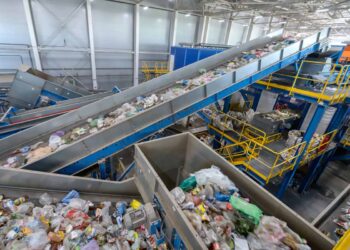
    Rare look inside the world’s largest plastics recycler

    Mass balance matters: Why different rules can lead to different outcomes 

    Certification Scorecard — Week of June 1, 2026

    IT asset disposition and electronics recycling: Now and then

    $60 billion in AI servers will create an ITAD challenge

    The independent ITAD at a crossroads

    DMD acquires ITAD firm Lifespan, outlines acquisition strategy

  • Conferences
    • Resource Recycling Conference
    • Plastics Recycling Conference
    • E-Scrap: The Longevity Conference
    • Textiles Recovery Summit
  • Publications
    • E-Scrap News
    • Plastics Recycling Update
    • Policy Now
    • Resource Recycling
    • Other Topics
      • All Topics
      • Brand Owners
      • Critical Minerals
      • Glass
      • Grant Watch / RFPs
      • Markets
      • Organics
      • Packaging
      • Research
      • Technology
      • Textiles
Subscribe
No Result
View All Result
Resource Recycling
  • The Latest
  • Analysis
    • All
    • Certification Scorecard
    • Industry Announcements
    • Opinion
    Rainforest

    Inside the Circle: What the rainforest can teach us about EPR

    Closeup of a printed circuitboard

    Hardware demand puts new focus on parts harvesting

    Rare look inside the world’s largest plastics recycler

    Mass balance matters: Why different rules can lead to different outcomes 

    Certification Scorecard — Week of June 1, 2026

    IT asset disposition and electronics recycling: Now and then

    $60 billion in AI servers will create an ITAD challenge

    The independent ITAD at a crossroads

    DMD acquires ITAD firm Lifespan, outlines acquisition strategy

  • Conferences
    • Resource Recycling Conference
    • Plastics Recycling Conference
    • E-Scrap: The Longevity Conference
    • Textiles Recovery Summit
  • Publications
    • E-Scrap News
    • Plastics Recycling Update
    • Policy Now
    • Resource Recycling
    • Other Topics
      • All Topics
      • Brand Owners
      • Critical Minerals
      • Glass
      • Grant Watch / RFPs
      • Markets
      • Organics
      • Packaging
      • Research
      • Technology
      • Textiles
Subscribe
No Result
View All Result
Resource Recycling
No Result
View All Result
Home Plastics

Panelists: Secondary sorting fills vital recycling role

Antoinette SmithbyAntoinette Smith
January 8, 2025
in Plastics
Secondary sortation will continue to play a role in the recycling value chain, panelists said. | Dan Holtmeyer/Resource Recycling

With materials recovery facilities becoming ever more sophisticated and AI and robotics providing customizable levels of materials sortation, chemical recycling feedstock provides the most promising end market for secondary sorting, according to panelists at the recent Resource Recycling Conference.

And although the number of secondary sorting facilities has decreased, said panelist Adam Lovewell, process engineer at Van Dyk Recycling Solutions, “I think that we’re seeing the emergence of secondary sorting facilities because it’s a business that people can make money from. It might not be as much as the MRF, but there’s still money to be made other than just sending it to the landfill.” 

Secondary sorting is the process of culling further value from bales that have already undergone a primary sort at a MRF. 

“We’re serving waste and recycling companies that want to get their hands on more tons and grow their business,” said Jed McDonald, director of corporate development at robotics company AMP, which sells recycling technology. The company also announced in November it was partnering with hauler Waste Connections to build a MRF in Colorado, AMP’s first ground-up investment. 

In addition to the development of end markets, the practicalities of primary sorting help ensure that secondary sorting doesn’t become extinct, said Tom Ferretti, senior vice president of operations at Balcones Recycling. “I don’t think the economics are going to work” for designing a system that eliminates the usefulness of a secondary sort, he said. However, not every waste handler can afford a system costing $10 million to $30 million.

“So you get very good at what you do with what you have.” 

Chemical recycling requires specialized feedstock

Although public perception may be that chemical recycling operations are burning trash, Mylinda Jacobsen, senior vice president of plastics at chemical recycling firm Encina Development Group, pointed out that they have feedstock specifications like any plant and are buying a curated blend from secondary sorters rather than from MRFs. Encina is a chemical recycling business based near Houston.

“It’s not a landfill,” she said. “It’s a specialized beast that can take some streams and maybe upgrade them a little bit, but you can’t just put anything in there. You have to understand what’s coming in and look even like what’s going to change in two years, five years, 10 years,” considering what equipment will be needed in the future to handle changing material streams. 

“Secondary sorting is a front end for a chemical recycler,” she said, adding that chemical recycling facilities are trying to extract maximum value from streams that have already had most of the value taken out. In addition, the massive volumes required for chemical recycling aren’t going to come from what the MRF produces, she said, and price points are different than for mechanical recycling operations. “You’re not competing in that same space for materials.”

The growing number of chemical recycling companies struggle with uncertainty over their feedstock supply, Lovewell said. “They have their feedstock that they were able to source this week, but next week it will be from somewhere else, and it’s very difficult to predict.” 

They require infrastructure to process feedstock streams from anywhere, he said, from MRF residuals to carpet backing. And although “there’s a little bit of a doom-and-gloom conversation going on” surrounding the future of secondary recycling, developing end markets – including chemical recycling – will drive secondary sorting.

McDonald concurred, saying that helping chemical recycling operators achieve the desired feedstock specifications has “unlocked downstream of us a new offtake that adds to the sellable things we can precisely sort.” 

AMP also views secondary sorting from a tolling perspective, in particular for chemical recycling, which needs a certain feedstock that’s easier and cheaper with technology like AMP’s, McDonald said. Tolling typically entails outsourcing an aspect of a company’s manufacturing process to a third party that can perform it more efficiently or economically than the manufacturer itself, without investing capital.

Nevertheless, Jacobsen pointed out that not every residual stream is suitable for secondary sorting. “You really need to do your homework on them first and kind of look at patterns and what is your kind of average over time that you’re going to recover, and certainly make sure that there are markets available on where to sell some of this stuff,” she said. Due to regional differences in material streams, she continued, “you have to pick where you’re going to be very carefully as well.” 

Lovewell added that “it’s very hard to justify these secondary sorting facilities unless there are markets for those materials, unless you have enough material to justify building a plant that can handle that. And all that requires being in the vicinity of where this operation is going.” 

Extracting value remains paramount

Ultimately the panelists agreed that the primary goal of secondary sorting was to reduce the tonnage headed for landfills, and to extract as much value as possible from consumer material streams. 

At the MRF level, “we keep on mining and stripping that value out of that waste bill,” said Ferretti, adding that he didn’t want to leave behind any value in a bale. “So my goal is to, unfortunately, hurt the secondary sorter. 

“I don’t want to give up one PET bottle,” he said. “I don’t want to give up one HDPE bottle. My job is to extract as much value on one pass of that material coming in that front door where it is no more than landfill. Landfill costs are massive. I want to reduce that.”

In addition, brand owners face mandates for recycled content in packaging or have made what may be “unrealistic” public announcements surrounding PCR targets in packaging, McDonald said. “So they’ll basically take any amount of net new tons they can get their hands on, meaning they’ll almost finance a full facility for us just to guarantee themselves the offtake,” such as clear PET. 

Because the MRF’s goal is to derive maximum value from bales, said Jacobsen, “if you’re anybody in the secondary sorting space, you have to look beyond the MRF.”  

A version of this story appeared in Resource Recycling on Apr. 18.
Tags: MRFsPlastics
TweetShare
Antoinette Smith

Antoinette Smith

Antoinette Smith has been at Resource Recycling Inc., since June 2024, after several years of covering commodity plastics and supply chains, with a special focus on economic impacts. She can be contacted at [email protected].

Related Posts

Q1 containerboard exports drop by 19%

What SB 54 looks like from the packaging floor

byStefanie Valentic
June 1, 2026

With compliance deadlines coming on quickly, smaller companies are struggling to absorb changes and stay on the right side of...

WM, Circular Materials announce new Canadian facility

byStefanie Valentic
May 21, 2026

Hauler WM will open a new preconditioning recycling facility (PCF) in Edmonton in early 2027, bringing advanced optical sorting to...

WM opens new $60m MRF in Indy

byAntoinette Smith
April 10, 2026

The newest recycling facility has annual capacity of 200,000 tons and will send all mixed paper to Pratt Industries for...

Plastics Recyclers Have the Capacity to Recycle More. Now Let’s Use It.

Study finds most recycling occurs within 30 miles of access

byBrian Clark Howard
April 8, 2026

Researchers at the University at Buffalo also found that Americans produce similar volumes of plastic package waste regardless of economic...

Mike Whitney led the group through the CP Group plant.

A look inside a MRF equipment factory

byBrian Clark Howard
March 25, 2026

The Plastics Recycling Conference’s facility tour went to San Diego-based CP Group, a leading supplier of equipment for MRFs.

WM brings Orange, CA recycling facility online in $1.4B MRF push

WM brings Orange, CA recycling facility online in $1.4B MRF push

byStefanie Valentic
March 11, 2026

WM has activated its upgraded Orange, California recycling facility, the latest step in the company's $1.4 billion MRF modernization strategy...

Load More
Next Post

The political pendulum swings back

More Posts

Recycling industry addresses Beyond Plastics report

Recycling industry addresses Beyond Plastics report

May 26, 2026
Fire at an EMR recycling facility in Camden, New Jersey May 29, 2026.

EMR faces shutdown calls after numerous fires

June 2, 2026
IT asset disposition and electronics recycling: Now and then

$60 billion in AI servers will create an ITAD challenge

June 3, 2026
House resolution aims to make recyclability central to product design

NY EPR bill fails to advance after third try

June 8, 2026
The independent ITAD at a crossroads

DMD acquires ITAD firm Lifespan, outlines acquisition strategy

June 2, 2026
CalRecycle withdraws proposed regs for SB 54

Oceana, NRDC, CAW sue CalRecycle over SB 54 regs

June 5, 2026
BASF, Encina expand circular feedstock partnership

BASF, Encina expand circular feedstock partnership

June 3, 2026
Our top stories from June 2021

Colorado advances EV battery EPR law

June 3, 2026
War, not demand driving polymer pricing

War, not demand driving polymer pricing

June 2, 2026
In My Opinion: Comparing the nation’s first packaging EPR laws

What Maine’s vape EPR law means for recyclers

June 4, 2026
Load More

About & Publications

About Us

Staff

Archive

Magazine

Work With Us

Advertise
Jobs
Contact
Terms and Privacy

Newsletter

Get the latest recycling news and analysis delivered to your inbox every week. Stay ahead on industry trends, policy updates, and insights from programs, processors, and innovators.

Subscribe

Welcome Back!

Login to your account below

Forgotten Password?

Retrieve your password

Please enter your username or email address to reset your password.

Log In

Add New Playlist

No Result
View All Result
  • The Latest
  • Analysis
  • Recycling
  • E-Scrap
  • Plastics
  • Policy Now
  • Conferences
    • E-Scrap Conference
    • Plastics Recycling Conference
    • Resource Recycling Conference
    • Textiles Recovery Summit
  • Magazine
  • About Us
  • Advertise
  • Archive
  • Jobs
  • Staff
Subscribe
This website uses cookies. By continuing to use this website you are giving consent to cookies being used. Visit our Privacy and Cookie Policy.