Resource Recycling
  • The Latest
  • Analysis
    • All
    • Certification Scorecard
    • Industry Announcements
    • Opinion

    Who should pay for lithium-ion battery fire damage?

    America’s critical-materials buildout has a feedstock problem

    Certification scorecard – week of Sept. 14

    Canada Plastics Pact reports 2024 progress

    Trade tensions shift global mineral partnerships 

    Spin-off lets Linca focus on battery mineral recovery

    Critical mineral policy shift creates opportunity

    CommanderAI launches searchable hauler database

    Inside the Circle: Put AI to work for the people who do the work

  • Conferences
    • Resource Recycling Conference
    • Plastics Recycling Conference
    • E-Scrap: The Longevity Conference
    • Textiles Recovery Summit
  • Publications
    • E-Scrap News
    • Plastics Recycling Update
    • Policy Now
    • Resource Recycling
    • Other Topics
      • All Topics
      • Brand Owners
      • Critical Minerals
      • Glass
      • Grant Watch / RFPs
      • Markets
      • Organics
      • Packaging
      • Research
      • Technology
      • Textiles
Subscribe
No Result
View All Result
Resource Recycling
  • The Latest
  • Analysis
    • All
    • Certification Scorecard
    • Industry Announcements
    • Opinion

    Who should pay for lithium-ion battery fire damage?

    America’s critical-materials buildout has a feedstock problem

    Certification scorecard – week of Sept. 14

    Canada Plastics Pact reports 2024 progress

    Trade tensions shift global mineral partnerships 

    Spin-off lets Linca focus on battery mineral recovery

    Critical mineral policy shift creates opportunity

    CommanderAI launches searchable hauler database

    Inside the Circle: Put AI to work for the people who do the work

  • Conferences
    • Resource Recycling Conference
    • Plastics Recycling Conference
    • E-Scrap: The Longevity Conference
    • Textiles Recovery Summit
  • Publications
    • E-Scrap News
    • Plastics Recycling Update
    • Policy Now
    • Resource Recycling
    • Other Topics
      • All Topics
      • Brand Owners
      • Critical Minerals
      • Glass
      • Grant Watch / RFPs
      • Markets
      • Organics
      • Packaging
      • Research
      • Technology
      • Textiles
Subscribe
No Result
View All Result
Resource Recycling
No Result
View All Result
Home Plastics

Eastman execs elaborate on mixed-plastics technology

byJared Paben
April 17, 2019
in Plastics

Global chemical company Eastman has unveiled a recycling process that breaks down polymers into gases for use in chemical manufacturing. It’s now looking for suppliers.

The Kingsport, Tenn.-headquartered company earlier this month announced what it calls carbon renewal technology, through which mixed plastics are deconstructed into hydrogen and carbon monoxide molecules. Eastman then feeds the gases into its existing large-scale system for producing chemicals used in a variety of products.

“The world has a waste plastic problem today, and this is something that can start contributing to fixing that,” said Ron Sheppard, director of corporate innovation at Eastman.

The carbon renewal technology is separate from a different plastics recycling process Eastman unveiled in March, called “advanced circular recycling.” That process, covered by Plastics Recycling Update last month, uses methanolysis to depolymerize tough-to-recycle polyester items into their building blocks, dimethyl terephthalate (DMT) and ethylene glycol (EG), which are monomers that can then be used to make new plastic.

“We really see both of these technologies as complementary to the existing mechanical recycling stream,” said Holli Alexander, strategic initiative manager of global sustainability at Eastman.

Alexander and Sheppard spoke with Plastics Recycling Update to provide more details on the carbon renewal technology.

How the technology works

At its sprawling Kingsport facility, Eastman currently feeds fossil fuel resources into a production unit, generating hydrogen and carbon monoxide, Sheppard said. The chemistry is essentially what’s found in a partial oxidation, or POX, unit, where a carbon source is heated in an oxygen-starved environment to create hydrogen, carbon monoxide and a smaller amount of carbon dioxide, which helps generate heat for the process, Sheppard said.

The resulting hydrogen and carbon monoxide are then used by Eastman to produce a number of chemical intermediate products, including acetic acid, methanol, methyl acetate, and acetic anhydride.

The carbon renewal technology is essentially an adaptation of the front end of the system, allowing Eastman to used mixed plastics as feedstock instead of virgin fossil fuel resources.

“We’ve done multiple trials with different materials in our Kingsport facility at scale,” Sheppard said. “We have very high confidence in the technology.”

The resulting intermediate chemicals are used in any number of products, including LCD screens, durable plastics, textiles and more, Alexander said. For example, Eastman in January 2017 first introduced a cellulosic yarn product called “Naia,” which can be used in clothing. Sheppard explained that the cellulose acetate in Naia comes from wood pulp from sustainably managed forests with some amount of acetic anhydride derived from fossil fuel sources. With the carbon renewal technology, Eastman can use scrap plastics to produce the acetic anhydride that goes into Naia, he said.

The partial oxidation process is highly efficient at converting materials, but it will leave as residues non-carbon contaminants such as calcium carbonate and glass fillers, Sheppard said. When asked about the energy efficiency of the process, he said the company expects a smaller energy footprint from using recycled plastics than from using the current virgin resources.

The company is looking for suppliers of mixed and otherwise difficult-to-recycle streams that lack recycling markets today, Alexander said. Carbon renewal technology can take a number of different materials, including engineering plastics, commodity packaging plastics, thermoset resins and more (however, Eastman isn’t looking for PVC). The technology can also take plastic in different forms, including multi-layer flexible films and textiles.

Eastman is expecting commercial-scale production of chemicals from scrap plastics by the end of 2019.

Part of wider industry trend

Advanced chemistry approaches are being increasingly discussed – and in a number of cases embraced – as a strategy for tackling plastic streams that mechanical reclaimers can’t easily handle because of contamination or material heterogeneity.

For example, a recent report from industry investment group Closed Loop Partners explored the landscape of plastics purification, depolymerization and conversion technologies across North America. It found at least 60 companies in the space, including a number of startups.

A number of worldwide virgin plastics and chemical companies are also investing in research or partnering with startups in the advanced recycling technologies space, including Americas Styrenics (AmSty), BASF, Borealis, Braskem, Indorama Ventures, INEOS Styrolution, LyondellBasell, MOL Group, Royal DSM, SABIC, Total and others.

Those technologies are being developed at a crucial moment for the wider plastics industry. Asian import restrictions on recyclables and growing discussion worldwide about marine debris have forced plastics stakeholders to address end-of-life materials management in new ways.

In the case of the carbon renewal technology, Eastman didn’t have to start from scratch. The company has practiced the partial oxidation technology since the early ’80s, Alexander said.

In mid-2018, Eastman made the modifications to the front end of the existing large-scale system to allow it to accept mixed plastics, Sheppard said. The modifications are trade secrets, although some elements will be made public via patent filings in the future.

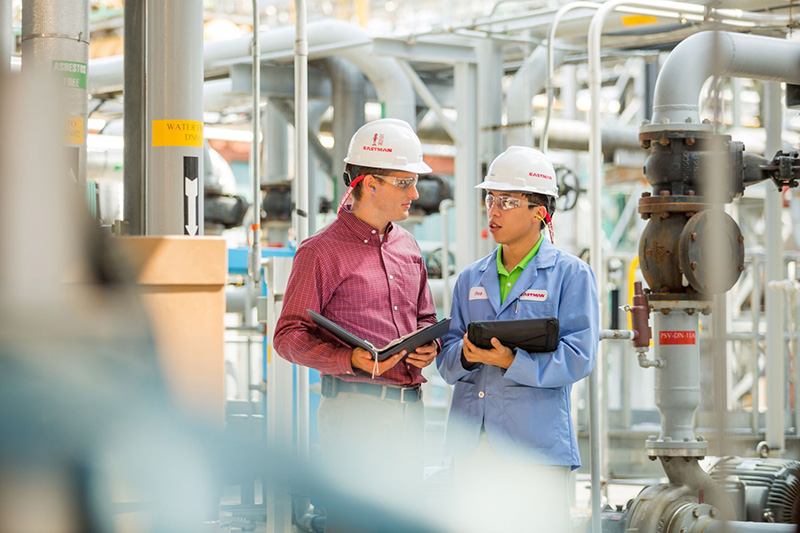
Photo courtesy of Eastman.

To receive the latest news and analysis about plastics recycling technologies, sign up now for our free monthly Plastics Recycling Update: Technology Edition e-newsletter.



Save the Date for the 2020 Plastics Recycling Conference.

Tags: Technology
TweetShare
Jared Paben

Jared Paben

Related Posts

Study assesses environmental cost of excess data storage

BAN paper says AI e-scrap estimates are low

byPaul Lane
September 17, 2026

The advocacy group said current estimates on the scrap resulting from data centers don’t account for the full picture of...

Google Pixel 6 phone

Google makes repairability part of design ethos

byBrian Clark Howard
September 16, 2026

The tech titan supports the right-to-repair movement in several key ways.

CommanderAI launches searchable hauler database

Inside the Circle: Put AI to work for the people who do the work

byBill Shireman
September 14, 2026

There is more than one way to use AI, and some ways are more valuable than others.

iFixit launches 2-week circuit board training course

Printed circuit board (PCB) recycling explained

byJavier Castilloand2 others
September 9, 2026

Recycling PCBs presents significant technical challenges because these waste streams combine metallic, non-metallic and electronic fractions with different characteristics and...

Inside the sneaker recycling boom

Report: AI opportunity robust in footwear recycling

byPaul Lane
September 8, 2026

BCC Research found AI’s usage in the footwear recycling space is growing but remains in the early stages, holding the...

Dell expects PC refresh to extend into next year

Dell, HP show enterprise PC spending separating from unit volume

byDavid Daoud
September 3, 2026

Large enterprises are still refreshing their PC fleets, but the broader market is becoming less dependable as a source of...

Load More
Next Post

Nestlé Waters CEO: 100% packaging recovery is possible

2026 Buyers’ Guide

Equipment, services and technology suppliers serving the recycling industry.

Browse the Guide

More Posts

Canada tariffs latest in new normal for RPET

Canada tariffs latest in new normal for RPET

September 11, 2026

SB 54 plan for cartons, film draws warning

September 15, 2026
Alpek closing Pennsylvania RPET plant

Alpek seizing on war-related opportunity 

July 27, 2026
Study assesses environmental cost of excess data storage

BAN paper says AI e-scrap estimates are low

September 17, 2026
New Jersey pushes back PCR mandate to 2030

New Jersey pushes back PCR mandate to 2030

September 10, 2026
Additive cuts acetaldehyde migration in RPET bottles

PET roadmap pairs demand, CO2 footprint

September 15, 2026
US packaging is evolving. The recycling system isn’t ready

US packaging is evolving. The recycling system isn’t ready

September 16, 2026
California Governor Gavin Newsom speaking at podium.

What’s on Newsom’s desk after the CA session end

September 14, 2026
Spin-off lets Linca focus on battery mineral recovery

Critical mineral policy shift creates opportunity

September 14, 2026
Google Pixel 6 phone

Google makes repairability part of design ethos

September 16, 2026
Load More

About & Publications

About Us

Staff

Archive

Magazines

Work With Us

Advertise
Jobs
Contact
Terms and Privacy

Newsletters

Get the latest recycling news and analysis delivered to your inbox every week. Stay ahead on industry trends, policy updates, and insights from programs, processors, and innovators.

Subscribe

Welcome Back!

Login to your account below

Forgotten Password?

Retrieve your password

Please enter your username or email address to reset your password.

Log In

Add New Playlist

No Result
View All Result
  • The Latest
  • Analysis
  • Recycling
  • E-Scrap
  • Plastics
  • Policy Now
  • Conferences
    • E-Scrap Conference
    • Plastics Recycling Conference
    • Resource Recycling Conference
    • Textiles Recovery Summit
  • Magazines
  • About Us
  • Advertise
  • Archive
  • Jobs
  • Staff
Subscribe
This website uses cookies. By continuing to use this website you are giving consent to cookies being used. Visit our Privacy and Cookie Policy.