Resource Recycling
  • The Latest
  • Analysis
    • All
    • Certification Scorecard
    • Industry Announcements
    • Opinion
    State program revamp proposal advances in Oregon

    Oregon EPR ruling looms: what legal experts think

    Triple-digit revenue gains propel ABTC’s expansion

    LFP batteries gain acceptance. Can they be recycled?

    May pricing bullish for most bales

    August pricing bearish for plastic bales

    End markets, policy key to RPET viability

    PET in focus: Is help on the way?

    Paladin is building a domestic recovery path for rare earths in steel scrap

    Re-Teck opens site in Southeast Asia

    ERI expands global footprint into Vietnam

  • Conferences
    • Resource Recycling Conference
    • Plastics Recycling Conference
    • E-Scrap: The Longevity Conference
    • Textiles Recovery Summit
  • Publications
    • E-Scrap News
    • Plastics Recycling Update
    • Policy Now
    • Resource Recycling
    • Other Topics
      • All Topics
      • Brand Owners
      • Critical Minerals
      • Glass
      • Grant Watch / RFPs
      • Markets
      • Organics
      • Packaging
      • Research
      • Technology
      • Textiles
Subscribe
No Result
View All Result
Resource Recycling
  • The Latest
  • Analysis
    • All
    • Certification Scorecard
    • Industry Announcements
    • Opinion
    State program revamp proposal advances in Oregon

    Oregon EPR ruling looms: what legal experts think

    Triple-digit revenue gains propel ABTC’s expansion

    LFP batteries gain acceptance. Can they be recycled?

    May pricing bullish for most bales

    August pricing bearish for plastic bales

    End markets, policy key to RPET viability

    PET in focus: Is help on the way?

    Paladin is building a domestic recovery path for rare earths in steel scrap

    Re-Teck opens site in Southeast Asia

    ERI expands global footprint into Vietnam

  • Conferences
    • Resource Recycling Conference
    • Plastics Recycling Conference
    • E-Scrap: The Longevity Conference
    • Textiles Recovery Summit
  • Publications
    • E-Scrap News
    • Plastics Recycling Update
    • Policy Now
    • Resource Recycling
    • Other Topics
      • All Topics
      • Brand Owners
      • Critical Minerals
      • Glass
      • Grant Watch / RFPs
      • Markets
      • Organics
      • Packaging
      • Research
      • Technology
      • Textiles
Subscribe
No Result
View All Result
Resource Recycling
No Result
View All Result
Home Plastics

Scrap plastic sampling and sorting guidelines released

byJared Paben
October 3, 2018
in Plastics

Public and private entities regularly sample waste streams to glean data on the plastics that could be captured for recycling. Now, guidelines have been developed to standardize the process so results can be compared.

The Association of Plastic Recyclers (APR) this week unveiled the best management practices for sorting plastics during waste characterization studies. A Sept. 26 webinar introduced the standards to the industry.

Plastic waste characterization studies involve scooping samples of garbage or recyclables, sorting out the plastics and weighing them. The data helps reclaimers, materials recovery facility (MRF) operators, public recycling programs, state governments and others understand what’s in the plastic stream and how it’s changing over time. For reclaimers, it can also help inform decisions on capital investments to maximize recovery and, thus, revenue.

The problem is not all studies categorize and sort plastic items the same way, making comparisons difficult or impossible. APR’s best management practices are intended to provide standardization.

“What we know is that there’s a loss of clarity when we diverge from standards, so we can’t necessarily compare like items to like items if we’re not calling them and dividing them and sorting them in the same way,” Tonya Randell of More Recycling said during the webinar.

More Recycling conducts industry surveys to gather data for national plastics recycling reports, so the consulting film understands the importance of apples-to-apples comparisons, she said.

“The best management practices help us with better comparisons across the board,” she said.

‘A great idea because it allows consistency’

Liz Bedard of APR and Stacey Luddy of More Recycling took the lead in creating the best management practices, with input from Cascadia Consulting, MSW Consultants, RSE USA, RRS and SCS Global Services. They were developed with support from the American Chemistry Council (ACC).

The effort started a couple of years ago, Bedard said, when APR’s Rigids Committee gathered various waste characterization studies and found the results couldn’t be compared. For example, one study may have sorted PET into eight different subcategories while another used four.

“Without that consistency, without that ability to compare, it was impossible for us to understand trends,” she said.

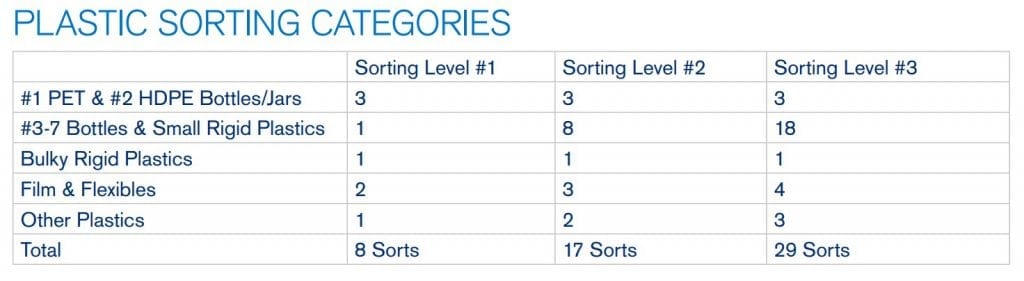
APR’s standards broadly place plastics into five categories: PET and HDPE bottles and jars, Nos. 3-7 bottles and small rigids, bulky rigids, film and flexibles, and other plastics.

Three sorting levels are provided, depending on how extensive a study is desired and how much money is available to pay for it. Level 1 means separating plastics into eight sub-categories, level 2 involves 17, and level 3 involves 29.

“These categories are based on marketable bales,” Bedard said. “We want this to very much be based on reality, what’s happening out there in the real world.”

The number of sub-categories varies. For example, all three levels require separating PET/HDPE into three sub-categories: PET, HDPE natural and HDPE color. “Those are the commodities that are really being pulled out by just about every program in the United States,” Randell said.

But the number of sub-categories jumps substantially in the 3-7s category – from one in level 1 up to 18 in level 3 – simply because of the huge variety of plastics in the 3-7 category.
Stacey Demers of SCS Engineers explained that the more categories you have, the more time it takes and, generally, the more expensive it becomes. Her firm conducts waste characterization studies for municipalities, states, businesses and institutions.

“Every time we do a different study, there’s always a different list of materials. Sometimes they’ve copied it from another study they’ve seen. Sometimes it’s just curiosity. Sometimes they’re not even sure why they have those categories,” she said. “So having … the best management practices put out for the different categories, I think, is a great idea because it allows consistency. It allows material that can fit into categories to help municipalities know the percentage of recyclable plastics that’s in their waste stream and what their program needs to target later on.”

Photo credit: Tunatura/Shutterstock

 

Tags: Industry Groups
TweetShare
Jared Paben

Jared Paben

Related Posts

Auto Draft

New Compudopt CEO hopes to nurture agency’s growth

byPaul Lane
August 14, 2026

Allison Kotarski assumed the organization’s top spot after several years as COO.

Mass balance matters: Why different rules can lead to different outcomes 

SWANA CEO Amy Lestition Burke to depart organization

byStefanie Valentic
August 11, 2026

SWANA's board is beginning a national search following CEO Burke’s departure.

APR expands design training to 3 days

byAntoinette Smith
August 11, 2026

The September session in Indianapolis will include behind-the-scenes tours of Republic Services and Blue Polymers facilities, plus the former Nova...

APR launches recyclability assessment platform

APR launches digital plastic evaluation tool

byPaul Lane
August 7, 2026

The new platform will allow companies to have their plastics assessed for recyclability and compliance with EPR-related regulations.

The most important decision in tire recycling happens before the shredder

Oregon wash hub looks to slash single-use plastic

byPaul Lane
August 4, 2026

Planners hope to remove 250,000 single-use serviceware items from the waste stream within the first year of operation.

CAA opens series of Oregon EPR webinars

byStefanie Valentic
August 3, 2026

CAA is opening a formal consultation series to gather input from producers to regulators before the 2028-2032 blueprint locks in,...

Load More
Next Post

Our top stories from September 2018

2026 Buyers’ Guide

Equipment, services and technology suppliers serving the recycling industry.

Browse the Guide

More Posts

PureCycle sees easing headwinds to R-PP adoption

PureCycle says H2 outlook already playing out 

August 13, 2026

Two pilot programs in CA recycle commercial film

August 10, 2026

What nine years of acquisitions taught Coastal Waste’s CEO

August 12, 2026
Sabic launches engineered plastic with 75% PCR

Sabic launches engineered plastic with 75% PCR

August 11, 2026
Re-Teck opens site in Southeast Asia

ERI expands global footprint into Vietnam

August 11, 2026
Europe’s recyclers miss most of the critical materials

Market surge expected for plastic from e-scrap

August 10, 2026
End markets, policy key to RPET viability

PET in focus: Is help on the way?

August 17, 2026
Spinning globe with black background.

ITAD challenges, opportunities vary around the world

August 13, 2026
State program revamp proposal advances in Oregon

Oregon EPR ruling looms: what legal experts think

August 17, 2026
May pricing bullish for most bales

August pricing bearish for plastic bales

August 17, 2026
Load More

About & Publications

About Us

Staff

Archive

Magazine

Work With Us

Advertise
Jobs
Contact
Terms and Privacy

Newsletter

Get the latest recycling news and analysis delivered to your inbox every week. Stay ahead on industry trends, policy updates, and insights from programs, processors, and innovators.

Subscribe

Welcome Back!

Login to your account below

Forgotten Password?

Retrieve your password

Please enter your username or email address to reset your password.

Log In

Add New Playlist

No Result
View All Result
  • The Latest
  • Analysis
  • Recycling
  • E-Scrap
  • Plastics
  • Policy Now
  • Conferences
    • E-Scrap Conference
    • Plastics Recycling Conference
    • Resource Recycling Conference
    • Textiles Recovery Summit
  • Magazine
  • About Us
  • Advertise
  • Archive
  • Jobs
  • Staff
Subscribe
This website uses cookies. By continuing to use this website you are giving consent to cookies being used. Visit our Privacy and Cookie Policy.