





Resource Recycling
  • The Latest
  • Analysis
    • All
    • Certification Scorecard
    • Industry Announcements
    • Opinion
    Meta-Corning deal signals IT hardware retirement wave

    Meta-Corning deal signals IT hardware retirement wave

    Malaysia clamps down on illegal e-waste imports amid probes

    Malaysia clamps down on illegal e-waste imports amid probes

    URT builds alliance to remake electronics plastics at scale

    ICYMI: Top 5 e-scrap stories from January 2026

    Server resale values surge in AI-driven markets

    Certification scorecard for the week of Feb. 2, 2026

    Auditors warn EU may fall short on critical metals

    Auditors warn EU may fall short on critical metals

    Industry announcements for January 2026

    Industry announcements for February 2026

    ICYMI: Top 5 recycling stories from January 2026

    Certification scorecard for week of Jan. 26, 2026

    New entrepreneurs bring renewed energy to e-cycling

    Europe pulls ahead on ITAD now while US growth remains slower

  • Conferences
  • Publications

    Other Topics

    Textiles
    Organics
    Packaging
    Glass
    Brand Owners

    Metals
    Technology
    Research
    Markets
    Grant Watch

    All Topics

Subscribe
No Result
View All Result
Resource Recycling
  • The Latest
  • Analysis
    • All
    • Certification Scorecard
    • Industry Announcements
    • Opinion
    Meta-Corning deal signals IT hardware retirement wave

    Meta-Corning deal signals IT hardware retirement wave

    Malaysia clamps down on illegal e-waste imports amid probes

    Malaysia clamps down on illegal e-waste imports amid probes

    URT builds alliance to remake electronics plastics at scale

    ICYMI: Top 5 e-scrap stories from January 2026

    Server resale values surge in AI-driven markets

    Certification scorecard for the week of Feb. 2, 2026

    Auditors warn EU may fall short on critical metals

    Auditors warn EU may fall short on critical metals

    Industry announcements for January 2026

    Industry announcements for February 2026

    ICYMI: Top 5 recycling stories from January 2026

    Certification scorecard for week of Jan. 26, 2026

    New entrepreneurs bring renewed energy to e-cycling

    Europe pulls ahead on ITAD now while US growth remains slower

  • Conferences
  • Publications

    Other Topics

    Textiles
    Organics
    Packaging
    Glass
    Brand Owners

    Metals
    Technology
    Research
    Markets
    Grant Watch

    All Topics

Subscribe
No Result
View All Result
Resource Recycling
No Result
View All Result
Home E-Scrap

AI will increase e-scrap, but reuse can help

Colin StaubbyColin Staub
December 12, 2024
in E-Scrap
AI will increase e-scrap, but reuse can help

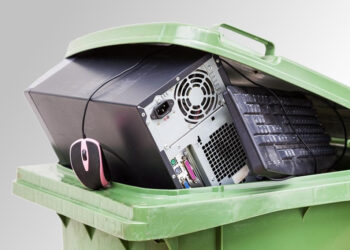
As artificial intelligence continues to ramp up, researchers said the computing-heavy tool could lead to skyrocketing volumes of end-of-life electronics and called for equal attention to asset management.

Researchers from the University of China Academy of Sciences in Beijing, Reichman University in Israel and the University of Cambridge in the U.K. on Oct. 28 published “E-waste challenges of generative artificial intelligence,” which appeared in the peer-reviewed Nature Computational Science journal.

The research traces the growth in large language models, the type of AI that’s used in high-profile tools like ChatGPT. These tools are “trained on vast datasets,” the researchers noted, demanding “considerable computational resources for training and inference, which require extensive computing hardware and infrastructure.”

In practice, that means more – and much more powerful – data centers. The researchers considered waste generation from 2023 through 2030 under a few different models for how aggressively AI could be rolled out. They looked only at the key hardware involved in AI computing: servers that include graphics processing units, central processing units, storage, memory units, internet communication modules and power systems. 

Without any strategic planning, the research found cumulative e-scrap generation of these materials from data centers could total at least 1.2 million metric tons under the most limited rollout and up to 5 million metric tons under the most aggressive. 

This e-scrap generation would naturally be concentrated in data center-heavy regions, with 58% in North America, 25% in East Asia and 14% in Europe, the researchers added.

In a statement to E-Scrap News, study author Penn Wang of the Chinese Academy of Sciences said the findings underscore a need for greater transparency from data center operators on how much end-of-life material they are generating, a need to better link data center operators with electronics processors, greater regulation on how end-of-life material from data centers is handled, and global cooperation to handle these projected volumes of material.

AI’s energy consumption draws wide focus

As AI has exploded into the public discourse over the last couple years, generating both excitement and trepidation for its potential, many analysts have considered the ripple effects of major data center growth. 

Early this year, Goldman Sachs projected AI will increase data center power demand by 160% by 2030, because “a ChatGPT query needs nearly 10 times as much electricity to process as a Google search.” 

That power consumption means more emissions, the World Economic Forum said in July, noting that data center demand had contributed to a 30% spike in Microsoft’s CO2 emissions and a 50% spike in Google’s. The energy consumption challenge has led to ambitious planning, including Microsoft recently proposing to revive the infamous Three Mile Island nuclear power generator in Pennsylvania.

Now the research into waste generation is highlighting the need for similarly ambitious planning to reduce the projected growing volume of end-of-life devices from AI infrastructure.

“This rapid growth in hardware installations, driven by swift advancements in chip technology, may result in a substantial increase in e-waste and the consequent environmental and health impacts during its final treatment,” the researchers wrote.

IT asset disposition firms are already gearing up to meet this projected influx. But the new research offers insights into how important data center refresh practices will be during the next several years.

Extending first-use and prioritizing reuse are key

The Nature Computational Science study looked at several scenarios that could affect the volume of end-of-life data center assets, and they found the most effective practices are extending equipment’s first use and prioritizing reuse through dismantling and parts harvesting.

First-use extension can be achieved when a data center operator moves an end-of-life piece of equipment into a lower intensity application. The paper offered the example of a server at the end of its three-year lifespan being redeployed into a section of the data center serving non-AI or less-intensive AI needs.

Redeploying assets in this way for just one additional year would reduce equipment entering the end-of-life stream by 62%, or 3.1 million metric tons, under the “aggressive” AI adoption scenario.

Engaging in server module reuse by dismantling, refurbishing and remanufacturing used GPU or CPU modules and returning them back into the high-intensity AI applications, for example, would reduce waste generation by 42%, or 2.1 million metric tons, the researchers estimated.

There are plenty of other factors that will influence end-of-life server generation. The researchers noted geopolitical factors like chip import and export restrictions prevent data centers in certain countries from obtaining the latest-model equipment. That’s important because newer models can often perform better with less physical equipment. 

Tags: Research
TweetShare
Colin Staub

Colin Staub

Colin Staub was a reporter and associate editor at Resource Recycling until August 2025.

Related Posts

UT Austin spinout Supra launches to recover rare earths

byScott Snowden
February 3, 2026

Supra Elemental Recovery launched today, aiming to recover gallium and scandium from US waste streams to help reduce import dependence...

Leveraging materials testing for procurement efficiency

byDr. Pradyumna Gupta
January 23, 2026

In real-world application, variations in resin properties translate into budget risk, from increased scrap rates and production downtime to premature...

Robot pilot targets legacy parts to help supply defense

Robot pilot targets legacy parts to help supply defense

byScott Snowden
December 29, 2025

Although chip availability has improved since the worst shortages earlier in the decade, Tuurny says demand for legacy electronics remains...

Chemical bonds

Alberta catalyst discovery targets hydrogen and plastics

byScott Snowden
December 10, 2025

A chance discovery inside a University of Alberta laboratory has developed into a Canadian cleantech project that aims to reshape...

Global recycling patent trends may reflect legislative push

Global recycling patent trends may reflect legislative push

byAntoinette Smith
November 25, 2025

Patent applications for chemical recycling technologies have reached a record high globally with government initiatives among the factors driving innovation,...

Study maps barriers to firms’ supply chain climate goals

byAntoinette Smith
October 14, 2025

Publicly articulating clear sustainability goals helps ensure company follow-through, according to an annual supply chain study from the Massachusetts Institute...

Load More
Next Post
Online retailers to contribute to UK e-scrap funding

Online retailers to contribute to UK e-scrap funding

More Posts

Agilyx leaves US chem recycling, Houston sorting center

Agilyx leaves US chem recycling, Houston sorting center

February 4, 2026

Greenchip launches fund for community impact and trust

February 5, 2026
Third ExxonMobil recycling plant operational

Third ExxonMobil recycling plant operational

February 4, 2026
Stakeholders respond to California recyclability report

CalRecycle opens SB 54 draft for comments

February 2, 2026

Cirba Solutions: Battery fires stoking EPR bill movement

February 2, 2026

Eastman looks to recycling plant to drive growth

February 2, 2026

Allied Industrial portfolio companies complete two early-year deals

February 5, 2026
Chinese processing group details goals for US visit

AMP lays out vision of next-generation, AI-driven MRFs

July 24, 2024

PP cups now ‘widely recyclable’ with increased acceptance

February 3, 2026

UT Austin spinout Supra launches to recover rare earths

February 3, 2026
Load More

About & Publications

About Us

Staff

Archive

Magazine

Work With Us

Advertise
Jobs
Contact
Terms and Privacy

Newsletter

Get the latest recycling news and analysis delivered to your inbox every week. Stay ahead on industry trends, policy updates, and insights from programs, processors, and innovators.

Subscribe

Welcome Back!

Login to your account below

Forgotten Password?

Retrieve your password

Please enter your username or email address to reset your password.

Log In

Add New Playlist

No Result
View All Result
  • The Latest
  • Analysis
  • Recycling
  • E-Scrap
  • Plastics
  • Policy Now
  • Conferences
    • E-Scrap Conference
    • Plastics Recycling Conference
    • Resource Recycling Conference
    • Textiles Recovery Summit
  • Magazine
  • About Us
  • Advertise
  • Archive
  • Jobs
  • Staff
Subscribe
This website uses cookies. By continuing to use this website you are giving consent to cookies being used. Visit our Privacy and Cookie Policy.