






Tax reform legislation moving through Congress could help electronics recycling companies deduct equipment expenditures.
Tax reform bills approved by the U.S. House and Senate include sweeping cuts to business taxes, and recycling industry associations are applauding the business-friendly measures.
Corporations and many higher-earning pass-through businesses receive tax cuts under proposals approved by both chambers. In addition, an export incentive is retained in both bills. And as an equipment-heavy sector, recycling would likely benefit from a measure allowing immediate full expensing of purchased business assets.
“Overall, I think there’s some good stuff in this bill for the scrap industry,” said Billy Johnson, chief lobbyist at the Institute of Scrap Recycling Industries (ISRI), referring to the Senate legislation that was recently passed.
House lawmakers approved the Tax Cuts and Jobs Act on Nov. 16, and the Senate Finance Committee passed its version of the tax bill the same day. It was approved on the Senate floor in the early hours of Dec. 2. Both versions passed along party lines, carried by Republicans with no Democrats in either chamber voting for the legislation.
Now, lawmakers from both Congressional chambers will come together in a conference committee to discuss differences between the bills. Once reconciled, the revised bill goes for a floor vote of each chamber once again, before heading to the White House for President Trump’s consideration and signature.
The Senate proposal approved Friday contains a number of differences from the House bill. For example, the “alternative minimum tax” provision that ensures businesses pay at least a certain amount of tax each year, is eliminated altogether in the House proposal but is retained in the Senate version.
But the architecture of both bills is consistent, particularly in offering broad tax cuts to businesses.
Pass-through model prominent in recycling
Both chambers cut the corporate tax rate from 35 percent to 20 percent; the House proposal implements this in 2018 and the Senate bill delays it until 2019.
Tax liability would also be lowered for businesses not organized as standard C corporations. But these “pass-through” entities, such as S corporations, limited-liability corporations and other business types, are treated differently under both chambers’ proposals.
Pass-through business income is taxed as individual income for the business owner, meaning instead of being subject to the corporate tax rate, pass-through income is subject to the individual income tax levels. A business earning more than $418,400 in taxable income falls into the top individual tax rate of 39.6 percent under the current tax code.
The House bill caps the pass-through tax rate at 25 percent, which would lower taxes for higher-earning pass-through businesses. Tax modeling has shown roughly 90 percent of pass-through businesses are already in or below the 25 percent tax bracket.
The Senate version takes a different approach to lowering pass-through tax liability. Rather than a rate cap, it allows business owners a 23 percent deduction for pass-through business income, though it has a cap on that deduction.
A substantial majority – 90 percent – of all businesses in the U.S. are organized as pass-throughs, according to the Tax Policy Center, and the recycling sector is no exception. Johnson of ISRI told Resource Recycling a large portion of the group’s members are organized as pass-through businesses.
“Having the pass-through (rate) being reduced is a very positive thing for most of our members,” Johnson said.
Billy Johnson, chief lobbyist at the Institute of Scrap Recycling Industries (ISRI)
Pass-through income was a key area of interest for ISRI as it lobbied legislators during the tax reform process, Johnson said. He also cited the change in how business assets are expensed as a positive move for the industry.
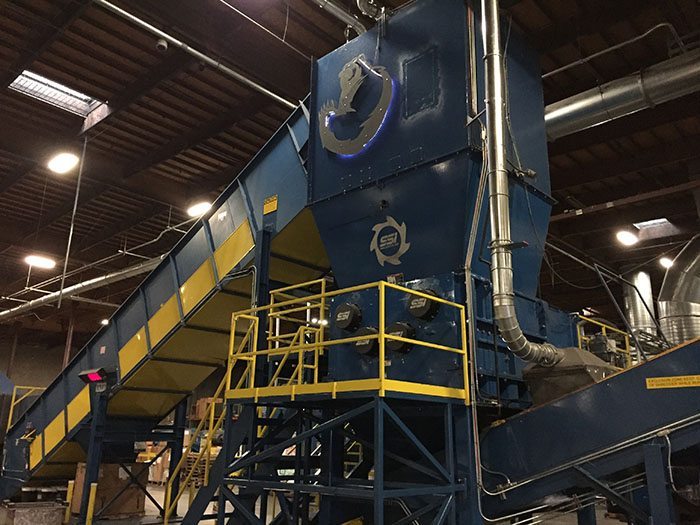
Both bills allow full and immediate expensing of purchased equipment through 2023. Johnson said this is an important measure for the recycling industry, which includes many equipment-heavy operations. The expensing step lets companies deduct the cost of new equipment purchases from their taxable income.
“That gets people to pull the trigger on purchasing a new piece of equipment,” Johnson said, noting it will benefit equipment manufacturers as well as buyers. This was one of ISRI’s priorities in the tax discussions.
Implications on exports and R&D
Johnson also highlighted an export incentive, called an “interest charge domestic international sales corporation” and referred to as the IC-DISC provision. This essentially allows companies to have their income from exported goods taxed at a lower rate than regular income. Both bills preserve this incentive; the Senate bill initially ended it but that clause was removed late in negotiations.
Johnson said that retaining this provision would continue to make exporting as attractive as it has been, which could be particularly important when Chinese import restrictions are impacting the export market substantially.
“It kind of puts things at a [more] level playing field for you to sell it to global markets,” Johnson said.
However, the tax legislation could also bring some negative business impacts to the materials recovery industry. For instance, although both bills preserve the research and development tax credit, they change how tax deductions for research and development projects would work.
Currently, businesses can immediately write off research and development expenses. According to Bloomberg News, the tax reform bills would require these investments to be capitalized and amortized over five years, which means the write-offs would have to be spread out into smaller amounts over five years.
A number of industry associations in addition to ISRI have come out in support of the tax bills. The American Chemistry Council, American Forest & Paper Association, the American Iron and Steel Institute and the Plastics Industry Association all praised aspects of the House or Senate bill.
The National Waste and Recycling Association (NWRA) is paying attention to the business provisions of the tax plans, particularly the tax proposals for corporations and pass-throughs, as they have big implications for its members.
“Our membership is full of small haulers and larger companies, and we’ve sort of got everybody in between,” said Brandon Wright, spokesman for NWRA.
In addition to the business provisions, Wright said the association is particularly interested in the energy tax credits around landfill gas. Under the tax proposal, renewable energy tax credits that sunsetted in 2016 would be reinstated.
“We’re going to let the process play out, and we’re just keeping an eye on what comes out of the conference committee and the pass-throughs,” Wright said.
Variations in growth projections
Lawmakers in support of the tax cuts promoted the economic growth the additional after-tax revenue would provide for businesses. Economists have mostly agreed there will be growth, but have differed in how much.
For example, in the Joint Committee on Taxation’s analysis of the bill as it first appeared in the Senate, the group found the cuts would generate more than $450 billion in economic output over the next decade, although it would add a net $1 trillion to the deficit through lost revenue.
The Tax Foundation criticized this assumption, making several arguments for higher GDP growth stemming from the cuts. Republican lawmakers have also criticized the findings as too low.
The U.S. Department of the Treasury received a letter from several economists predicting 4 percent GDP growth over the next decade, rather than the 0.8 percent assumed by the joint committee’s finding. That letter was, in turn, criticized by other prominent economists.