





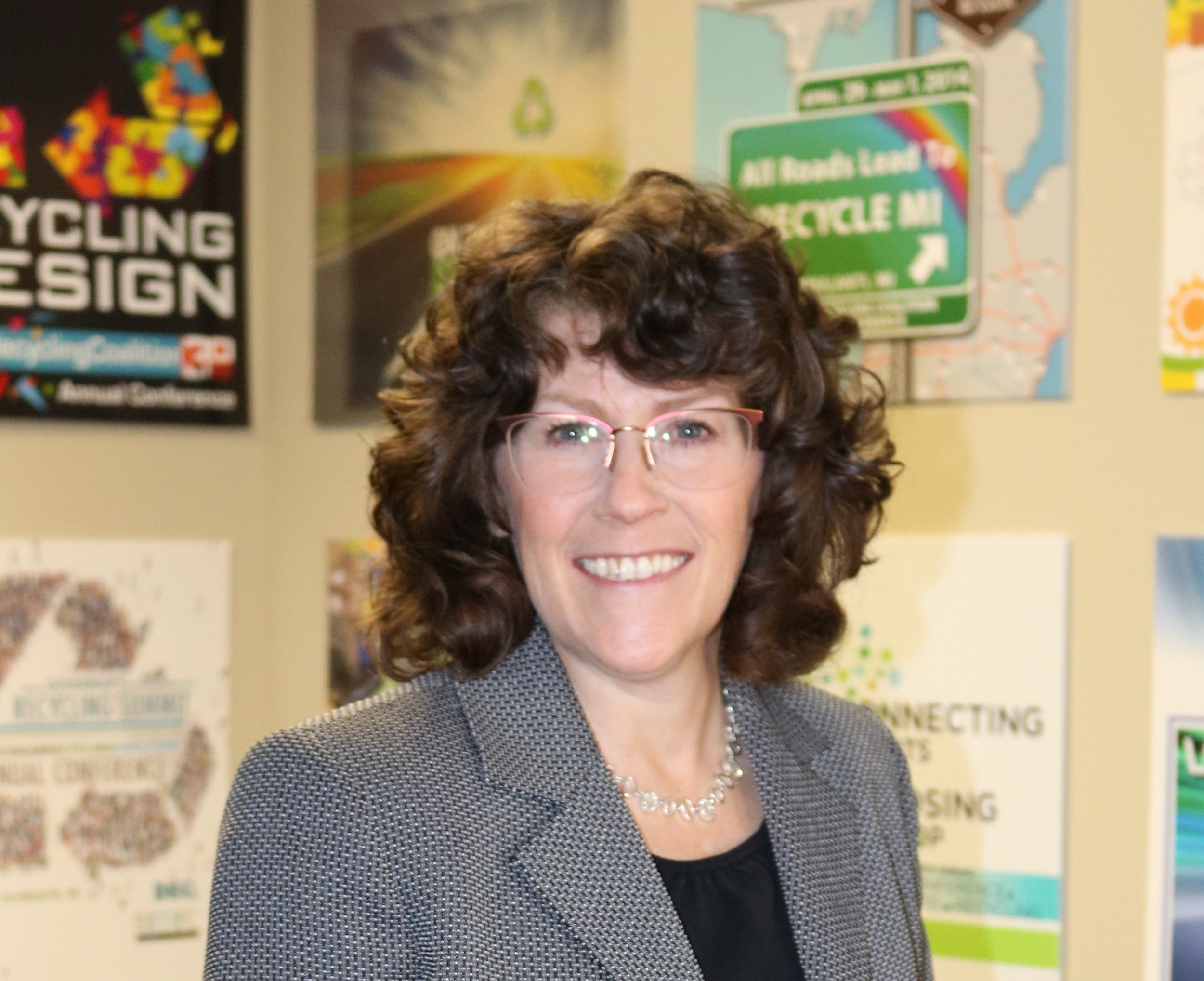
A warm welcome back to “Women in Circularity”, where we shine a light on women moving us toward a circular economy. This month, I was pleased to connect with a dynamic nonprofit leader: Kerrin O’Brien, executive director of Michigan Recycling Coalition — a longstanding state recycling organization, or SRO, which advances the circular economy by educating and mobilizing businesses, government, nonprofits and individuals to advance their resource use and recovery initiatives. Kerrin has almost 30 years of experience advancing sustainable materials management through market development, stakeholder engagement and public policy initiatives.
What first drew you to recycling and how has your perspective on advancing a circular economy evolved throughout your career?
I was camping with my family in the Smoky Mountains when I was about 10 years old. It was the first time I had been in a mountain range. Our campsite backed up to a cliff and my siblings and I immediately went exploring. The cliffside was covered in garbage and we were appalled. My family got to work right away cleaning it up. That experience stayed with me and ultimately led me to study environmental issues through a social science lens at Michigan State University.
A few years later, a friend working for a Michigan County later recruited me to volunteer at an early Michigan Recycling Coalition (MRC) conference and the rest is history. Over the years, my perspective has evolved from focusing primarily on recycling programs to understanding the importance of policy, market development and systems-level solutions in creating lasting change.
What strategies have you found most effective in motivating businesses and communities to adopt diversion practices and drive lasting behavior change?
The MRC works to attract and orient members around our recycling mission, so we tend to engage organizations and individuals who already recognize the value of this work. We listen closely to our members and stakeholders to understand the real challenges communities and the businesses serving them face.
These strong relationships help us identify common priorities, focus on practical solutions and build a strong community around shared goals. Lasting behavior change happens when people see themselves reflected in the solution and have the tools, resources and support they need to succeed.
Is there a strategic partnership that has been particularly meaningful to you and what makes it stand out among your accomplishments?
The MRC’s partnerships with industry stakeholders, community leaders and state agencies have been especially meaningful because they have informed and enabled policy solutions that reflect the needs and priorities of our engaged membership. Building trust and maintaining long-term relationships has been essential to that success. Some of the most impactful outcomes have emerged when government, industry and community stakeholders come together around a shared vision and commit to moving it forward collectively.
That leadership and policy work has helped make funding available for highly effective programs, including grants for communities and businesses, NextCycle Michigan, which supports the acceleration of innovative ideas and projects, and statewide assessments that inform the development of needed collection and management services. Seeing collaborative policy efforts translate into tangible resources and measurable community impact has been one of the most rewarding aspects of my career. And, it positioned the MRC to continue its work through an EPA Recycling Education and Outreach grant.
What emerging trends do you believe have the greatest potential to accelerate circularity over the next decade?
Extended Producer Responsibility (EPR) policies hold tremendous promise. Internalizing the costs and impacts of waste into product design and management is key to creating a more effective and accountable system. By creating stronger connections between producers and end-of-life management, EPR has the potential to drive improvements in product design, increase recycling rates and strengthen markets for recovered materials.
Our challenge in Michigan is finding the most cost-effective and convenient ways to deliver high-quality services at the local level. When paired with strong local infrastructure and market development, EPR can help create a more resilient and circular materials management system.
What unique experience has most influenced your work and would you recommend it to others interested in circular economy solutions?
I was fortunate to be invited to participate in the Ocean Plastics Leadership Network’s (now Circle) Policy Expedition on EPR and Deposit Return Systems a few years ago. It was an incredibly valuable experience. Dave Ford and his team brought together a diverse group of policy practitioners and stakeholders from across the country. Sharing long bus rides and meals together amplified and supported integration of the tours and presentations they had planned for us.
The opportunity to learn directly from others actively developing and implementing policy gave me a strong foundation and a supportive network for the work ahead. I would absolutely recommend opportunities like this to others interested in circular economy solutions because they provide both practical knowledge and invaluable professional connections.