






Resource Recycling
  • The Latest
  • Analysis
    • All
    • Certification Scorecard
    • Industry Announcements
    • Opinion
    Spin-off lets Linca focus on battery mineral recovery

    Critical mineral policy shift creates opportunity

    CommanderAI launches searchable hauler database

    Inside the Circle: Put AI to work for the people who do the work

    Northeast commodity values for Q2 reach 2-year high

    Will a MRF shortage limit EPR growth?

    From claims to custody: PCR procurement grows up

    Certification scorecard — week of September 7

    iFixit launches 2-week circuit board training course

    Printed circuit board (PCB) recycling explained

    Sims: Parts reuse helped offset 2020 cloud challenges

    ITAD providers should choose their data-center niche

  • Conferences
    • Resource Recycling Conference
    • Plastics Recycling Conference
    • E-Scrap: The Longevity Conference
    • Textiles Recovery Summit
  • Publications
    • E-Scrap News
    • Plastics Recycling Update
    • Policy Now
    • Resource Recycling
    • Other Topics
      • All Topics
      • Brand Owners
      • Critical Minerals
      • Glass
      • Grant Watch / RFPs
      • Markets
      • Organics
      • Packaging
      • Research
      • Technology
      • Textiles
Subscribe
No Result
View All Result
Resource Recycling
  • The Latest
  • Analysis
    • All
    • Certification Scorecard
    • Industry Announcements
    • Opinion
    Spin-off lets Linca focus on battery mineral recovery

    Critical mineral policy shift creates opportunity

    CommanderAI launches searchable hauler database

    Inside the Circle: Put AI to work for the people who do the work

    Northeast commodity values for Q2 reach 2-year high

    Will a MRF shortage limit EPR growth?

    From claims to custody: PCR procurement grows up

    Certification scorecard — week of September 7

    iFixit launches 2-week circuit board training course

    Printed circuit board (PCB) recycling explained

    Sims: Parts reuse helped offset 2020 cloud challenges

    ITAD providers should choose their data-center niche

  • Conferences
    • Resource Recycling Conference
    • Plastics Recycling Conference
    • E-Scrap: The Longevity Conference
    • Textiles Recovery Summit
  • Publications
    • E-Scrap News
    • Plastics Recycling Update
    • Policy Now
    • Resource Recycling
    • Other Topics
      • All Topics
      • Brand Owners
      • Critical Minerals
      • Glass
      • Grant Watch / RFPs
      • Markets
      • Organics
      • Packaging
      • Research
      • Technology
      • Textiles
Subscribe
No Result
View All Result
Resource Recycling
No Result
View All Result
Home Analysis

Inside the Circle: Put AI to work for the people who do the work

Bill ShiremanbyBill Shireman
September 14, 2026
in Analysis, Opinion, Recycling
CommanderAI launches searchable hauler database

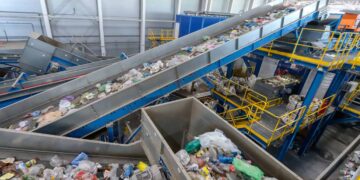
Chaosamran_Studio / Shutterstock

Inside the Circle is a monthly column on circular economy trends transforming source reduction and recycling.

People fear artificial intelligence in part because they see it as a threat to jobs. If a camera and an algorithm can sort a PET bottle faster than a person, the reasoning goes, then the person on the line is the cost the technology exists to remove.

That is one way to use AI.  But it is not the most valuable one.

Economists who study automation — Daron Acemoglu, David Autor and Simon Johnson among them — draw a line between two kinds of technology. One removes the human being from the process. The other removes the drudgery, the guesswork and the bottlenecks from the human being, and hands the capability back. They call the second kind pro-worker AI, and it is the version our industry should be building toward. Because in recycling, the bottleneck has almost never been the worker. It has been contamination, confusion and materials we could not economically sort, no matter our skill or speed.

Start with contamination — the quiet tax that degrades nearly every load. Intuitive AI’s Oscar, an assistant that retrofits to almost any bin, watches the moment of disposal and tells a person, in real time, which stream an item belongs in. It does not sort the waste for them; it makes the upstream human decision correct more often, before the mistake is baked into the bale — a very different intervention from adding another sorter downstream. 

Just as important, it measures what is actually being thrown away, item by item, at the point the material enters the stream. You can only manage what you can measure, and for most of this industry’s history, waste at the bin has been invisible. Oscar is already running where contamination is worst and the stakes are public — stadiums, airports, campuses, event venues — turning the messiest moment in the whole system, an untrained hand hovering over three identical lids, into a correct decision and clean data.

SuperCircle works the other end of the pipe, on a stream much of the industry has written off: textiles. Apparel and footwear are built from blended synthetics — polyester, nylon, elastane — that conventional systems cannot economically separate, so most of it is landfilled, incinerated or shipped abroad. SuperCircle’s AI-driven sortation reads incoming garments and routes each to its best next life, whether fiber-to-fiber recycling, component recovery, or reuse, across dozens of downstream pathways. It also runs the reverse logistics that let brands like Guess, J.Crew and Reformation take product back at all. A $24 million Series A late last year is a signal worth reading: recovering the “unrecyclable” is starting to look like a business rather than a pilot.

Notice what these tools have in common. Neither replaces a recycling professional. Each removes a barrier that has capped what the professional and the system could accomplish — poor inbound quality, confusion at the bin, materials with no viable path forward. That is the pattern worth adopting. The AI worth having in this industry is not the kind that promises to run the plant with fewer people. It is the kind that lets the people and plants we already have capture more material, at higher quality, from streams that used to escape us entirely.

This matters beyond efficiency, and it matters for the reason the circular economy exists at all. A circular economy is not simply a linear one run in reverse. It depends on material actually finding its way back and moving forward to its highest use — cleanly, affordably, at scale. Every point where a person guesses wrong, or a material has nowhere to go, is a place where the circle breaks and the loop reverts to a line. Tools that repair those breaks are doing circular work, whether or not they put the word on their website.

The caution is real, and worth stating plainly. AI can just as easily be pointed the other way: used to squeeze more output from the same people, to concentrate control of hard-won waste data in a few hands, or to sell the appearance of diversion without its substance. The technology does not choose its purpose. We do — in what we buy, what we reward, and what we ask it to optimize. A smarter linear economy is still a linear economy. The goal is not a more efficient machine. It is a system that behaves less like a machine and more like a living cycle.

That choice is the conversation this industry should be having now, while the tools are still young enough to shape — sorting where AI is genuinely advancing circularity on the ground from where it is only industrialism with better cameras.

The recycling community has spent a decade being told that AI will change everything. The more useful question is the one worth pressing every vendor, every pilot, and every proud new deployment to answer — how will we use AI, to change things for good?  

Tags: ContaminationTechnology
TweetShare
Bill Shireman

Bill Shireman

Bill Shireman is a longtime environmental entrepreneur and policy innovator. He helped write California’s original bottle recycling law, which has helped recover hundreds of billions of containers. As CEO of Solution Citizen, he works at the intersection of circular economy policy, democratic renewal, and cultural transformation—and occasionally wanders rainforests looking for better ideas than the ones we currently have. He recently launched Circle America, a new affinity group and campaign for advancing a circular economy and culture. Learn more and join the community at CircleAmerica.us

Related Posts

iFixit launches 2-week circuit board training course

Printed circuit board (PCB) recycling explained

byJavier Castilloand2 others
September 9, 2026

Recycling PCBs presents significant technical challenges because these waste streams combine metallic, non-metallic and electronic fractions with different characteristics and...

Inside the sneaker recycling boom

Report: AI opportunity robust in footwear recycling

byPaul Lane
September 8, 2026

BCC Research found AI’s usage in the footwear recycling space is growing but remains in the early stages, holding the...

Dell expects PC refresh to extend into next year

Dell, HP show enterprise PC spending separating from unit volume

byDavid Daoud
September 3, 2026

Large enterprises are still refreshing their PC fleets, but the broader market is becoming less dependable as a source of...

CommanderAI launches searchable hauler database

Companies treating AI as an afterthought risk falling behind

byStefanie Valentic
August 27, 2026

AI adoption has moved from optional upgrade to competitive necessity. Companies restructuring around it is growing faster than most leaders...

Mich. sortation project shows shifting MRF role

Mich. sortation project shows shifting MRF role

byAntoinette Smith
August 26, 2026

Kent County's use of AMP sorting tech is part of a broader expansion of recycling recovery architecture.

Sabic launches engineered plastic with 75% PCR

Sabic launches engineered plastic with 75% PCR

byAntoinette Smith
August 11, 2026

A new compound from the Saudi materials science giant uses post-consumer polycarbonate from wastewater bottles and compact discs, and PCR...

Load More

2026 Buyers’ Guide

Equipment, services and technology suppliers serving the recycling industry.

Browse the Guide

More Posts

New Jersey pushes back PCR mandate to 2030

New Jersey pushes back PCR mandate to 2030

September 10, 2026
Lawsuits hover days after SB 54 approval

Preparing for SB 54 design compliance

September 8, 2026
Northeast commodity values for Q2 reach 2-year high

Will a MRF shortage limit EPR growth?

September 10, 2026

SB 54 Unpacked: Can film catch up to cartons?

September 4, 2026
Analysis: CA climate rules set off ripple effect for thousands

SB 54 Unpacked: California jurisdictions face scramble to comply

September 2, 2026
Sims: Parts reuse helped offset 2020 cloud challenges

ITAD providers should choose their data-center niche

September 8, 2026
Alpek closing Pennsylvania RPET plant

Alpek seizing on war-related opportunity 

July 27, 2026
Hawaii's state capitol building.

Funding lapse leaves Hawaii e-scrap collectors seeking answers

September 10, 2026
Study explores cleanliness of food packaging in bins

SB 54 Unpacked: REMs, reimbursements remain moving targets

September 3, 2026
Bale pricing mostly flat for September

Bale pricing mostly flat for September

September 9, 2026
Load More

About & Publications

About Us

Staff

Archive

Magazines

Work With Us

Advertise
Jobs
Contact
Terms and Privacy

Newsletters

Get the latest recycling news and analysis delivered to your inbox every week. Stay ahead on industry trends, policy updates, and insights from programs, processors, and innovators.

Subscribe

Welcome Back!

Login to your account below

Forgotten Password?

Retrieve your password

Please enter your username or email address to reset your password.

Log In

Add New Playlist

No Result
View All Result
  • The Latest
  • Analysis
  • Recycling
  • E-Scrap
  • Plastics
  • Policy Now
  • Conferences
    • E-Scrap Conference
    • Plastics Recycling Conference
    • Resource Recycling Conference
    • Textiles Recovery Summit
  • Magazines
  • About Us
  • Advertise
  • Archive
  • Jobs
  • Staff
Subscribe
This website uses cookies. By continuing to use this website you are giving consent to cookies being used. Visit our Privacy and Cookie Policy.