Before living in Florida, I spent most of my life in Cleveland, Ohio — my hometown — and the place that shaped my baseline for what “normal” recycling looks like. Access there was convenient for the most part, despite the city’s challenges with the program.
I’d roll my bin out the night before, and on cue every week, I’d hear the hydraulics groaning at the crack of dawn. The bin was empty before I finished my coffee.
Recycling was a constant – set it out, forget it and repeat. I didn’t have to think about where any of it went, because the whole point of that system was that I never had to.
Then I moved to an unincorporated community of about 1,500 on the shore of a freshwater lake in central Florida.
My closest recycling center is 13 miles away, managed by the county. There’s no second truck rolling past my dirt road every Tuesday to dump. If I want to recycle, I have to plan for it. Separate it into separate bags for transport, load the car and make the drive. Some weeks I don’t make the trip, and the recyclables just sit under the carport getting sorted a second and third time in my head. I also consider reuse more often, such as using water jugs as planters.
Recycling stopped being convenient. It became something I had to manage with purpose and integrate it into a new routine.
It sounds like a small change or adjustment, but it wasn’t. Lack of curbside services rewired how I think about my own trash, and then about my job.
Curbside to roadside
I think about that Cleveland curb a lot now, the fading black house number sprayed over the wearing concrete. Every house on my street had a bin and every bin was picked up on the same morning, like clockwork.
The sanitation truck ran the route in a couple of hours because of the proximity of the homes. The streets were paved and predictable. That’s an efficient infrastructure, a city built densely enough that one truck can service hundreds of households without driving more than a few miles.
My road has the opposite problem. The private, dirt road is barely enough for one car to drive down. The neighborhood pays for maintenance themselves. A hauler willing to come out this far needs a vehicle that can handle a rutted dirt road and a route where 20 minutes of driving might net just a handful of homes.
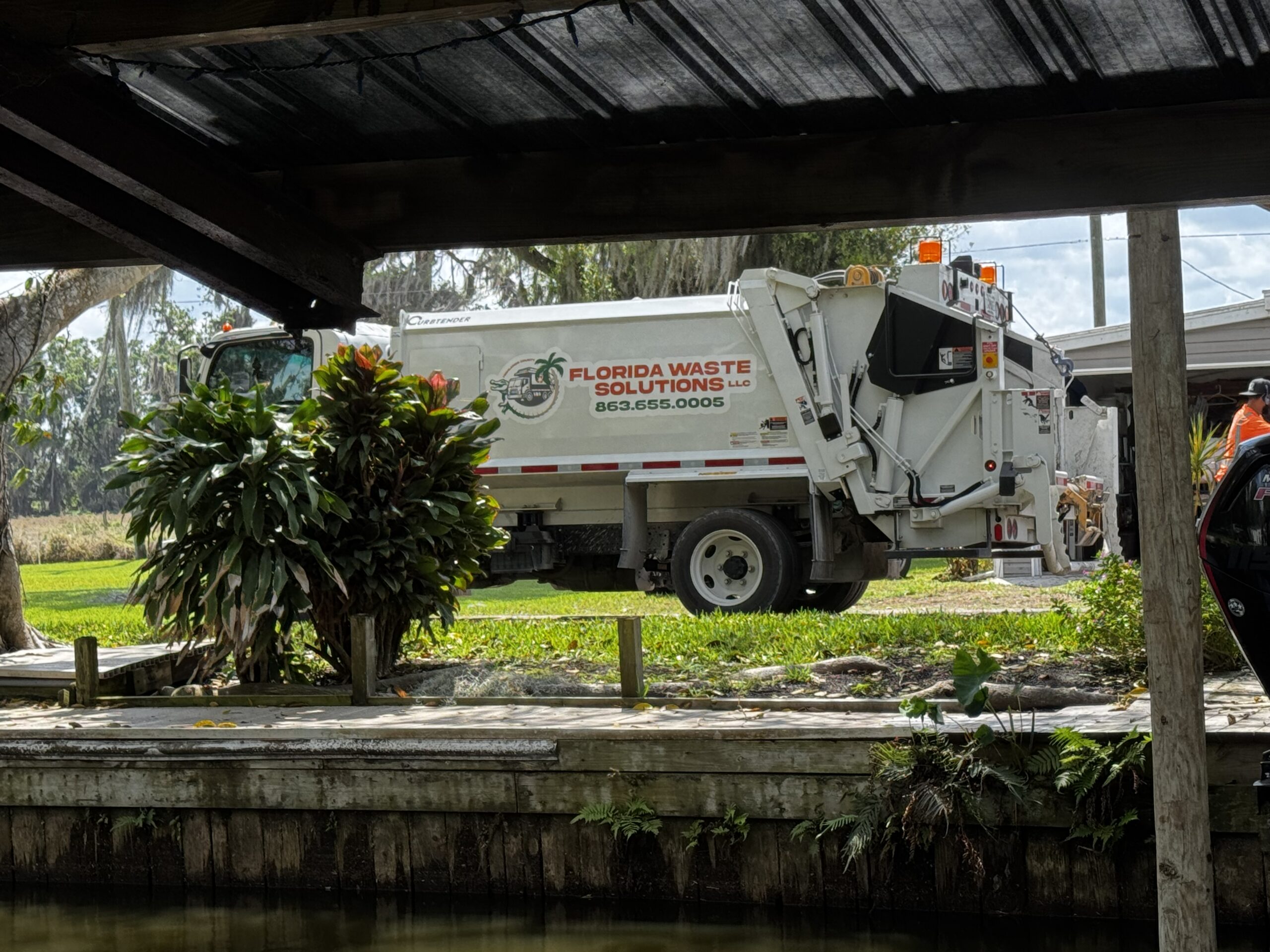
Florida Waste Solutions, which is contracted with Highlands County for waste and recycling pickup, has specialized trucks that drive these routes.
Yard waste and bulk waste are in a whole other world too. Just past the entrance to the nearby fish camp, a stack of tires marks where residents place their items, which are collected on alternating weeks.
The “standard” sanitation truck that rolled down my old Cleveland street and the truck that would have to find my house now are solving completely different puzzles, and neither one could do the other’s job. I hadn’t thought about that until I was the one 13 miles from the recycling drop-off point.
From the lake to the farm
There’s a project right in my front yard that is reframing using waste as a resource. For two years, a contractor working with the South Florida Water Management District has been vacuuming decades of muck off the bottom of Lake Istokpoga, the same muck that’s been suffocating fish, birds and native plants, and spraying it straight onto a neighboring cattle ranch. That cattle ranch is owned by the family who started this town.
What was choking the lake is now fertilizing pasture. The ranch hasn’t bought commercial fertilizer in two years. The cows are healthier. The hay comes in monthly instead of once a season.
Nobody up there calls it a recycling program. But it’s the exact idea I write about every day, just in a different context: waste is a resource, and something written off as destined for a landfill in one place could be beneficial for another community, ecosystem or industry.
Bigger county, same question
I’ve already jumped into learning about my new home state, by traveling throughout Florida for conferences and out of pure curiosity. I’m able to see how the state is utilizing waste and a resource as its population grows, driving the need to view waste as a resource.
In July, Miami-Dade County Mayor Daniella Levine Cava stood up at a press conference at the Miami Marriott Biscayne Bay and unveiled the county’s long-awaited Zero Waste Master Plan after four years and dozens of public workshops in the making.
“We have the means, the people and the money,” she told the room, which was filled with municipalities, hospitality and tourism reps, environmental groups, business owners and residents who’d shown up throughout the years of surveys and community meetings to help build the plan’s framework.
This was really encouraging to see, because a county full of very different stakeholders agreed the trash problem was everyone’s problem.
Miami-Dade County’s trash problem is not abstract. The county generates more than 5 million tons of waste a year, roughly double the national average, and landfill capacity is expected to run out within five years. More than 21 million tourists a year generate thousands of tons of hotel and restaurant waste on their own.
The county’s trash woes, in addition to the South Florida population boom, traces back to a single fire.
In February 2023, Miami-Dade’s Doral incinerator burned down, wiping out roughly a million tons of annual disposal capacity overnight. No replacement has been built, and commissioners scrapped plans for a new one after years of neighborhoods fighting to keep it out of their backyard.
In the meantime, Miami-Dade has been shipping its garbage out by rail and truck to the tune of tens of millions of dollars a year to landfills in Sumter, Okeechobee and St. Lucie counties, sometimes as far as Georgia. It’s the flip side of everything I deal with in a rural setting.
The Zero Waste Master Plan, which has a goal of more than doubling the recycling rate by 2039, from roughly 32% to 77%, holds solutions for the county.
And South Florida’s population isn’t making it an easy task. It’s compounding the same underlying issue: What do we actually do with everything we’re about to throw away?
A conscious, collective decision
“Waste” is a resource, and it should be considered before it hits the bin, whether it winds up at a recycling center or as feed for farm animals or even compost. Recycling itself is a decision, made on purpose, no matter where you live.
My decision looks like an hour-long round trip with a packed truck bed every couple of weeks, while Miami-Dade County’s decision is full of stakeholders and a 13-year plan. None of it happens on its own.
Whether it’s a different geography or a different truck, the logistics questions remain: What’s actually in that bin and is there something better waiting for it before it gets to the landfill.