





Resource Recycling
  • The Latest
  • Analysis
    • All
    • Certification Scorecard
    • Industry Announcements
    • Opinion
    Apple store

    Apple leads on inputs, faces questions on ITAD

    Unlocking the power of source reduction in US EPR

    Unlocking the power of source reduction in US EPR

    Following petition, Microsoft extends Windows 10 support

    Windows AI Recall is pushing data destruction upstream

    Certification Scorecard — Week of April 27, 2026

    Five trends shaping PCR packaging to 2031

    Intel sign on company building with blue sky and trees.

    Intel boosts margins by selling what it used to scrap

  • Conferences
    • Resource Recycling Conference
    • Plastics Recycling Conference
    • E-Scrap: The Longevity Conference
    • Textiles Recovery Summit
  • Publications
    • E-Scrap News
    • Plastics Recycling Update
    • Policy Now
    • Resource Recycling
    • Other Topics
      • Brand Owners
      • Critical Minerals
      • Glass
      • Grant Watch
      • Markets
      • Organics
      • Packaging
      • Research
      • Technology
      • Textiles
      • All Topics
Subscribe
No Result
View All Result
Resource Recycling
  • The Latest
  • Analysis
    • All
    • Certification Scorecard
    • Industry Announcements
    • Opinion
    Apple store

    Apple leads on inputs, faces questions on ITAD

    Unlocking the power of source reduction in US EPR

    Unlocking the power of source reduction in US EPR

    Following petition, Microsoft extends Windows 10 support

    Windows AI Recall is pushing data destruction upstream

    Certification Scorecard — Week of April 27, 2026

    Five trends shaping PCR packaging to 2031

    Intel sign on company building with blue sky and trees.

    Intel boosts margins by selling what it used to scrap

  • Conferences
    • Resource Recycling Conference
    • Plastics Recycling Conference
    • E-Scrap: The Longevity Conference
    • Textiles Recovery Summit
  • Publications
    • E-Scrap News
    • Plastics Recycling Update
    • Policy Now
    • Resource Recycling
    • Other Topics
      • Brand Owners
      • Critical Minerals
      • Glass
      • Grant Watch
      • Markets
      • Organics
      • Packaging
      • Research
      • Technology
      • Textiles
      • All Topics
Subscribe
No Result
View All Result
Resource Recycling
No Result
View All Result
Home E-Scrap

Solvent breakthrough could lead to more e-plastics recovery

Colin StaubbyColin Staub
April 5, 2018
in E-Scrap
Solvent breakthrough could lead to more e-plastics recovery

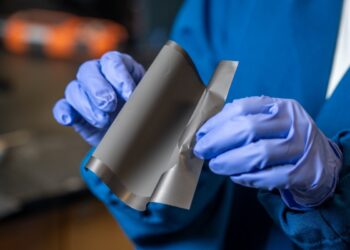
Research partially funded by a prominent IT asset disposition company led to the development of a non-toxic method for recycling e-plastics.

Sriraam Chandrasekaran and B.K. Sharma, scientists from the University of Illinois, found that a particular solvent can recover a clean stream of polycarbonate (PC) from mixtures of different e-plastics. It is particularly effective for plastics that contain just two polymers, such as PC and polyamide (PA).

The PC resin is known for durability and its ability to insulate electrical components. In addition to electronics, it is used regularly in construction and automotive applications.

The approach from Chandrasekaran and Sharma offers a non-toxic solution for recycling materials that have often been exported or sent to disposal. A select few North American facilities process e-plastics.

The research team hopes the solvent they studied, which is called N-methyl-2-pyrrolidone (NMP), can help make an impact quickly.

“The idea we had right from the beginning was commercialization,” said Chandrasekaran. “NMP is a commercially used solvent and it’s economically feasible as well.”

Chandrasekaran and Sharma are based at the Illinois Sustainability Technology Center (ISTC), a program of the Prairie Research Institute at the University of Illinois. They presented their research in a paper titled “Materials and energy recovery from e-waste plastics,” published in February in the ACS Sustainable Chemistry & Engineering journal.

Connecting with phone processor

The team has worked on plastics recovery previously, targeting other resins and investigating the use of pyrolysis for materials that are not typically recovered in materials recovery facilities (MRFs). After publishing a number of papers focused on that sector, the researchers came in contact with HOBI International.

HOBI processes mobile devices at a number of locations, including a Chicago facility near the researchers. HOBI leaders described to the research team how plastics in e-scrap are less frequently recycled than the higher value metals found in the stream.

“Most of the time it’s either incinerated or it ends up in a landfill,” Sharma explained. “We started researching how we can extract some useful polymer out of these plastics.”

Existing recovery methods often use other solvents and aim to dissolve the entire polymer, recovering the monomers for reuse. It can be “quite intensive, and not cost effective,” Chandrasekaran said.

There are also health and environmental concerns with existing practices. One common solvent, DCM, has a relatively low boiling point at about 35 degrees Celsius, and puts out carcinogenic vapor.

“We do not want to use some kind of solvent that, even at slight leakage, would threaten the environment,” Chandrasekaran said.

A cleaner solution

The team wanted to come up with a safe method of polymer recovery, and also wanted it to make use of a solvent that already exists and is commercially available. They set out on a research project funded in part by HOBI and by ISTC’s Hazardous Waste Research Fund.

Chandrasekaran and Sharma found their solution with the NMP solvent. It’s been used in the paint and petrochemical industries to strip off polymers in those applications. NMP has a boiling point of nearly 200 degrees Celsius and is non-carcinogenic. That means it can be heated to the point at which the polymers dissolve, without fear of vaporizing the solvent itself.

The team found NMP provides 89 percent recovery in certain cases.

For the best results, the process should be used on plastics that contain polycarbonate and one other polymer, such as polyamide. NMP yields polycarbonate of high purity, suitable for reuse in a variety of applications including electronics, construction materials and more.

The process is less well-suited for more complex materials that include additional polymers such as ABS or PMMA.

“For those types of plastics we found we can still recover polycarbonate from it, but it’s not very energy efficient or economical,” Sharma said.

The team tested a pyrolysis method to convert those more complex mixtures into oil. Doing so reduces the solid content of the plastic to about 40 percent of its original mass, and that material can be landfilled.

Next, the researchers plan to investigate solvent reuse, to determine how many times NMP can be recycled before it loses its potency. So far, they’ve found that it can be reused at least twice without losing efficacy.

“Once we demonstrate it on a larger scale, this is something that can be done in a centralized facility,” Sharma said.

Photo credit: myibean/Shutterstock
Tags: E-PlasticsResearch

TweetShare
Colin Staub

Colin Staub

Colin Staub was a reporter and associate editor at Resource Recycling until August 2025.

Related Posts

Float-sink technology at the Quantum Lifecycle Partners facility in Toronto, Canada enables the processing of e-plastics.

E-plastics recovery line opens in Canada

byPaul Lane
April 28, 2026

Toronto-based Quantum Lifecycle Partners is helping close the gap on North American e-plastic processing.

What Netflix’s ‘Plastic Detox’ gets wrong – and right

byKeith Loria
April 23, 2026

Advocates are excited about the attention brought on plastics by the documentary, but scientists say more nuance is needed.

Hawaii trials asphalt made with plastic debris and nets

Hawaii trials asphalt made with plastic debris and nets

byScott Snowden
April 20, 2026

Researchers at Hawaii Pacific University test asphalt made with fishing nets and plastic debris, with early results showing no increase...

Amazon, DOE partner on critical materials recovery

byScott Snowden
April 13, 2026

DOE and Amazon will study recovery of graphite from textiles and gallium from IT hardware, aiming to strengthen US supply...

Rice researchers use lemon juice to boost battery recycling

byScott Snowden
April 9, 2026

Rice researchers reported a battery recycling process that uses plasma and mild solvents to recover most metals from black mass...

Packaging sector sees shift from AI pilots to wider use

byScott Snowden
April 1, 2026

AI adoption is expanding across packaging operations as costs fall and use cases widen, though concerns around accountability, ROI and...

Load More
Next Post

Certification scorecard: April 5, 2018

More Posts

What Netflix’s ‘Plastic Detox’ gets wrong – and right

April 23, 2026
EPR fees are a market signal. Here’s what they’re telling you.

Oregon DEQ flags 250 producers for RMA noncompliance

April 21, 2026
Intel sign on company building with blue sky and trees.

Intel boosts margins by selling what it used to scrap

April 29, 2026
Birch Plastics gets FDA green-light for post-industrial PP

LyondellBasell upgrade to PreZero assets on hold

April 23, 2026

PCA keeping focus on virgin fiber products

April 27, 2026
Intel sign outside of company building.

What Intel’s blockbuster quarter means for ITAD

April 27, 2026
Float-sink technology at the Quantum Lifecycle Partners facility in Toronto, Canada enables the processing of e-plastics.

E-plastics recovery line opens in Canada

April 28, 2026
Our top stories from April 2022

Peters-Michaud named CEO, Houghton chair of Sage Sustainable Electronics

April 28, 2026
Plastic Ingenuity to use PureCycle PP for coffee lids

Plastic Ingenuity to use PureCycle PP for coffee lids

April 30, 2026
Dow touts US PE advantage amid Iran war

Dow touts US PE advantage amid Iran war

April 24, 2026
Load More

About & Publications

About Us

Staff

Archive

Magazine

Work With Us

Advertise
Jobs
Contact
Terms and Privacy

Newsletter

Get the latest recycling news and analysis delivered to your inbox every week. Stay ahead on industry trends, policy updates, and insights from programs, processors, and innovators.

Subscribe

Welcome Back!

Login to your account below

Forgotten Password?

Retrieve your password

Please enter your username or email address to reset your password.

Log In

Add New Playlist

No Result
View All Result
  • The Latest
  • Analysis
  • Recycling
  • E-Scrap
  • Plastics
  • Policy Now
  • Conferences
    • E-Scrap Conference
    • Plastics Recycling Conference
    • Resource Recycling Conference
    • Textiles Recovery Summit
  • Magazine
  • About Us
  • Advertise
  • Archive
  • Jobs
  • Staff
Subscribe
This website uses cookies. By continuing to use this website you are giving consent to cookies being used. Visit our Privacy and Cookie Policy.