






Resource Recycling
  • The Latest
  • Analysis
    • All
    • Certification Scorecard
    • Industry Announcements
    • Opinion
    Closeup of a printed circuitboard

    Hardware demand puts new focus on parts harvesting

    Rare look inside the world’s largest plastics recycler

    Mass balance matters: Why different rules can lead to different outcomes 

    Certification Scorecard — Week of June 1, 2026

    IT asset disposition and electronics recycling: Now and then

    $60 billion in AI servers will create an ITAD challenge

    The independent ITAD at a crossroads

    DMD acquires ITAD firm Lifespan, outlines acquisition strategy

    Packaging policy is not one-size-fits-all

    Packaging policy is not one-size-fits-all

  • Conferences
    • Resource Recycling Conference
    • Plastics Recycling Conference
    • E-Scrap: The Longevity Conference
    • Textiles Recovery Summit
  • Publications
    • E-Scrap News
    • Plastics Recycling Update
    • Policy Now
    • Resource Recycling
    • Other Topics
      • All Topics
      • Brand Owners
      • Critical Minerals
      • Glass
      • Grant Watch / RFPs
      • Markets
      • Organics
      • Packaging
      • Research
      • Technology
      • Textiles
Subscribe
No Result
View All Result
Resource Recycling
  • The Latest
  • Analysis
    • All
    • Certification Scorecard
    • Industry Announcements
    • Opinion
    Closeup of a printed circuitboard

    Hardware demand puts new focus on parts harvesting

    Rare look inside the world’s largest plastics recycler

    Mass balance matters: Why different rules can lead to different outcomes 

    Certification Scorecard — Week of June 1, 2026

    IT asset disposition and electronics recycling: Now and then

    $60 billion in AI servers will create an ITAD challenge

    The independent ITAD at a crossroads

    DMD acquires ITAD firm Lifespan, outlines acquisition strategy

    Packaging policy is not one-size-fits-all

    Packaging policy is not one-size-fits-all

  • Conferences
    • Resource Recycling Conference
    • Plastics Recycling Conference
    • E-Scrap: The Longevity Conference
    • Textiles Recovery Summit
  • Publications
    • E-Scrap News
    • Plastics Recycling Update
    • Policy Now
    • Resource Recycling
    • Other Topics
      • All Topics
      • Brand Owners
      • Critical Minerals
      • Glass
      • Grant Watch / RFPs
      • Markets
      • Organics
      • Packaging
      • Research
      • Technology
      • Textiles
Subscribe
No Result
View All Result
Resource Recycling
No Result
View All Result
Home Plastics

RPET imports raise industry concerns

Antoinette SmithbyAntoinette Smith
February 20, 2025
in Plastics
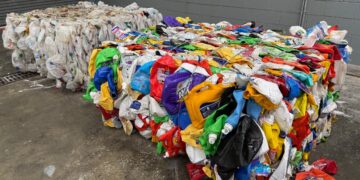
Scrap PET imports rose faster than overall scrap plastic imports did last year, continuing what has been an emerging challenge for the domestic plastics recycling industry. | S Oleg/Shutterstock

Domestic RPET market participants have struggled to compete with inexpensive imported material for nearly two years. But the lack of a specific Harmonized Tariff System code obscures the scale of the issue even as PET’s share of scrap imports surpassed 50%. 

In 2024, total scrap plastic imports rose by 9% to 492,139 metric tons, while exports fell by about 2% to 409,601 metric tons, according to U.S. trade data. Of the import total, 51% was PET scrap in 2024, compared to 46% and 34% in 2023 and 2022 respectively. 

Scrap PET imports rose disproportionately in 2024 – by 20% on the year to 250,975 metric tons – while PE scrap imports fell by 1.3%. And although PET scrap exports also rose by nearly 30% to 81,505 metric tons, with nearly 60% going to Mexico, the U.S. is by far a net importer of PET scrap. 

Meanwhile, in PET resin – whose HTS code covers both virgin and recycled PET – imports for 2024 were lower by 1.7% on the year at 1.4 million metric tons, and 14% lower than in 2022.

Not being able to properly quantify the influx of imported material concerns Ed Dominion, president and founder of Texas-based PET recycling company D6. 

“If I’m supporting recycling here, you want to see it recycled in this country, to be returned back to the goods, and we have more than enough capacity to do it in the country,” he said. 

Providing validation of recyclate content as well as origin is crucial amid the preponderance of misinformation surrounding plastics recycling, he added. “I think that will go a long way with consumers” to build trust in recycling systems. 

State-level extended producer responsibility programs for packaging are a logical place to include such validation, Dominion said, especially considering the programs are funded by domestic producers. “If these fees are going to come in for recycling, we have to recycle the materials here and not offshore.” 

However, maintaining a robust reporting system under EPR regulations is more important for compliance than having a separate HTS code, leaving producers to self-report the source of their material, said Alex Delnik, president and COO of RPET processor Circularix.  

Delnik said the impossibility of competing with cheaper imported resin has meant little new domestic RPET capacity is coming online. Even so, Circularix recently announced it was building additional capacity in Florida, and in early 2024 it entered a long-term supply agreement with U.S. hauler Republic Services. 

“We are facing in the RPET industry what overall manufacturing in the U.S. was facing 30, 40, 50 years ago, without understanding the impact,” Delnik said. Imported material is cheaper and may be of comparable or better quality, he said, “so tell me why, if I’m a brand or a converter, why wouldn’t I import material instead of buying domestic?” 

Lack of HTS code hinders clarity

After hearing from market players last year that increasing volumes of RPET flake and pellet were being offered, the National Association for PET Container Resources found a number of import cargoes shipped under the 3915 HTS plastic scrap code that were described as RPET flake, said Alasdair Carmichael, program director at NAPCOR. 

In further analysis of U.S. trade data, the industry group noted stable import volumes from 2018 until 2022 but saw significant increases in 2023 and 2024. “We believe this increase is partly due to the surge in imports of RPET flake entering the US under the PET scrap tariff number,” Carmichael told Plastics Recycling Update.

Recycled PET resin is supposed to be imported using the 3907 HTS code, which requires importers to pay import duties. 

NAPCOR attributes use of the incorrect code to two factors: “Partly it is due to a lack of an HTS code to cover RPET imports and therefore exporters can claim it is unclear which code should be used. The fact that the PET scrap code has an import duty of 0% and the PET resin code, which should be used, has a 6.5% duty might well influence the decision of which to use if there is felt to be a lack of clarity,” Carmichael said.

“We believe the highest level of clarity would be provided by the US adding a designated HTS code for imports of RPET flake or pellets,” he said.

With some imported material purporting to contain 100% post-consumer recyclate, D6 testing has found post-industrial resin or regrind mixed with virgin resin, Dominion said: “These are codes that international importers are using, and nobody is checking at the source” that this is real PCR. 

Similar to the recycled resin sector, participants in e-scrap – another quickly evolving industry – struggled to accurately quantify trade movements before in 2022 implementing new HTS codes to help provide clarity. For example, the 8549 heading previously included battery scrap descriptions but now also covers “electrical and electronic waste and scrap,” including printed circuit boards, leaded cathode ray tube glass and other components that have been shredded or otherwise destroyed and are destined for commodities recovery rather than reuse.

Nevertheless, while a designated RPET code would be useful, the more important issue is trying to compete with inexpensive imported material as domestic recyclers face high fixed costs including labor and energy, Delnik said. 

Tags: PETTrade & Tariffs
TweetShare
Antoinette Smith

Antoinette Smith

Antoinette Smith has been at Resource Recycling Inc., since June 2024, after several years of covering commodity plastics and supply chains, with a special focus on economic impacts. She can be contacted at [email protected].

Related Posts

War, not demand driving polymer pricing

War, not demand driving polymer pricing

byAntoinette Smith
June 2, 2026

While prices for recycled commodities are tracking rises in virgin markets, few transactions are occurring, said an ICIS analyst.

Data to verify recycling for Indy 500

Data to verify recycling for Indy 500

byAntoinette Smith
May 22, 2026

A verification platform from Circular Solutions will provide independent verification for the world's largest single-day sporting event on May 24.

Niagara acquires rPlanet Earth assets in California

Niagara acquires rPlanet Earth assets in California

byAntoinette Smith
May 15, 2026

Adding the Southern California facility to its operations, Niagara is expanding its beverage manufacturing operations and pursuing vertical integration.

Industry descends on DC to fight for PET

Industry descends on DC to fight for PET

byAntoinette Smith
May 13, 2026

Amid numerous recent hits to the common packaging plastic, a stakeholder coalition is engaging with policy makers to encourage policy...

PP bales rise, paper grades edge higher

byRecyclingMarkets.net Staff
May 11, 2026

The national average price of post-consumer PET beverage bottles and jars rose marginally in May, now averaging 2.24 cents per...

May pricing bullish for most bales

May pricing bullish for most bales

byAntoinette Smith
May 11, 2026

Parts of the struggling recycling sector are seeing upside in war-related surges in commodity pricing.

Load More
Next Post

Oregon simplifies EPR exemption process

More Posts

Recycling industry addresses Beyond Plastics report

Recycling industry addresses Beyond Plastics report

May 26, 2026
Machinex

Longview mill tragedy raises broader questions for fiber, recycling sectors

May 29, 2026
Fire at an EMR recycling facility in Camden, New Jersey May 29, 2026.

EMR faces shutdown calls after numerous fires

June 2, 2026
The independent ITAD at a crossroads

DMD acquires ITAD firm Lifespan, outlines acquisition strategy

June 2, 2026
IT asset disposition and electronics recycling: Now and then

$60 billion in AI servers will create an ITAD challenge

June 3, 2026
War, not demand driving polymer pricing

War, not demand driving polymer pricing

June 2, 2026
Q1 containerboard exports drop by 19%

What SB 54 looks like from the packaging floor

June 1, 2026
BASF, Encina expand circular feedstock partnership

BASF, Encina expand circular feedstock partnership

June 3, 2026
California extends compostable labeling law

California bills crack down on false recycling, compostable claims

May 29, 2026
Our top stories from June 2021

Colorado advances EV battery EPR law

June 3, 2026
Load More

About & Publications

About Us

Staff

Archive

Magazine

Work With Us

Advertise
Jobs
Contact
Terms and Privacy

Newsletter

Get the latest recycling news and analysis delivered to your inbox every week. Stay ahead on industry trends, policy updates, and insights from programs, processors, and innovators.

Subscribe

Welcome Back!

Login to your account below

Forgotten Password?

Retrieve your password

Please enter your username or email address to reset your password.

Log In

Add New Playlist

No Result
View All Result
  • The Latest
  • Analysis
  • Recycling
  • E-Scrap
  • Plastics
  • Policy Now
  • Conferences
    • E-Scrap Conference
    • Plastics Recycling Conference
    • Resource Recycling Conference
    • Textiles Recovery Summit
  • Magazine
  • About Us
  • Advertise
  • Archive
  • Jobs
  • Staff
Subscribe
This website uses cookies. By continuing to use this website you are giving consent to cookies being used. Visit our Privacy and Cookie Policy.