



The fifth and final United Nations Intergovernmental Negotiating Committee meeting started in a whirlwind in Busan, South Korea, on Nov. 25.
It is the culmination of several years’ work on an international, legally binding instrument on plastic pollution, with a particular focus on the marine environment.
INC-5 is the last chance the delegates have to meet the deadline of having treaty text ready to present to a Conference of Parties by the end of 2024, a finish line that was set in a March 2022 vote. The meeting is set to wrap up on Dec. 1.
Daily reports from The Earth Negotiations Bulletin, a division of the International Institute for Sustainable Development, painted a picture of both pressure and hope on the ground.
Kim Wan Sup, minister of environment for South Korea, opened by telling delegates, “we must end plastic pollution before plastic pollution ends us.”
Final push comes after some agreement, and some flip-flopping
At INC-4 in April, delegates walked away with a rough agreement on the need for mandates on product design, composition, performance and extended producer responsibility – and agreed to do intersessional work on the financial mechanism, plastic products, chemicals of concern and product design, reusability and recyclability.
However, caps and reductions on primary plastic polymers was not among the intersessional work topics, and the regulation of those polymers, as well as problematic and avoidable plastics and chemicals of concern, have remained contentious, with blocs of countries holding their positions.
In August, the U.S. delegation briefly signaled it was open to a plastic production cap, but it has since walked away from that position, according to Sarah Martik with the Center for Coalfield Justice. In a Nov. 15 media briefing held by Break Free From Plastics, Martik said members of the U.S. delegation “confirmed they were not supporting” such caps and “instead will rely on market signals and individual countries’ signals to set these caps and timelines for us.”
Similarly, analysis by law firm Beveridge & Diamond suggests the administration of President-elect Donald Trump will likely pull back U.S. involvement in international environmental efforts such as the plastics treaty, after he takes office in January.
In parallel, on Nov. 13, Maryland Sen. Benjamin Cardin, a Democrat, introduced a resolution to the Senate calling for the U.S. to “continue to play a critical leadership role in developing an ambitious international agreement that seeks to end plastic pollution.”
“The attitude of ‘it’s better than the nothing we had’ is simply not good enough,” Martik said. “In fact, the U.S.’s lack of ambition could derail efforts by other countries to show real leadership here. We need the U.S. to get in the game or sit the bench on this one and let serious delegations get us to a treaty, because our communities and our planet is on the line.”
A “non-paper” – a U.N. term for a draft document that hasn’t been made official – released by Luis Vayas Valdivieso, chair of the Intergovernmental Negotiating Committee on Plastic Pollution, in early November also left many environmental groups wanting more. At INC-5, several delegations, including the Arab Group, opposed using the non-paper as a basis, while the majority of states supported it, noting that time is short and a streamlined starting point would help move negotiations along.
“If we are to succeed and finalize treaty negotiations within the mandated period, we need to start with a more streamlined text which we can actually (finally) negotiate,” one delegate said. Due to the majority support, the non-paper was adopted by vote as the basis for negotiations and is now officially a “paper.”
In his opening remarks, Vayas told delegates to demonstrate “unwavering commitment, relentless effort and bold political will” to finish the treaty language.
Sub-groups convene to tackle components of plastic pollution
Four sub-groups, called contact groups, will work throughout the week. Contact Group 1 will be co-chaired by Brazil and Germany and will address plastic products, chemicals of concern used in plastic products, product design and production/supply. Contact Group 2, co-chaired by Ghana and Finland, will focus on plastic waste management, emissions and releases, existing plastic pollution and just transition.
The third contact group will be co-chaired by Palau and Australia and will address finances, capacity building, technical assistance, technology transfer and international cooperation. The final contact group, co-chaired by South Korea, Antigua and Barbuda, will consider implementation and compliance, national plans, reporting, monitoring of progress and effectiveness evaluation, information exchange and awareness, education and research.
There is also a legal drafting group that will ensure the treaty text is legally sound. That group will be co-chaired by Canada, Cameroon and Saudi Arabia.
On Wednesday, the contact groups started working on negotiations and drafting text suggestions in their respective areas.
Among its other work, Contact Group 2 debated draft article 9, on existing plastic pollution, with disagreement on whether a provision to identify, evaluate and prioritize locations or zones most affected by existing plastic pollution should be legally binding or voluntary.
It also started line-by-line negotiation on plastic waste management, and after disagreement, the co-chairs were directed to revise the text and present it to the group later in the week.
Debate over meeting accessibility
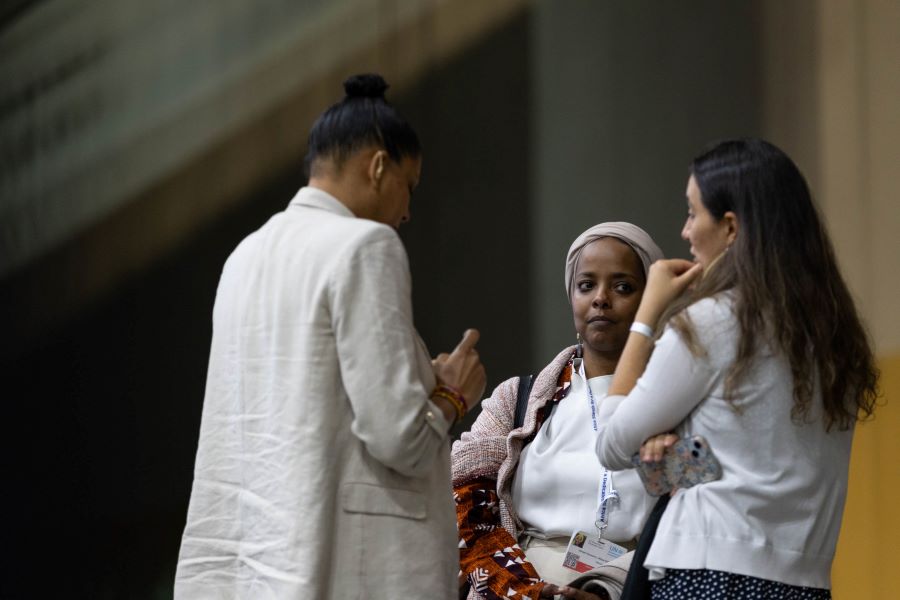
There has also been frustration over logistics, as there are several thousand participants at INC-5, but contact group meetings are being held in rooms with 60 seats allotted for non-member state participants, or about 3% of registered observer participants, according to the Center for International Environmental Law.
“Observers are queuing outside of the rooms waiting for a seat to open up and those who leave the room to go to the bathroom are unable to return,” a Nov. 26 email from CIEL said.
The Civil Society and Rights Holders Coalition said in a statement that “this exclusionary arrangement undermines the principles of transparency and inclusivity that, as the Chair continues to note, are essential components of procedural justice in the negotiations.”
“Observers are not mere spectators; they bring vital lived experiences, technical and traditional knowledge, expertise and legal insights that strengthen the treaty development process,” the statement added. “Moreover, Indigenous Peoples, waste pickers, women, youth and frontline communities have a right to participate.”
The coalition noted there was a similar issue in Paris during INC-2, and called on the INC Secretariat and South Korea to provide larger rooms and overflow rooms with live streaming.
One observer, stuck in a hallway despite arriving a half-hour early to try to get a seat, said it was “unbelievable that we came all the way here only to stand in the corridors,” according to The Earth Negotiations Bulletin.