
The National Association of Wholesaler-Distributors (NAW) spent months fighting Oregon’s EPR law, which eventually was partially blocked in court, and now it wants the same outcome in California.
Weeks after securing a preliminary injunction against Oregon’s Plastic Pollution and Recycling Modernization Act, NAW joined a 17-state coalition on June 22 in a federal lawsuit challenging SB 54, California’s packaging EPR law. NAW is the only business plaintiff in the case, led by Nebraska Attorney General Mike Hilgers.
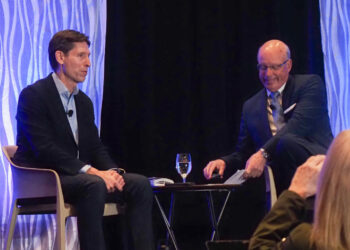
Karen Harned, NAW’s director of litigation and legal policy, spoke with Resource Recycling about why the association filed when it did, what’s different about the California fight, and why, in her view, there’s no version of the current EPR model NAW could get behind.
‘Ideal’ timing
Harned said the timing of the lawsuit wasn’t incidental but rather the product of a coalition finally coming together.
That February ruling was narrow. The court sided with NAW on an injunction but dismissed the bulk of the organization’s other claims against Oregon’s DEQ, its attorney general and its Environmental Commission. NAW had originally filed that case in August 2025.
Even with the limited injunction, NAW treated it as validation. Eric Hoplin, the association’s president and CEO, said at the time that member companies had been impacted by steep fees imposed under the law by producer responsibility organization Circular Action Alliance (CAA), and NAW has leaned on that Oregon win as a template.
“As soon as the regulations went, we were looking, hoping that we would be able to sue sooner rather than later, but also looking for coalition partners to see what made the most sense for us,” Harned said.
The lesson from Oregon was to move earlier, she said. NAW members weren’t paying close attention to EPR laws until Oregon’s program came online and they realized they qualified as producers.
“Our members realized they were impacted, it was like, ‘oh my gosh, this is a problem for our business,'” she said. “We very much want to be more ahead of the process than we were able to be in Oregon.”
A tight squeeze
Distributors sit in a uniquely exposed position compared to other regulated industries, Harned said. Unlike manufacturers, who can spread compliance costs across a broader business, or retailers, who have more control over what they stock, wholesaler-distributors are hit the moment they ship into a state, with little say over the packaging decisions that trigger the fees in the first place.
“If we’re shipping in the state, which is what our business is, we are impacted 100% of the time,” Harned said. “I don’t know that any other industry can say that.”
Costs compound the pressure. NAW members operate on profit margins averaging 3% to 5%, thinner than the retailers and manufacturers also participating in EPR compliance. Harned said that gap leaves distributors with far less room to absorb new fees.
Four claims, one core argument
The lawsuit leans on four constitutional arguments around the Commerce Clause, the Import-Export Clause, the First Amendment and due process.
On due process, Harned pointed to the basic structure of the program: a private organization, with a board that includes some of her members’ competitors, setting fee methodology behind closed doors and requiring binding arbitration for disputes.
“Even for somebody that’s not a lawyer, I think they could see — don’t we have a due process clause in the Constitution?” she said.
Regarding the Commerce Clause, Harned argued California’s law discriminates against out-of-state businesses in ways that go beyond Oregon’s statute.
On the First Amendment, she cited two separate harms: being compelled to join and associate with CAA, and being barred from itemizing EPR fees on invoices to customers.
The Import-Export Clause claim, she acknowledged, is newer legal territory, but one NAW feels confident about.
Harned pushed back directly on CAA’s position that its fee-setting process has been transparent. CAA has said its methodology has been discussed in public comment periods and open forums.
“They’re transparent, and if you have this type of packaging, it costs this much,” Harned said. “It is not transparent in how they got there, how those numbers were determined and what the methodology they used was. All of that is confidential to this day.”
Who controls the PRO
Harned raised a separate objection about who actually sits on CAA’s board. She said several board members compete directly with NAW members, and that she’s aware of people who sought a board seat and were turned away — though she stopped short of confirming any of them were NAW members specifically.
For Harned, that structure is the clearest illustration of what she sees as the deeper legal problem. A private entity, governed in part by companies with a stake in the outcome, has effectively been handed government-style authority — setting fees, guiding compliance, resolving disputes — without the oversight that would normally come with it.
“This model, we think, is completely unconstitutional,” she said. “It lacks due process, and it empowers the PRO to act as a governmental entity in every step of the way.”
Harned said state regulators aren’t doing much more than a “check-the-box exercise” once they hand implementation to the PRO, a level of delegation she said the Constitution doesn’t permit, regardless of how the program is structured.
No middle ground
When asked whether any version of packaging EPR could work for her members, Harned responded that while NAW supports the goals of a circular economy, they do not support the legislation’s structure.
“We think it’s unconstitutional, and there’s no middle ground here,” she said. “If American citizens want to get the objectives that these laws are claiming to get, it needs to be done in a way that the citizens of each state understand what these structures are and are helping pay for them and know that they’re paying for them.”
Because California bars businesses from itemizing EPR fees on invoices, the added cost gets folded into the price consumers pay without any signal of where it came from, Harned said.
“Why are the consumers’ costs going up? They’re not going to know that it’s because of this law,” she said. “I don’t really know what this law is doing to encourage them and incentivize them to recycle more.”
EPR programs were built to push people toward more sustainable packaging and better recycling habits, but structured in a way that hides the very costs meant to drive behavior change, she added.
Without transparency about what’s being charged and why, Harned argued, there’s no mechanism connecting the fee to the behavior it’s supposed to shift, for consumers or for the distributors paying into the system in the first place.
NAW’s trial in Oregon is scheduled for July 13-17 in Portland. The California case is just getting underway, but Harned made clear the association isn’t treating the two as separate fights.
Harned was careful to draw a line between opposing the EPR structure and opposing recycling itself. Asked what NAW members are doing in the meantime to address packaging waste, she pointed to efforts already underway, even without a mandate forcing the issue.
“Our members are doing all that they can,” she said. “I can 100% tell you this based on conversations, visiting them, to do what they can to minimize the packaging that they use — though they again have the least control over it.”