Resource Recycling
  • The Latest
  • Analysis
    • All
    • Certification Scorecard
    • Industry Announcements
    • Opinion
    HP receives ocean plastics certification

    HP Inc. earnings point to memory inflation challenge

    Certification scorecard for the week of Feb. 23, 2026

    Umicore highlights strength in recycling, catalysis

    Apto, Tusaar partner on rare earths recovery

    Apto, Tusaar partner on rare earths recovery

    Certification scorecard for the week of Feb. 16, 2026

    Sims Lifecycle leverages hyperscale decommissioning

    Sims Lifecycle leverages hyperscale decommissioning

    The electronics recycling industry is undergoing a transformation from labor-intensive manual operations to highly automated, AI-driven facilities that use advanced robotics, cleaner chemistry and digital tracking systems to extract critical materials.

    The cyber-physical MRF: AI and robotics reshape e-waste recovery

    Certification scorecard for the week of Feb. 9, 2026

    Meta-Corning deal signals IT hardware retirement wave

    Meta-Corning deal signals IT hardware retirement wave

  • Conferences
  • Publications

    Other Topics

    Textiles
    Organics
    Packaging
    Glass
    Brand Owners

    Metals
    Technology
    Research
    Markets
    Grant Watch

    All Topics

Subscribe
No Result
View All Result
Resource Recycling
  • The Latest
  • Analysis
    • All
    • Certification Scorecard
    • Industry Announcements
    • Opinion
    HP receives ocean plastics certification

    HP Inc. earnings point to memory inflation challenge

    Certification scorecard for the week of Feb. 23, 2026

    Umicore highlights strength in recycling, catalysis

    Apto, Tusaar partner on rare earths recovery

    Apto, Tusaar partner on rare earths recovery

    Certification scorecard for the week of Feb. 16, 2026

    Sims Lifecycle leverages hyperscale decommissioning

    Sims Lifecycle leverages hyperscale decommissioning

    The electronics recycling industry is undergoing a transformation from labor-intensive manual operations to highly automated, AI-driven facilities that use advanced robotics, cleaner chemistry and digital tracking systems to extract critical materials.

    The cyber-physical MRF: AI and robotics reshape e-waste recovery

    Certification scorecard for the week of Feb. 9, 2026

    Meta-Corning deal signals IT hardware retirement wave

    Meta-Corning deal signals IT hardware retirement wave

  • Conferences
  • Publications

    Other Topics

    Textiles
    Organics
    Packaging
    Glass
    Brand Owners

    Metals
    Technology
    Research
    Markets
    Grant Watch

    All Topics

Subscribe
No Result
View All Result
Resource Recycling
No Result
View All Result
Home Plastics

How a startup will track scrap plastic shipments

byJared Paben
March 23, 2022
in Plastics
Bill Robberson, president and chief technology officer for Kamilo, Inc., presented during a plenary session focused on greenhouse gas emissions at the 2022 Plastics Recycling Conference. | Brian Adams Photo

The U.S. EPA has provided funding to Kamilo, Inc., which uses technology to monitor material moving through the recycling chain, with a goal of increasing the value of recycled resins.

The EPA in December awarded a $100,000 grant to Kamilo, an Oakland, Calif.-based startup that uses advanced software to help the value chain track material shipments. Founded in late 2019, the for-profit public benefit corporation is the brainchild of Anna-Marie Cook and Bill Robberson, both formerly U.S. EPA staff members.

The goal of Kamilo’s technology is to provide accurate plastics recycling supply chain data, which is lacking, Cook, the company’s co-founder and CEO, told Plastics Recycling Update in an interview. 

“It’s very granular compared to anything that’s out there now,” she said, “and we’re hoping that it’ll bring much better measurements and much better data for what’s going into products that call for recycled materials.” 

Subscribers to the Kamilo technology use an app on their mobile devices to scan digital identifiers (QR codes or transponders) attached to shipments of scrap plastic. Those digital identifiers could be attached to gaylords, super sacks, bales, truckloads, shipping containers or other containers.

The user inputs a few elements, including shipment weight and the polymer, and takes photos, and the information is uploaded to a quantum ledger database (QLDB) hosted by Amazon Web Services. QLDBs provide immutable, transparent and cryptographically verifiable transaction logs.

Kamilo’s technology is hosted on a geospatial portal provided by Esri, a geographic information systems (GIS) software company, allowing information on shipments of bales, flakes, pellets or interim or final products to be integrated with GIS layers containing information on transportation systems, land use, natural features, utilities and more. 

Subscribers have access to a dashboard where they can access the information in real time, Cook said. “We can watch the movement of plastic as it goes from facility to facility,” all the way to the final product, Cook said. 

Hawaii trip inspires action

When they worked for EPA’s Region 9, which includes California, Hawaii and the Pacific Island territories, Cook and Robberson visited Hawaii’s Kamilo Point. In Hawaiian, “kamilo” means twisting or swirling currents.

At the southern tip of the Big Island, the beaches there are inundated with plastic litter, said Cook, who started EPA Region 9’s marine debris program. That program is now the EPA’s Trash Free Waters program that is receiving funding through the Save Our Seas Act 2.0 passed and signed into law in December 2020. 

Cook said she and Robberson made a pact that, someday, they would start a for-profit company together aimed at lifting the value of plastics so they wouldn’t be discarded and end up in the environment. Robberson left the EPA in August 2018 and Cook left in February 2021. They incorporated Kamilo, Inc. in November 2019, although work developing the startup didn’t proceed in earnest until early 2021, she said. Robberson is company co-founder, president and chief technology officer. The small team also includes Chief Financial Officer Dave Reilly, who joined in 2020. 

For customers, the data generated by Kamilo’s technology provides assurances to consumers and brand owners that they’re receiving products made with recycled resin, potentially allowing Kamilo to provide verifications of recycled content that are required under legislation coming on-line in a number of states, including California, Cook said. 
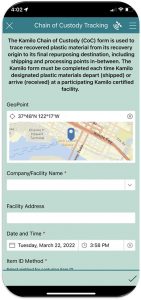
Screenshot of Kamilo's chain of custody tracking software.
Screenshot of Kamilo’s chain of custody tracking program.

The data also gives materials recovery facilities (MRFs) and other upstream participants confidence that the bales they’re shipping out are being recycled, not burned or landfilled, she said.

“Our idea was to measure plastic’s journey and reward the players who are already doing the right thing and encourage those who are thinking about doing the right thing in recycling plastic,” Cook said. 

Kamilo is also able to offer levels of anonymity for companies that don’t want to be identified by name as buyers or sellers of the material, while still providing generic data to indicate where the material traveled, Cook said. 

The inclusion of Ersi’s geospatial data helps value chain participants know where to send their plastic to reduce their greenhouse gas (GHG) emissions, Cook said, and it can help inform decisions about facility siting. The software relies on the EPA’s Waste Reduction Model (WARM) to calculate GHG impacts of using the recycled resins, shipping impacts and more. Robberson spoke about his company’s GHG emissions data capabilities during a GHG-focused plenary session at the 2022 Plastics Recycling Conference, which was held March 6-8 near Washington, D.C.

EPA funding supports pilot projects

The EPA money Kamilo received was a Small Business Innovation Research (SBIR) Phase I grant (because of her former work on microplastics for the EPA, Cook said she consulted with and followed guidance from EPA’s ethics attorneys in applying for a grant). 

The money from the Phase 1 grant, which runs through May 31, 2022, helped Kamilo launch pilot projects around California, Cook said. The organizations Kamilo is working with primarily handle HDPE and LDPE film, with a little PP. 

“By and large, I’d say the response has been overwhelmingly positive,” she said. 

Kamilo also plans to apply for EPA SBIR Phase II funding, which pays to bring a technology to full commercialization, she said. 

The technology can be used to track shipments of any materials, including other recyclables, she noted. For example, people who are participating in the pilot project have expressed interest in tracking downstream shipments of cardboard, she said. 

The EPA’s funding website notes the universal desire for more transparency in recycling markets: “Extensive interviews and discussions with recycling industry stakeholders including municipalities, MRF operators, recycling brokers and processors, waste generators, manufacturers, regulators, consumer brands and individuals show almost universal agreement that more transparency is needed and would benefit the recycling market.”

 

Tags: Technology
TweetShare
Jared Paben

Jared Paben

Related Posts

RCI, CurbWaste partner on waste management software 

RCI, CurbWaste partner on waste management software 

byPaul Lane
February 24, 2026

CurbWaste now provides the operational management and data platform for the Recycling Certification Institute, which works to improve transparency in...

The electronics recycling industry is undergoing a transformation from labor-intensive manual operations to highly automated, AI-driven facilities that use advanced robotics, cleaner chemistry and digital tracking systems to extract critical materials.

The cyber-physical MRF: AI and robotics reshape e-waste recovery

byDavid Daoud
February 12, 2026

The electronics recycling industry is entering a new phase of technological acceleration. Advances in artificial intelligence, robotics, advanced chemistry, and...

Cirba Solutions: Battery fires stoking EPR bill movement

byStefanie Valentic
February 2, 2026

As batteries appear in everything from light-up shoes to electric vehicles, new EPR laws are reshaping recycling requirements.

TÜV rolls out traceability audits for recycled inputs

TÜV rolls out traceability audits for recycled inputs

byScott Snowden
January 14, 2026

Based in Germany, TÜV Rheinland launched a closed-loop recycled material verification program for electronics supply chains, auditing traceability and quality...

Robot pilot targets legacy parts to help supply defense

Robot pilot targets legacy parts to help supply defense

byScott Snowden
December 29, 2025

Although chip availability has improved since the worst shortages earlier in the decade, Tuurny says demand for legacy electronics remains...

Glacier AI at Penn Waste aims to improve PET, fiber output

Glacier AI at Penn Waste aims to improve PET, fiber output

byScott Snowden
October 8, 2025

Glacier, the Amazon-backed AI and robotics company, has installed its sorting technology at Penn Waste’s MRF in York County, Pennsylvania,...

Load More
Next Post

Municipal recycling group blasts one area of chemical recycling

More Posts

PET bales stacked for recycling.

Evergreen closing RPET plants in Ohio, New York

February 24, 2026

Rising containerboard demand comes as OCC prices taper

November 5, 2024
WM opens new $90m MRF in south Florida 

WM opens new $90m MRF in south Florida 

February 23, 2026

Paper giants foresee continuing rise in OCC prices

August 28, 2023

North American paper mills discuss demand, OCC pricing

May 15, 2023
Battery fire risk isn’t going away. Insurance is responding

Battery fire risk isn’t going away. Insurance is responding

February 24, 2026
Recycled plastic lumber firms report diverging results

Trex CEO to retire after 23-year run

February 25, 2026
How will 2026 unfold for plastics recycling?

How will 2026 unfold for plastics recycling?

February 19, 2026
Chinese processing group details goals for US visit

AMP lays out vision of next-generation, AI-driven MRFs

July 24, 2024
Minnesota publishes prelim EPR assessment

Minnesota publishes prelim EPR assessment

February 20, 2026
Load More

About & Publications

About Us

Staff

Archive

Magazine

Work With Us

Advertise
Jobs
Contact
Terms and Privacy

Newsletter

Get the latest recycling news and analysis delivered to your inbox every week. Stay ahead on industry trends, policy updates, and insights from programs, processors, and innovators.

Subscribe

Welcome Back!

Login to your account below

Forgotten Password?

Retrieve your password

Please enter your username or email address to reset your password.

Log In

Add New Playlist

No Result
View All Result
  • The Latest
  • Analysis
  • Recycling
  • E-Scrap
  • Plastics
  • Policy Now
  • Conferences
    • E-Scrap Conference
    • Plastics Recycling Conference
    • Resource Recycling Conference
    • Textiles Recovery Summit
  • Magazine
  • About Us
  • Advertise
  • Archive
  • Jobs
  • Staff
Subscribe
This website uses cookies. By continuing to use this website you are giving consent to cookies being used. Visit our Privacy and Cookie Policy.