


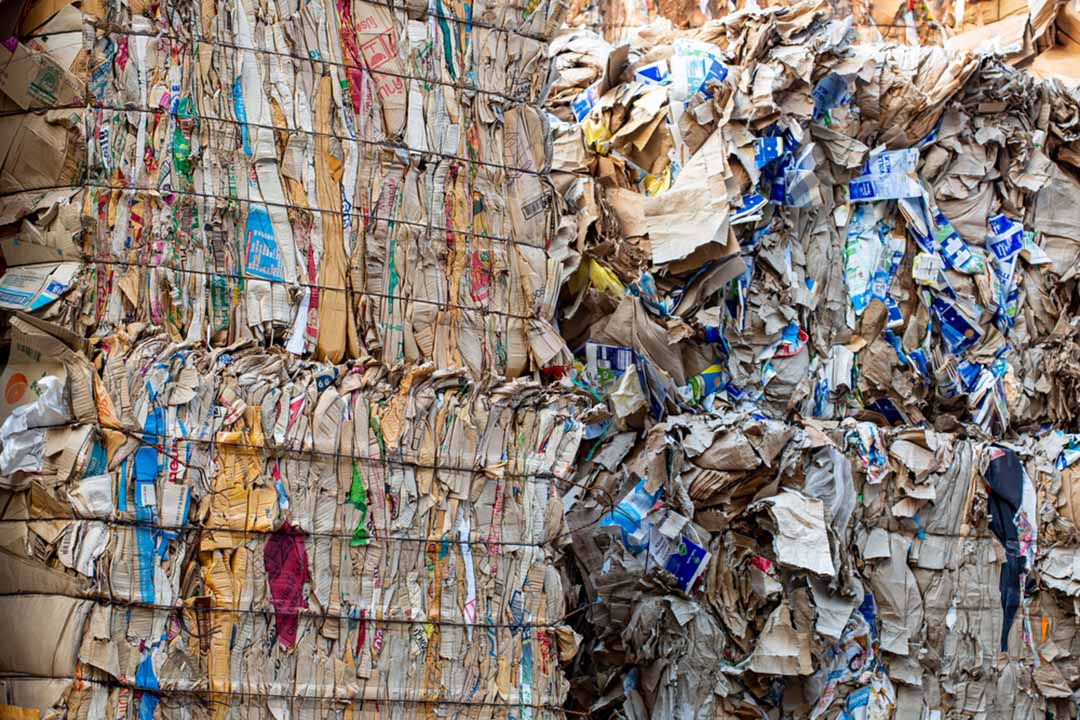
Recycled paper mill leaders recently weighed in on the factors behind market shifts, how the coronavirus pandemic is impacting generation and demand, and where markets are headed in the future.
A July 29 virtual event hosted by Resource Recycling featured Linda Leone of WestRock, Jay Simmons of North Pacific Paper Company (NORPAC), and Ron Sasine of Crossroads Paper.
The three discussed recent expansion projects and fielded questions on recovered fiber market trends.
Companies shift to rebalance inbound fiber
WestRock, which operates recycling programs and paper mills, saw “significant change” with a shift from away-from-home packaging to at-home packaging as the pandemic took hold in the U.S. There was substantially more material going into curbside bins, noted Leone, who serves as vice president of recycled fiber supply at the company.
The shift from commercial to residential generation carries its own impacts for fiber feedstock. Residential material typically includes more contamination, and the OCC often comes in the form of smaller cardboard boxes used for e-commerce sales.
WestRock operates a number of mills with different cleaning capabilities, Leone said. Flexibility was key when adjusting to the pandemic.
“It was just a matter of really being able to keep up with that grade mix: So maybe we lost retail, but we gained grocery,” Leone said. “The dynamics of what was being produced and what was available to the market, we were able to shift that with our relationships and [we were] able to move stuff around from mill to mill, to get those right feed recipe mixes for what we were seeing.”
Sasine, who spent a decade as head of packaging at Walmart prior to joining Crossroads Paper, said material generation out of the restaurant and other foodservice sectors is way down. These businesses are typically relatively large generators of OCC, Sasine said, and that will have an impact this year.
Crossroads Paper is developing a recycled paper mill in Utah, looking to serve the western U.S. From his perspective planning a new mill during this time of feedstock disruptions, Sasine said the Crossroads team is quite confident that there will be a “rebalancing” of the material flow.
“The OCC that traditionally may have come from large institutional users, large retailers and other major sources, is now being distributed differently, and we’re seeing a greater number of boxes and larger-size boxes, more importantly, flowing into the bin and conventional residential collection,” Sasine said.
Leone of WestRock said she anticipates the elevated level of e-commerce in recent months will be a lasting trend, rather than a temporary increase that goes away once the pandemic dissipates. The recycling sector must prepare by investing in processing infrastructure to handle the shifting OCC stream.
OCC pricing explained
For MRF operators, the chaos of the pandemic was accompanied by a small bit of good news in the OCC market.
Following China’s National Sword import restrictions in late 2017 and early 2018, OCC prices plummeted and remained around a national average of $30 per ton until late 2019. Then, prices started to rise, and they increased to over $100 per ton in the months that followed. They’ve since dropped again, sitting at an average of $55 per ton nationally as of July.
Sasine said a dramatic increase in demand for coated recycled paperboard, combined with the e-commerce-driven demand for containerboard, created a tight market for recycled fiber. Coated recycled paperboard is used in consumer packaging, food, beverage and other applications, all of which saw substantial demand spikes as panic-buying took place across the U.S.
“The same OCC, the same mixed paper flows that are being pulled up by containerboard manufacturers likewise are being pulled up by coated recycled mills,” Sasine said.
For an idea of what’s to come, Sasine looks at historical trend lines for where OCC pricing has been in recent decades.
“We shift up and down off of a fairly established trend line, and that trend line doesn’t move a lot,” he said. “Yes, there’s going to be periods of time when we see significantly higher market pricing, and there will be times when we see significantly lower market pricing. But moving off of that benchmark pricing that we’ve seen now for 15 years is very unlikely.”
Simmons of NORPAC, which operates a large paper mill in Longview, Wash., added that the U.S. market is “never going to return to the pricing that you enjoyed when China was sucking up everything.”
“Those days are gone,” he said, “and you’re going to get back to the more normal domestic market pricing.”
If prices climb too high, mills are going to look for alternative ways to supply themselves with feedstock, he said. For example, if OCC goes too high, they’ll look at mixed paper, he said.
Although municipalities will not see the pre-National Sword pricing again, Sasine offered a silver lining with the new market normal. Local programs can anticipate far more predictability, without the massive market swings and volatility that came with export markets.
“That predictability is then the foundation of a really well-functioning program,” he said.
Accelerating decline for printing and writing paper
Companies that produce printing and writing paper have struggled in recent years as demand for those grades has dropped. Now, without offices and schools operating, demand for those products has declined even further. In recent months, multiple mills that produce those grades have idled.
Simmons said the COVID-19 impact on paper demand overshadows previous major events that lessened demand, such as 9/11 and the late-2000s recession. With offices closed and companies making long-term plans for employees to work at home, the impact appears primed to continue. Newsprint demand also continues to drop – the latest indication of this trend came several weeks ago with the permanent closure of a Washington state newsprint mill.
NORPAC last year announced it would convert some of its capacity from printing and writing papers to produce recycled packaging. The company is pondering further conversions, Simmons said.
Packaging, tissues and towels are “the only three markets that are really on the increase large enough to handle a large machine output like ours,” Simmons said.
Mill project delays?
Numerous domestic recycled paper mill investments have been announced in the past two years, suggesting a much stronger domestic market for recycled paper in the years to come.
It’s unclear how the coronavirus pandemic and its wider economic impact will affect all of the in-progress mill projects. But NORPAC and Crossroads investments are moving forward as planned, albeit with some delays.
NORPAC had a long pause on its project as the pandemic took hold. Like the mood at many companies, NORPAC did not want to talk publicly about any investments due to the many unknowns about what would come down the line with the pandemic.
That mood has shifted since those early days of uncertainty: Things are getting back on track and the company is moving forward with financing the packaging conversion project, Simmons said.
At Crossroads, “everything is on track, everything is moving forward as we hoped” with the plan to develop a new mill in Utah, Sasine said. That’s despite some of the challenges associated with developing a major project amid a pandemic.
“There are a few things that become a little bit more difficult,” Sasine said. “It’s hard to get folks in a room to make a decision, sometimes it’s hard to get out and walk a site, so there are things that just may take a little bit longer, but nothing has deterred us from the project or slowed us down beyond a calendar that we can all work with.”
Crossroads is anticipating a 2022 startup date.
Overcapacity and feedstock availability
With several new mills and expansion projects in the works, the U.S. containerboard market could potentially approach overcapacity. And with OCC already achieving a high recovery rate, substantial new domestic capacity could create tight competition for recovered fiber in the U.S.
But Sasine said he’s confident Crossroads will secure adequate feedstock. There are still substantial quantities of fiber that are not recovered for recycling, and a huge quantity of OCC still flows to China but will ostensibly be displaced in the coming year.
Additionally, some recycling programs have had trouble moving recovered fiber in recent years, largely due to the fallout of China’s import restrictions.
“As viable markets for that material emerge, that material is going to find its way to mills,” Sasine said. “We like to say that mills are like magnets, and they pull in the material from around them.”
NORPAC is also confident about feedstock sourcing, and Simmons suggested there is opportunity to take advantage of relatively untapped streams, such as mixed paper. He described recycling programs that are focusing on improving quality to meet domestic fiber standards.
With those efforts to clean up the fiber stream, Simmons said mills will have a greater impetus to use mixed paper as feedstock. That presents an opportunity: Although OCC currently has a very high U.S. recovery rate – 92% in 2019, according to the American Forest & Paper Association (AFPA) – mixed paper is recovered at a lower rate. AFPA reports a 2019 overall paper recycling rate of 66.2%.
Leone agreed that the move toward using more mixed paper is here to stay – provided the feedstock can reach certain quality thresholds.
“Most mills that consume corrugated can consume mixed paper, and if we can make a clean enough product, I think there will be a high demand for it,” Leone said. “From that standpoint, I really don’t see that changing.”