
This article appeared in the January 2025 issue of Resource Recycling. Subscribe today for access to all print content.
As communities grapple with the challenges of material management and environmental preservation, organic collection has become a crucial strategy to reduce landfill overflow, enrich soil health and promote a sustainable future in both the country’s largest city and one of its smallest communities.
Holden Village, an isolated retreat center in Washington’s North Cascades Mountains with fewer than 200 residents, and New York City, home to more than 8 million, have both launched programs for food scraps and other organics that reflect their unique environments and needs, community leaders said.
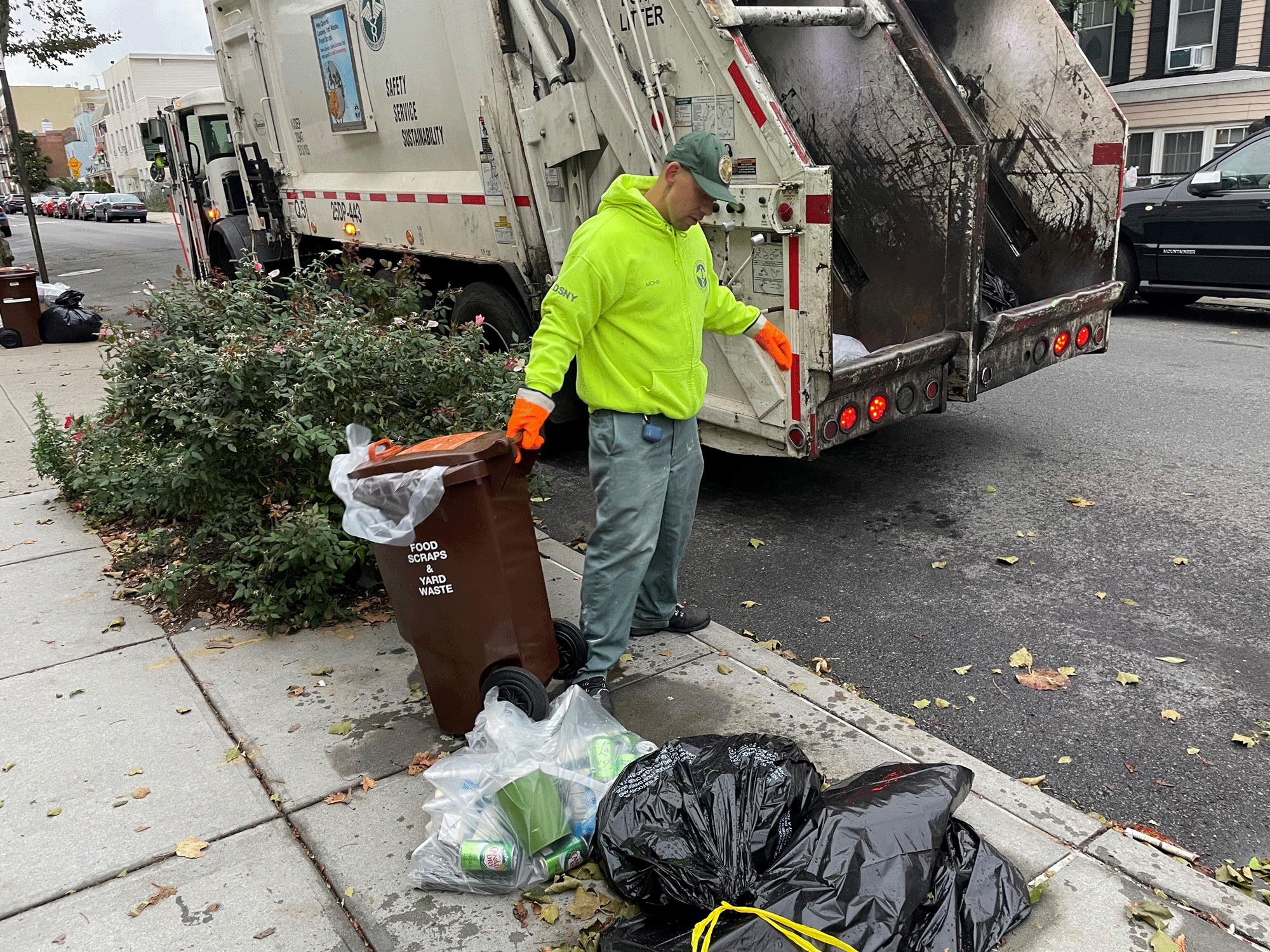
After years of trying to get an organics collection program underway in New York, the passage of the Zero Waste Act, introduced by Council Member Shahana Hanif and approved by Mayor Eric Adams last year, made residential curbside organics collection mandatory for all residents.
“Local Law 85 of 2023, which I’m proud to have authored, is a groundbreaking initiative (that) will divert organic waste from landfills, reduce harmful emissions, enrich our soil, power our homes and creates a cleaner, greener, rat-resistant sanitation system,” Hanif said in an email. “The climate crisis is no longer a distant threat — it’s here, flooding our streets, polluting our air, scorching our summers and sparking fires in our urban forests. Now is the time for bold, decisive action, and mandatory composting is a critical part of that solution.”
The city’s Department of Sanitation finished rolling out the program on Oct. 6, with residents of Manhattan, the Bronx and Staten Island required to separate their food scraps into a separate bin from their trash and recycling for curbside collection. Service had already been implemented for Queens and Brooklyn in the last two years.
With all five boroughs of New York now participating, New York now has the nation’s largest residential curbside organics program. Vincent Gragnani, press secretary for the sanitation department, said previous attempts included obstacles like bin requirements and signup requirements that discouraged participation.
“The Adams Administration set out to eliminate those obstacles and launched the nation’s largest and easiest curbside composting program,” he wrote in an email. “There’s no signup required, no requirement to use a specific bin and no confusion about pickup dates. Residents simply put their material out on their recycling day in a sealed bin, with a liner if they choose, and we pick it up and turn it into compost or renewable energy.”
Holden Village, a retreat and tourist community rooted in the Lutheran tradition, has been recycling and composting since the 1970s but wanted a larger, more reliable compost process, said Nathan McClure, who currently serves as Holden’s “garbologist.” The community last year upgraded to an enclosed, aerated bunker composting system from Green Mountain Technologies, partly in response to high disposal costs. All of its food scraps go into compost for local landscaping and ecosystem restoration.
“Holden Village has clearly demonstrated that if there is the will, there is a way to make recycling happen,” Rik Langendoen, director of environmental services at Green Mountain, said in a written statement. “They are a great role model for every community.”
Van Calvez, Green Mountain Technologies’ composting systems engineer who designed the system at Holden Village, has worked with both small communities and large municipal-built systems for cities. Whether looking at Holden Village or New York’s process, each approaches composting in the same way, only the size is different.
“The biological processes for facilitating a hot, aerobic composting process are the same regardless of scale,” he said. “However, the equipment and infrastructure needed varies considerably. The type of technology that is needed for a small community scale is entirely different than what is needed at a bigger municipal scale.”
Size matters
New York studied other successful programs in North America and learned that one of the keys to success was an early emphasis on yard trimmings, as residents already separate them from trash.
“This is one of the reasons we launched curbside composting in the early fall … when many residents are getting rid of leaves,” Gragnani said. “Of course, we accept all food and yard waste, and we continue to remind New Yorkers, ‘if you cook it or grow it, you can throw it.’”
While participation is mandatory, the department is focused on education at first and will begin issuing summonses for noncompliance in April. Fines for buildings with one to eight units start at $25 for the first offense, increase to $50 for the second offense, and rise to $100 for the third and any subsequent infractions. Meanwhile, larger buildings face fines starting at $100 for the first violation, escalating thereafter.
“Some material collected is composted while some goes to anaerobic digesters, but all compostable material is put to beneficial use,” Gragnani said. “Biogas produced in the digestion process and used to heat local homes and businesses takes the place of methane that would otherwise be fracked. This is a beneficial use for this material, far, far better than transporting it to landfill, where it would release methane into the atmosphere.”
The Staten Island Compost facility has produced nearly 42 million pounds of finished compost per year over the last several years. Historically, about 60% of the finished compost is sold to landscapers and 40% is given away to community groups, parks, residents and others, including free givebacks at the facility and in Brooklyn.
“We have several new contracts that, in light of the program’s recent citywide expansion, are diversifying where we send organic material collected and preventing overburdening one neighborhood,” Gragnani said. “And in light of the recent expansion, we are drastically increasing the number of districts whose material becomes composted while decreasing the number of districts sending material to anaerobic digesters.”
The program, though still facing some challenges from residents who are new to organics sorting, has been performing well since implementation.
In fiscal year 2024, which concluded on June 30, New York City collected around 130,000 tons of organic material, according to the sanitation department. This marked an increase of over 23% compared to the previous year, attributed mostly to the organics collected through the curbside program in Brooklyn and Queens. That number is expected to reach over 200,000 tons next year with the program now running in all five boroughs.
“We are fully dedicated to educating the community about this issue,” Gragnani said. “We remain optimistic and have every reason to believe that we’ll continue to see growth in the numbers.”
Small but mighty
In Holden Village’s dining room, where all of the community meals are served, any food left on plate is scraped into big trashcans along with any kitchen scraps. They’re then weighed and dumped into the composting system.
Originally, compost was put into pits dug into the ground, but being in a wilderness setting, that attracted bears and other animals. Three-walled bins also drew wildlife. The village began working with Green Mountain in 2009, McClure said.
“We had gotten a couple of their older systems called Earth Tubs, which are augers with a lid over it that spins around, so it was like a massive immersion blender to chop up the food waste and also fluff it up and aerate it as it goes along,” he said.
That system was in place for about 15 years, and last May the two partnered again on a newer, bigger system using an in-vessel system of three aerated bunkers, comprising 18 cubic yards of space for food and wood fiber collected within the village. It was installed inside a utility shop to withstand the heavy winter snowfall.
“With this new system having much more space, we are able to get everything in and give it the time it needs to cook, to fully break down before we take it out,” McClure said.
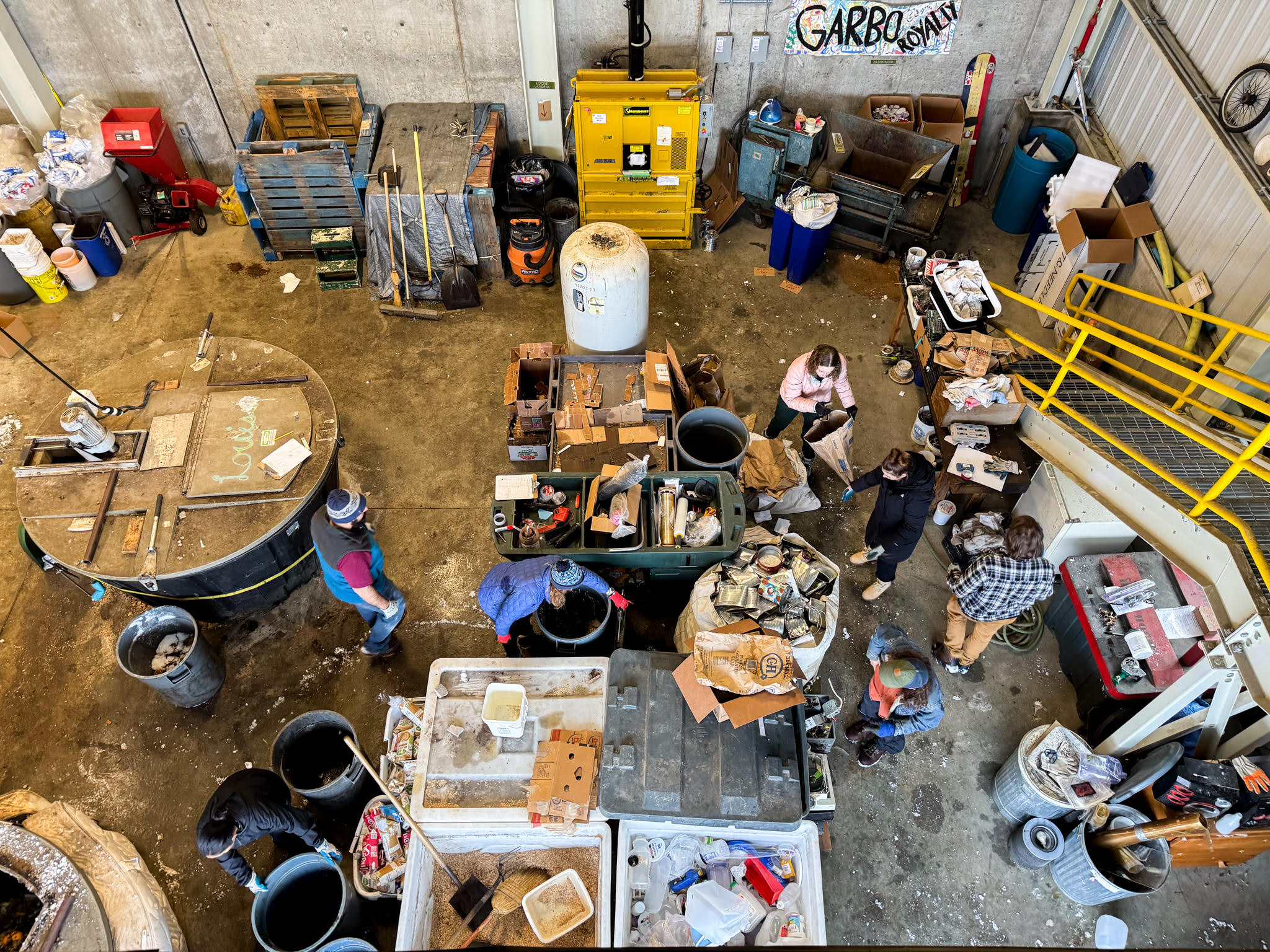
The aeration system, which operates on a timer, optimizes oxygen levels for effective microbial activity, and staff monitor temperature and moisture regularly. Once filled, each bunker processes the compost for eight to ten weeks with minimal need for mixing. The finished compost is then distributed within the village and used for local restoration projects, including mine remediation and areas affected by forest fires.
Holden Village also has a comprehensive recycling program, with separate storage containers for electronics, metal, plastic, cardboard and paper that are then shipped down to various centers on the eastern side of the Cascades. McClure estimates that the community diverts more than 90% of its solid waste away from landfills.
“It takes a lot of hands-on work and a lot of community involvement with all of the people here,” said McClure, who is part of a staff of 150 that shrinks to around 60 in the winter. “In 2023, 35,000 pounds of food waste was collected.”
McClure keeps tabs on other organics programs in the U.S., and although smaller than most cities and communities, he finds ideas and tips to be more efficient with composting and recycling.
He credits Calvez with helping to fine-tune the program and utilize whatever the community has on hand.
“The reason why this system works for them, in my opinion, is that it’s custom-built, designed specifically for this application,” Calvez said. “This was really a collaborative design process based on their needs.”