
This article appeared in the November 2024 issue of Resource Recycling. Subscribe today for access to all print content.
Orlando, Florida, was e-scrap central in late September and early October as around 950 industry leaders attended the 21st annual E-Scrap Conference, one of Resource Recycling’s three annual conferences. Dozens of sessions and an expo hall brought the e-scrap, ITAD and ITAM industries together to discuss how coming laws might affect them and the best ways to build public trust, industry resilience, compliance and circularity.
Untapped potential in plastics
With domestic demand building slowly, U.S. recyclers must look to other industries to absorb their e-plastics volumes, several executives said during a session focused on electronics’ non-metal side on Oct. 2.
Since North America offers little in the way of electronics manufacturers who might buy recycled e-plastics, the automotive sector in Asia and Mexico is a key area of growth, especially for ABS and polypropylene, said panelist Zhan “Bo” Zhang, director of BoMet Polymer Solutions. Japan and South Korea are among the top five countries for automobile production, for example, and they sell to Europe, which has upcoming mandates that new vehicles contain 25% recycled plastics.
Extending U.S. mandates beyond beverage bottles and into other industries could enable processors and recyclers to expand, added Hong Yoon, CEO of Hanil Eco Solutions, based in Southern California.
South Korea has a relatively small and stagnant population and thus a small supply of old vehicles, Yoon said. In addition, Korea does not shred used vehicles, opting instead to sell them to Russia and other countries. As such, Korea has a limited supply of post-consumer resin.
Meanwhile, the U.S. has a vast supply of used vehicles destined for shredding, Yoon said: “I want recyclers to understand that the material you’re shipping to Malaysia and other parts of Asia will be a strategic resource in the future that you have control of.”
As for current recovery streams, the recyclers on the panel agreed that they would like to see cleaner, more segregated e-scrap streams to help improve profit margins as well as yields. Yoon said Hanil also tries to find ways to recover more e-scrap so the onus isn’t only on feedstock suppliers.
In the EU, extended producer responsibility laws have definitely helped clean up recycling streams, said Pablo León, CEO of Spain-based recycler Sostenplas. This has made feedstock volumes more homogenous, though countries vary in collection practices, he added.
Nevertheless, upstream processors may not know what U.S. recyclers are looking for in regards to quality, said Clive Hess, president of ITAD processor CompuCycle.
“What we consider clean material is not clean material,” he said, using the example of printers shipped with paper and ink cartridges still inside. Hess described CompuCycle as a relative newcomer to the industry. It upgraded its six-year-old Houston plant with a float-sink system in November 2023 and in July 2024 added an electrostatic system to separate out ABS, polystyrene, polyethylene and PP.
A major roadblock for recycling of any plastic in the U.S. is the lack of mandates. European EPR schemes have contributed to material getting recycled, Leon said, but in the U.S. demand may lag because end users think there is no supply. But if no one recycles ABS, for example, there will be no demand for it, either.
In addition, in Europe recycled plastics have been available for decades, so the manufacturing industry is accustomed to using PCR, he said. Demand “is not something you build in one or two years.”
Zhang said that in the next three to four years, interest will grow but uncertainty will remain, including upcoming implementation of amendments to the Basel Convention, whose regulatory effects on supply are yet unclear.
Hess said processing e-plastics has to become more economical, with domestic
costs far higher than international. “There’s a very large supply of our product,” he said. “We just need to be able to process it economically.”
– by Antoinette Smith
Celebrating Billy Johnson’s life
Industry leaders opened the conference on Sept. 30 with a tribute to the Recycled Materials Association’s chief lobbyist, Billy Johnson, who passed away suddenly the Saturday before. Johnson, who had worked for ReMA for two decades, was “a tireless advocate for the recycled materials industry, and for the well-being of all of our members,” a ReMA statement said. “He was incredibly effective at raising our voice on Capitol Hill and within five Presidential Administrations, ensuring that our industry was known throughout Washington and the interests of all members were protected.”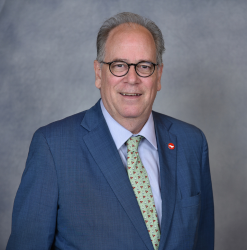
Others spoke fondly of Johnson during the conference’s opening plenary session. Colleague Cheryl Coleman, ReMA senior vice president of advocacy, safety and sustainability, recalled his kindness, while Craig Boswell of HOBI International emphasized how much Johnson did for the industry and how his presence was a staple at conferences.
Over his years of work, Johnson secured a special accelerated depreciation allowance for qualified recycling equipment through the Recycled Investment Saves Energy Act, challenged the market dominance of railroads on demurrage and accessorial charges, and achieved an essential business designation for the recycled materials industry from the Department of Homeland Security during the early years of the COVID-19 pandemic.
– by Marissa Heffernan
Reuse and recycling not at odds
During the opening plenary session highlighting current key trends in e-scrap and ITAD, industry experts discussed device repair, design regulations and battery fire dangers.
Walter Alcorn, vice president of environmental affairs and industry sustainability at the Consumer Technology Association, which represents OEMs, said manufacturers are seeing a continued focus on device repairability. He projected that will translate less into a mass movement of consumers repairing their own devices and more into more independent repair shops. Manufacturers have begun to open up to this idea much more than in years past, he added.
“That is a Rubicon we’ve crossed,” he said, referring to treating independent repair shops the same as authorized refurbishers. “We’re pretty much there.”
That’s a positive for e-scrap processors, who are dealing with lightweighting in devices contributing to lower volumes of precious metals recovered.
“There’s more value in reusable parts components,” Alcorn said. “The resale markets continue to be an important source of revenue.”
ReMA’s Coleman added that despite how it’s sometimes framed, recycling isn’t really at odds with reuse. Even with far greater adoption of refurbishment and reuse, those devices will still ultimately make their way to the recycling stream, she explained. So it doesn’t take away from commodities recovery in the end.
“Eventually it’s coming our way,” she said. “Maximize its use.”
And it’s an environmental win, said Jim Levine, senior vice president of North American operations for major ITAD firm Iron Mountain.
“We all know that repurposing and reuse is a lot more stress-free on the environment than recycling is,” Levine said.
That said, Levine highlighted room for improvement in device design for repair. He advocated for manufacturers to take an approach that embraces modular design allowing for easily removable and replaceable batteries rather than producing products with a glued-in battery. Alcorn strongly objected.
“The last thing I would want to see is consumers trying to figure out what battery to put in their smartphone,” Alcorn said. “If you put the wrong battery into the wrong phone, sometimes you get a thermal event, sometimes it doesn’t work.”
– by Colin Staub
Certification workshops
A pair of sessions dug into the finer points of e-Stewards and R2, two frequently competing, though sometimes collaborating, certification programs that recognize the safe, responsible reuse and recycling of electronic devices. Earning these certifications brings benefits to the recipient both directly and indirectly, their respective representatives said.
E-scrap and ITAD firms’ customers, for example, more and more insist on such a certification in order to comply with data protection laws where violations can cost tens of millions of dollars. Such missteps by Morgan Stanley in the late 2010s cost that company more than $160 million in settlements and fines, for example.
“It just makes life easier for multinational companies to work with R2,” said Patty McKenzie, education and outreach director at SERI, the owner and administrator of R2 certification.
Certification can also help companies stand out in answering RFPs and going about their business, said Daniel Puckett, business director for e-Stewards — if the recipients show off their certification on websites, in pamphlets and in bids for contracts.
“They shout to the whole market, ‘Hey, we know what we’re doing,’” he said of the e-Steward badges.
The two certifications scrutinize similar business aspects, such as material destinations and Basel Convention compliance, but also differ in important ways, the officials said. R2 certifies individual facilities, for example, while e-Stewards applies to companies.
– by Dan Holtmeyer