This article appeared in the June 2024 issue of Resource Recycling. Subscribe today for access to all print content.
The West Coast MRF operator Recology, which runs a major facility on San Francisco’s Pier 96 called Recycle Central, has seen an increase in the inquiries it receives from customers in recent months asking where their recycling is going.
The facility receives about 500 tons per day of recyclables from the city’s program. The vast majority of the recyclables that enter the MRF are fiber materials — 44% of it is OCC, and 23% is other paper. Only 6% is recyclable plastic.
Yet after Recology reassures inquiring customers that their recyclables are baled and sent to facilities like paper mills that process the recovered material into new products, “customers increasingly ask the follow-up question: ‘What about plastics?'” Recology spokesman Robert Reed said in a written statement.
Recology notes that certain types of plastic are not recyclable in San Francisco’s program, such as film and flexible packaging, Reed said. But otherwise, “we explain that we sort and bale plastic bottles — such as water, detergent, and shampoo containers — for recycling along with other hard or stiff plastics, such as yogurt tubs and clear plastic clamshell containers.”
Skepticism of recycling is nothing new — industry veterans surely remember John Tierney’s 1996 “Recycling is Garbage” column and his 2015 follow-up, both attacking the economics of recycling. But the ever-increasing global attention on plastic waste has corresponded with an increase in articles criticizing various points about plastics recycling.
On April 14, CBS Sunday Morning host Jane Pauley opened a segment of the show with a trope that’s become familiar within the recycling industry over the past several years.
“Many of us try to do the right thing, we dutifully separate plastics from our trash to recycle,” Pauley said. “But are we really making a difference?”
It was the lead-in to a story highlighting frequent critiques. By the end of the five-minute segment, viewers heard evidence that the chemical industry has long pushed recycling as a way to continue selling plastic products, that the “chasing arrows” symbol doesn’t actually mean a product is recyclable and that plastics as a whole have an incredibly low recycling rate. In short, they’re likely to come away even more confused and potentially dubious about the value of the blue bin.
The CBS story was tied to a recent report from the Center for Climate Integrity, called the “Fraud of Plastic Recycling.” The report received widespread coverage in NPR, The Guardian, Salon, Democracy Now and beyond. Most of it followed a narrative that’s come up in numerous waves of media coverage over the last few years, ever since Frontline published its lengthy investigation, “How Big Oil Misled The Public Into Believing Plastic Would Be Recycled,” in 2020.
Outside the “fraud” report, other notable headlines over the last couple years include, “Don’t waste your time recycling plastic,” an opinion piece in the Washington Post; “Recycling plastic is practically impossible,” from NPR; and “Plastic recycling doesn’t work and never will,” from The Atlantic.
Validity of the reporting within such articles aside, the constant barrage of skeptical messaging might affect customer behavior when it comes to recycling plastics and even other materials, several industry observers said.
“I think it creates confusion, certainly creates questions and, interestingly, forces folks like us to even more so step up our messaging in order to support the recycling initiatives that are working,” said Kevin Roche, CEO of Ecomaine, a nonprofit recycling operator in Maine.
 Transparency is a powerful tool
Recycling programs already face challenges communicating with residents about which materials go in the bin. According to The Recycling Partnership, there are more than 9,000 recycling programs operating across the U.S., with substantial variance in terms of how they’re set up —
single-stream, dual-stream, drop-off, multi-family — and what they accept.
That means blanket statements are almost impossible, and the answer to recyclability is almost always, “It depends.” So how do recycling programs and facility operators respond to headlines in nationwide publications and TV outlets, or the potential global reach of a single social media post, saying certain materials aren’t recyclable or that the entire industry is fraudulent?
Primarily, by doubling down on outreach to their local customers.
“It sends out mixed signals that we kind of have to correct, and we do,” Roche said.
Ecomaine recently spoke with a local media outlet to describe exactly how the organization handles collected recyclables and where they go.
“We invited them in and showed them all the accounting,” Roche said. Showing all the data detailing collection and material volumes can be a powerful way to communicate. “We wouldn’t go through all this process to toss the material into a waste-to-energy plant or a landfill.”
The resulting coverage had a headline much different from the doom-and-gloom narrative: “Yes, Maine groups recycle the paper, plastic, and metal placed in your curbside bin.”
Roche added Ecomaine acknowledges there are certainly ways to improve the recycling system, and his organization is looking forward to new elements like Maine’s extended producer responsibility for packaging program to bring assistance. But he said it’s important to not focus solely on the systemic problems.
“I’d rather be more focused on what is happening and what is being recovered,” Roche said.
Explaining exactly what happens in the recycling process is a popular tool among a variety of stakeholders looking to improve materials recovery.
The American Forest & Paper Association, which represents paper producers, including those that consume recovered fiber, noted it hasn’t seen data that suggests perceptions about recycling are negatively impacting paper recycling. That said, the organization does see opportunities to increase the quantity and quality of recovered fiber, and it favors an educational approach to doing so.
“The best way to convince people that paper is recycled is to show them,” said Abigail Sztein, executive director for recovered fiber at AF&PA. To that end, AF&PA has developed educational materials showing how paper goes from the bin to the MRF, is sorted and baled, sent to a mill for repulping and manufacturing into new paper products.
As a recyclable commodity, paper doesn’t undergo anywhere near the same media scrutiny as plastic, and it’s recovered at a far higher rate. Even so, there are persistent messages that industry groups like AF&PA look to address: Pizza boxes and paper padded mailers are two packaging types that the organization frequently dispels myths about, in part through a Q&A portion of its website. That has become one of the highest-traffic pages on AF&PA’s site, Sztein added.
Focusing on the fundamentals
Beyond simply educating customers by responding to inquiries, Recology in California has taken the conflicting messages about recycling — and the challenges posed by different material types — into account when designing its outreach materials.
In its latest quarterly customer newsletter that goes out to residents, the organization skipped over the confusion about plastics entirely. Instead, Recology offered a surprisingly simple list of recyclables for residents to concentrate on.
“Getting the basics right is critical to every endeavor’s success,” the newsletter stated. “In the case of recycling, we encourage customers to embrace the following: Be sure to recycle all bottles, cans, paper, and cardboard. These are the fundamental four.”
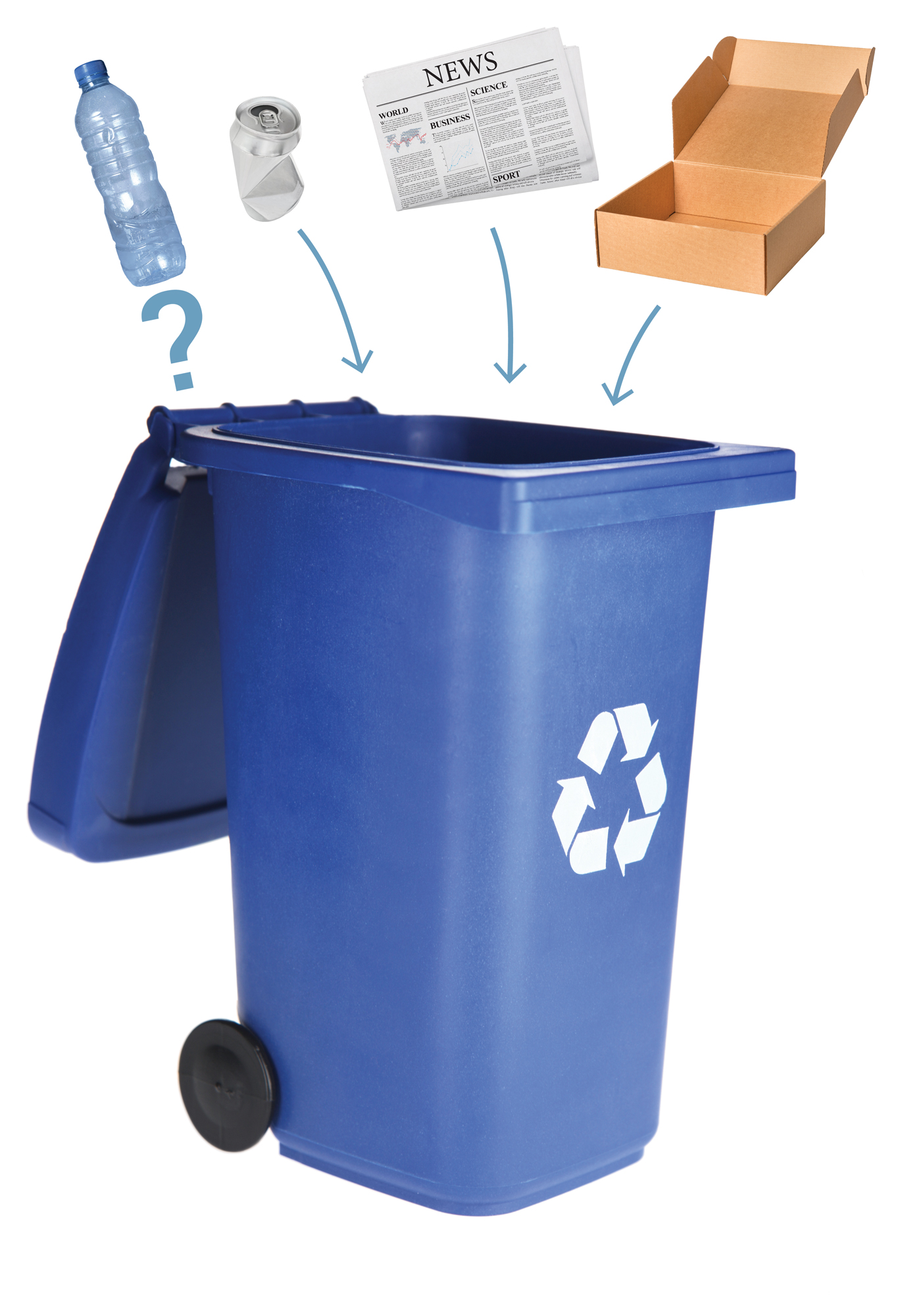
The accompanying illustration shows a flattened cardboard box, a piece of copy paper, an aluminum can and a glass bottle going into a blue bin. The word “plastic” doesn’t appear in the newsletter. Reed, the spokesman, reiterated that these four material types make up the “vast majority” of what is recycled in the bin, hence their focus in the outreach.
That’s not to say the organization doesn’t recover plastic – in a separate outreach initiative, Recology head of sustainability Julia Mangin spoke in depth about which plastics the organization recovers and how it does so. But the “fundamental four” outreach effort provides a clear, simple message for residents to keep in mind.
“People who consistently recycle the big four can take satisfaction in knowing they do a very good job of recycling,” the newsletter states.