This article appeared in the November 2022 issue of Resource Recycling. Subscribe today for access to all print content.
Growth of the plastics recycling industry seems to have always been blighted by the proverbial “chicken or egg” conundrum. Do you build more recycling capacity first, or wait until there is sufficient supply to fill that new capacity? Should you collect a new material if no market exists? How do you raise capital for a new facility with no current outlet for its products?
Clearly, it is unwise from a financial perspective to invest in new technology to improve material quality when market signals and demands are not showing you could get the desired return on investment. Fortunately, there are more and more situations where the forces of supply and demand align, but this is only occurring at an incremental rate. More often than not, the imbalance of these forces has delayed the growth of new collection and recycling capacity. How can we overcome this challenge?
Challenges to plastic recycling
Innovations that create seismic shifts in a system, such as the ones needed in plastics collection, recycling and manufacturing, can be difficult to scale for a number of reasons. Recycled plastic needs to transition from a niche material to a primary feedstock for plastics manufacturing. The ecosystem of the plastics industry must change to embrace the recycling industry as a standard part of the supply chain. To achieve that, sufficient volumes and quality need to be achieved for recycled plastic, and we need to scale product volumes and quality quickly.
Can we draw upon experiences from other industries that overcame these challenges and fast-track the evolution of a massive industry? GreenBlue and rePurpose Global believe we can.
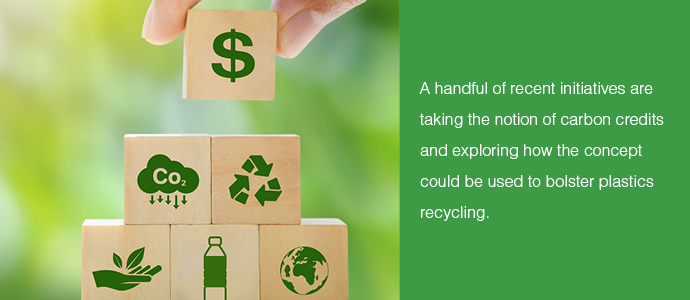
Plastic credits are one tool that shows promise, and they look a bit like renewable energy credits (RECs), which have successfully supported the development of the renewable energy industry. Plastic credits are a voluntary mechanism for companies to finance the infrastructure development needed for the removal, collection and recycling of plastic.
The design of plastic credit systems, such as rePurpose Global’s Plastic Credit Protocol, applies lessons learned from other credit markets, such as RECs and carbon credits, to avoid many of the shortcomings that have held these markets back. For example, well-designed plastic credit programs increase the visibility of the social and environmental impact of the projects they support. The plastic packaging portfolio of the brand partner is also linked directly to the types of impact projects they are eligible to support.
Developing plastic credit systems that aim to provide project financing and channel corporate investments into solving the “chicken or the egg” problem is essential. By creating a new environmental commodity, we build the infrastructure that is needed to collect and recycle plastic material and reduce the current supply-demand imbalance.
How credits work
Historically, companies have used credit- and certificate-trading systems to help meet sustainability commitments in situations where individual actors have a limited capability to achieve the desired goal.
Let’s take the example of a company that has a manufacturing facility tied to an energy grid powered by coal. The company is unlikely to possess the resources to change where they get their power from, so how can they meet their green energy goals? The solution is to purchase credits from a producer that has generated green energy and sold its claim separately from that unit of energy. With no associated environmental attribute currently attached to that unit of energy, the end user of the power cannot make any green energy claims, meaning that it is not double-counted.
By separating the environmental attribute, a given energy unit can be sold to a consumer that otherwise has no ability to access green energy. In order to continue to produce RECs, that green energy producer needs to continue to invest in new capacity. The credits continue to grow the share of green energy, providing the necessary finance to scale it, with the goal of reaching the tipping point where no further market interventions are necessary.
Now let’s consider an example of plastic credits in action. Consider a food product company that has committed to incorporating 30% PCR content into its packaging portfolio but does not have access to a supply of PCR that meets the specifications for its product line. How can this company meet its PCR goals? One solution is to purchase credits from a verified provider that invests in the infrastructure for plastic collection and recycling so as to help the company make good on its PCR commitments in the future. (The ultimate goal is for the company to reduce the overall use of virgin plastic in its packaging portfolio.)
Plastic credits contribute to new collection and recycling capacity and fund innovations to increase plastic recovery. By applying principles of additionality, project investments (through credits) open new channels for collection and recycling that were not previously available in the project region.
Accountability, measurability and verifiability of plastic credits are key. For projects generating plastic credits, rePurpose Global mandates that the recycler and/or co-processor issue a certificate of waste recycled and/or co-processed, including transport, shipment and weight details, to ensure the credits are traceable and not double-counted. For the Recycled Material Standard (RMS) program from GreenBlue, this is done through on-site audits and material tracking of recyclers generating attributes of recycled content (ARCs), the RMS version of a plastic credit.
Use of plastic credits
Plastic credits enable brands to bridge the gap between their current realities and their plastic commitments.
Brands that use plastic credits should have a publicly stated goal regarding the use of recycled materials and the reduction of virgin plastic. Internally, this should translate to targets for different aspects of the business, such as procurement, research and development, and product development. If those areas are not seeing progress toward the plastic packaging goals, for demonstrable reasons, plastic credits could be used to invest in immediate action that would help the system evolve more quickly.
Furthermore, the purchase of plastic credits should support the collection and recycling of similar material types used in the company’s product portfolio. A company that makes PET water bottles, for instance, should not use plastic credits developed from the collection of HDPE to achieve its goals. To kick-start recycling, the demand must match the investment in the resin being recycled.
In addition to meeting internal corporate goals around plastic packaging, plastics credits should be further explored as a means to achieve compliance with packaging standards. Meeting new regulations that mandate minimum levels of PCR in packaging is likely to be difficult for brands because the volume and quality of PCR supply are unlikely to match heightened demand.
If a company can prove sufficient supply is unavailable, credits could serve as a “market of last resort,” with end users purchasing credits that match the amount of recycled plastics they have not been able to procure. Similarly, for brands aiming to reach plastic reduction goals, a packaging solution may not yet be available for the brand’s products. Credits would represent immediate, meaningful action that brands can take to fund the innovations and systems needed for them to achieve their objectives.
Where credits go from here
The global pursuit of meaningfully advancing plastic recycling is still in its early stages, and we need all the tools we can get to drive the changes necessary for brands to meet their 2025 and 2030 plastic packaging goals. If we look back to the early stages of green energy development, being more reliant on renewable energy instead of fossil fuels seemed a long way out of reach. But today we see a clear pathway to achieving that goal, and states such as Oregon and New York have recently made commitments to 100% clean power by 2040.
We believe plastic credits can be effective in helping to bring about the seismic shift needed in plastics manufacturing and reach a point where recycled materials are used more than virgin plastics.
Kaley Cross is the sustainability strategy manager at public benefit corporation rePurpose Global, and Laura Thompson is the RMS program director at the Sustainable Packaging Coalition, a program of nonprofit GreenBlue. Cross can be reached at kaley@repurpose.global and Thompson can be reached at laura.thompson@greenblue.org.
This article appeared in the November 2022 issue of Resource Recycling. Subscribe today for access to all print content.